Programmatic Advertising VS PPC: What’s The Difference?
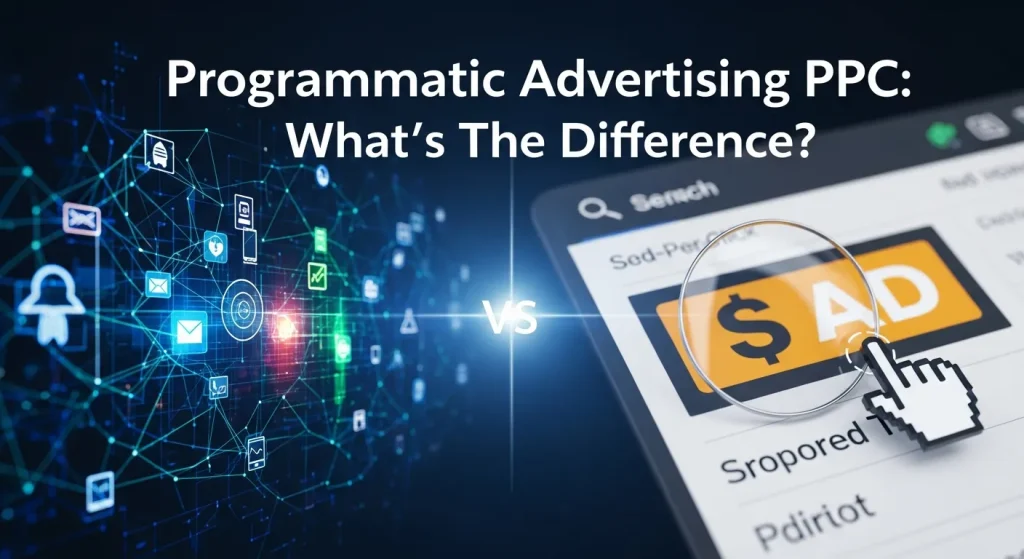
The digital advertising landscape is a confusing mess of technical lingo, just as PPC and programmatic advertising are names you’ll hear bandied about in marketing forums. However, they differ tremendously in their operation and results.
When you’re a business owner or a marketer looking to determine which tool suits your needs better, this blog will serve as a guide to understanding programmatic advertising and PPC’s essential differences and attributes. Informed decision points are up to you from there.
What is PPC Advertising and How Does It Work?
PPC, or pay-per-click advertising as it is more commonly known, is one of the most popular forms of online marketing. It works on a simple philosophy–advertisers pay for their ad only when someone actually clicks and lands on it. Major outlets for PPC include platforms such as Google AdWords, Bing Ads, and social networking sites (such as Facebook or Instagram).
Key Features of PPC
Manual bidding
With PPC campaigns, advertisers set their own budgets, pick keywords, and then bid on these to appear at the top of search engine results or social feeds.
“Intent-based” Advertising
Keyword research is crucial in PPC advertising because it mainly focuses on those actively seeking a product or service. A case in point: If someone looks up “best coffee maker,” they will see an ad for coffee makers delivered through PPC.
Direct Traffic and Lead Generation
PPC ads are designed to feed customers directly into your site, so they make a sterling tool towards short-term sales goals or driving direct lead flow.
PPC in Action
For example, you have a small catering company and buy the keywords “wedding catering services in my area”. When somebody searches for that on Google, your ad will appear at the top of the results. You only pay when someone clicks on the ad. Once they arrive at your site, you’ve got yourself a pay-per chain reaction
Pros of PPC Advertising
- The cost model is transparent and fair; you only pay for clicks (despite the losses).
- Immediate visibility in the search results or feeds means quick, sure-to-grab click-through rates.
- Strong search term-based advertising
Drawbacks
- The initial setup is tedious and slow-going.
- It’s subjective because whether it does well or not usually depends on market factors resembling those affecting a stock market; keyword competition, and others like that
- Costs can spiral out of control in competitive industries.
What Is Programmatic Advertising and How Does It Work?
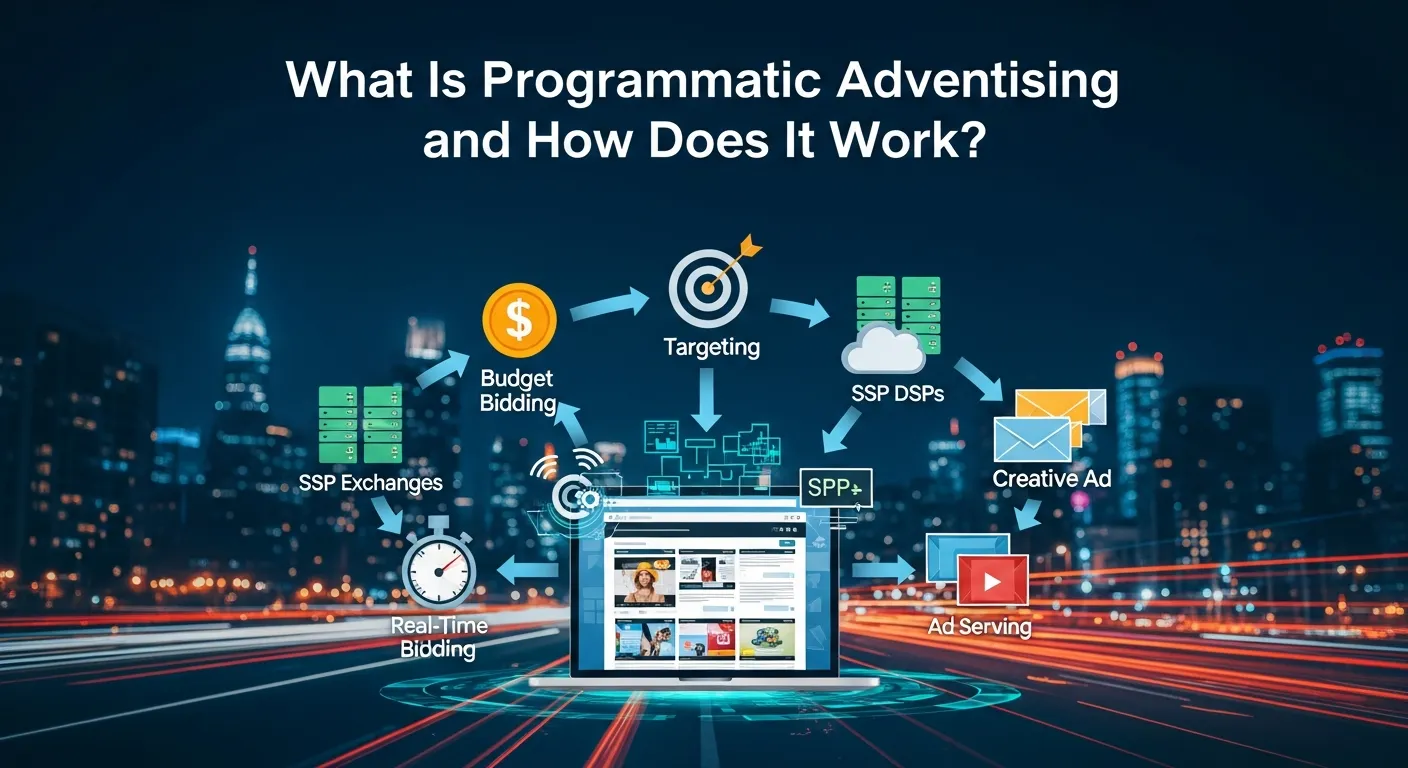
Programmatic advertising represents the crossroads of technology and marketing. It uses data-driven algorithms and real-time bidding to automate the entire purchasing process for advertising, thereby throwing ads in front of an audience where they will do best possible at that given time one form or another.
Key Features of Programmatic Advertising
Automation and Efficiency
By automating ad purchases with artificial intelligence and machine learning algorithms, programmatic platforms eliminate a host of traditional advertising campaign labor.
Audience Targeting
In contrast to PPC, which depends mainly on keywords, programmatic advertising is built around the larger concept of targeting behavior and demographics. The idea here is not really to get a user to actively seek your product; rather, programmatic advertising will advise who they are and how best to reach them.
Real-time Bidding (RTB)
Instead of buying and selling ad inventory at a fixed price, the programmatic approach auctions off pages in real-time. These auctions occur in fractions of a second and just prior to a web page loading.
Expanding the Audience via Multiple Platforms
No longer just confined to search engines or social media, it also applies across all kinds of media from video ads to banners placed on a website or in someone’s inbox, to native advertising, and even the TV screen.
An Example of Programmatic Advertising at Work
For instance, as a fitness apparel company, you are now able to reach more people than before. Instead of aimless targeting of search queries, programmatic advertising extends the reach. Previous web users who have browsed fitness pages and are likely to use the same type of site for streaming video or apps may be among those found.
Understanding Programmatic Advertising: The Ecosystem Behind the Scenes
To truly benefit from Understanding Programmatic Advertising, marketers must look beyond automation and examine the ecosystem that powers it. Unlike PPC platforms that operate within a single ad network, programmatic advertising involves multiple interconnected technologies working together in milliseconds.
The Core Components of the Programmatic Ecosystem
- Demand-Side Platforms (DSPs) – Allow advertisers to buy ad inventory automatically.
- Supply-Side Platforms (SSPs) – Help publishers sell available ad space.
- Ad Exchanges – Digital marketplaces where ad impressions are auctioned in real time.
- Data Management Platforms (DMPs) – Collect and analyze audience data to improve targeting accuracy.
- Customer Data Platforms (CDPs) – Use first-party data to create more refined audience segments.
How the Ecosystem Works Together
When a user visits a website:
- The publisher makes ad inventory available through an SSP.
- The ad exchange auctions that impression.
- Advertisers bid through their DSP.
- The highest bidder’s ad is served instantly.
All of this happens in under a second.
Why This Matters
Understanding this infrastructure allows marketers to:
- Choose the right partners and platforms
- Improve data utilization
- Reduce wasted ad spend
- Strengthen programmatic-advertising strategies for success
This section positions your blog as a more complete programmatic advertising guide rather than just a comparison piece.
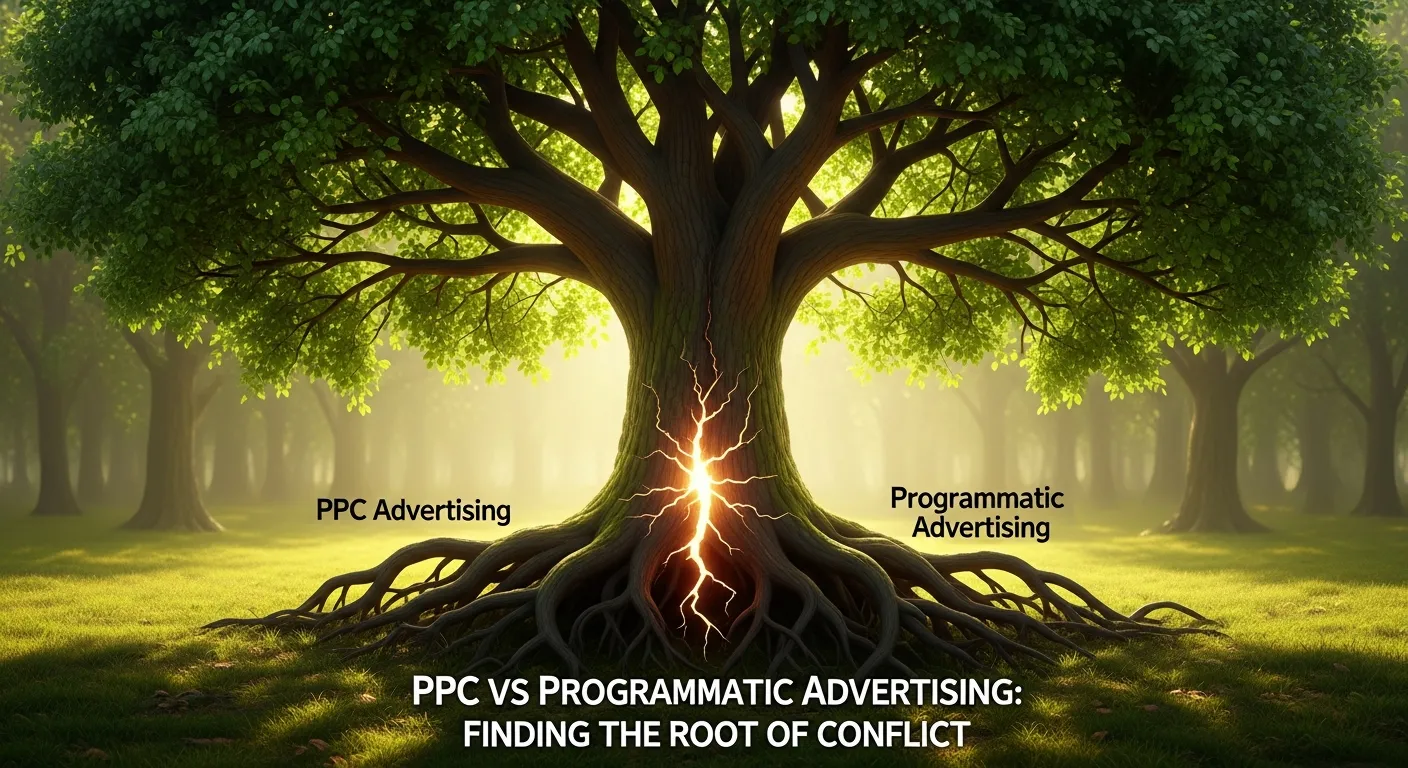
PPC vs Programmatic Advertising: Finding the Root of Conflict
Methodology for Targeting
PPC centers on the keyword-driven intent. For example, if someone searches “lawn care services,” you bid on a related ad under the corresponding keyword (in this case, “lawncare”).
On the other hand, Programmatic targets specific audiences based on demographic details such as work location or interest,s regardless of whether or not they’re currently seeking your product.
Automation
PPC requires manual management in the conception and control of your bidding strategies, campaigns, and keywords. Although Google’s Smart Bidding, etc., provides some automation to this process, it still requires a significant amount of human resources.
By contrast, programmatic advertising is almost entirely automated, utilizing algorithms to place ads across multiple platforms with minimal human input.
Ad Placements
PPC ads appear on search engines and social media as sponsored posts.
Programmatic advertising enables multi-channel placements including streaming services (OTT/CTV), banner ads, native ads and even mobile app interstitial ads.
Programmatic TV Advertising: How It Works and Why It’s Growing Fast
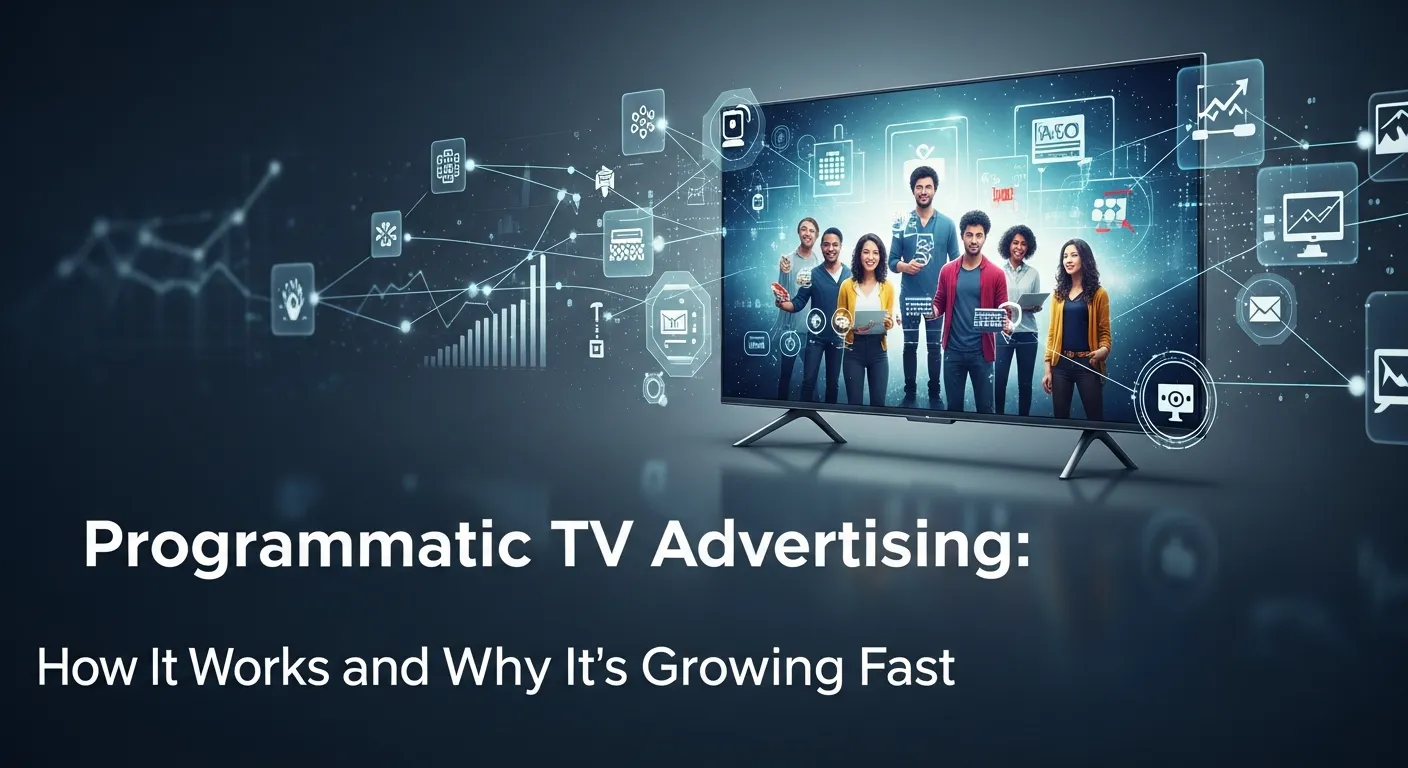
One rapidly expanding area not yet covered in your article is programmatic TV advertising work, particularly in Connected TV (CTV) and Over-The-Top (OTT) streaming environments.
What Is Programmatic TV Advertising?
Programmatic TV advertising applies automated ad buying to streaming platforms instead of traditional broadcast TV. It enables advertisers to serve ads to targeted households rather than broad audience segments.
How Programmatic TV Advertising Works
- Viewers stream content on smart TVs or devices.
- Data (location, device, behavior patterns) is analyzed.
- Advertisers bid on impressions in real time.
- Targeted video ads are delivered to specific households.
Unlike traditional TV buys that rely on estimated viewership, programmatic TV leverages actual user data.
Key Benefits
- Household-level targeting
- Cross-device retargeting (TV to mobile)
- Improved attribution tracking
- Reduced media waste
Traditional TV vs Programmatic TV
| Feature | Traditional TV | Programmatic TV Advertising |
|---|---|---|
| Targeting | Broad demographics | Behavioral & household-level targeting |
| Buying Method | Upfront bulk buying | Real-time bidding |
| Optimization | Limited mid-campaign adjustments | Real-time optimization |
| Measurement | Estimated ratings | Data-driven attribution |
Including this section enhances topical authority and targets the keyword programmatic TV advertising work naturally.
Model of Cost
With PPC, you pay only when a user clicks your ad, making it predictable for advertisers with tight budgets.
Programmatic advertising operates on a cost-per-thousand-impressions (CPM) model: for every 1,000 people who see your ad, whether they click it or not, will costs you money.
The Best PPC Scenarios
PPC is a good way to quickly and predictably realize the benefits of businesses without the huge publicity or long lead times. It’s ideal for capturing user intent and driving acquisitions/sales in a short time frame.
Programmatic, on the other hand, is better suited for branding campaigns or for reaching out to a broader and more narrowly targeted audience via many sites.
Which One Should I Choose?
The decision to use PPC or programmatic ads will depend on your goals, budget, and resources.
Choose PPC if:
- You need a short-term increase in traffic or sales
- You wish to target people who are actively looking for your product or service
- You have a limited budget and prefer to proceed according to the pay-per-click principle.
Choose Programmatic Advertising if:
- You wish to reach a broader audience and increase brand awareness.
- You prefer automated operations and are ready to invest in data-oriented ad buying.
- A multi-channel approach is fundamental to your efforts.
Combining PPC and Programmatic Advertising for Maximum Impact
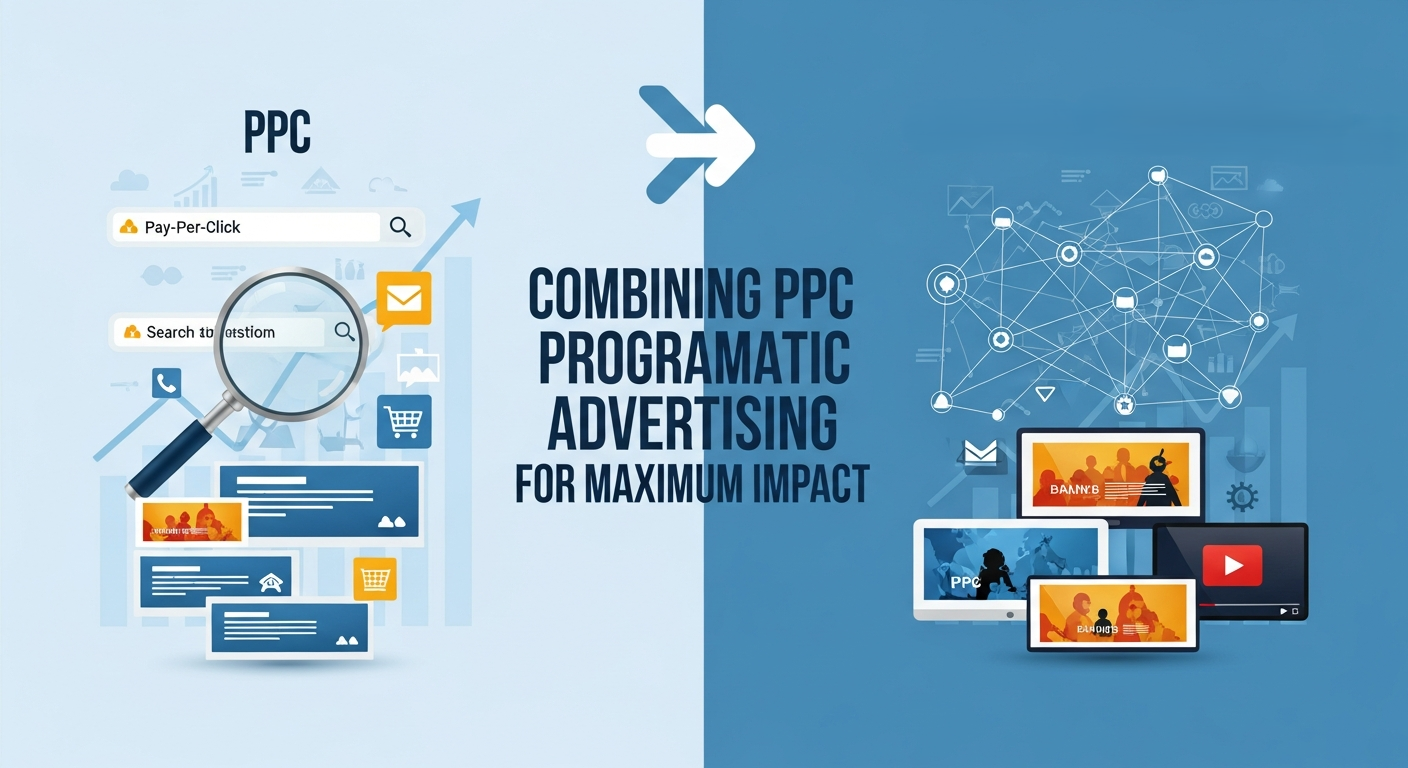
The good news is, you don’t have to choose between the two! A blend of PPC and programmatic strategies almost always produces the best results:
Use PPC to focus on those areas where a user is engaging directly with the intention of making a purchase. Then guide users’ attention or purchases as they turn to you.
Ally yourself with programmatic advertising in order to foster even deeper awareness for your brand among a wider audience, and in turn to re-engage users who interacted with your PPC efforts.
Programmatic advertising can also be a great way to enhance your PPC efforts. For a more detailed guide on how programmatic can elevate your marketing strategy, check out our post on How to Use Programmatic Advertising to Grow Your Business.
Data, Privacy, and the Future of Programmatic Advertising
As privacy regulations evolve, the future of Programmatic Advertising depends heavily on data ethics, compliance, and first-party data strategies.
The Shift Away From Third-Party Cookies
With increasing privacy regulations and browser restrictions, marketers must adapt their programmatic advertising SEM strategy to rely less on third-party cookies and more on:
- First-party data collection
- Contextual targeting
- AI-driven audience modeling
- Consent-based tracking
First-Party Data as a Competitive Advantage
Brands that collect and manage their own customer data will:
- Improve targeting precision
- Lower acquisition costs
- Increase programmatic advertising for engagement
- Strengthen long-term audience relationships
Privacy Regulations Impacting Programmatic
- GDPR (Europe)
- CCPA (California)
- Emerging global data laws
Compliance is no longer optional — it’s foundational to sustainable programmatic-advertising strategies for success.
The Future Outlook
The next evolution of programmatic advertising includes:
- AI-powered predictive bidding
- Contextual intelligence replacing cookies
- Retail media networks growth
- Deeper integration with CRM systems
- Meta programmatic advertising complete ecosystem integrations
Marketers who proactively adapt will gain a significant competitive advantage.
Programmatic Advertising Pros
- Advanced targeting for certain audience groups.
- Because software operates these systems for you, efficiency is higher.
- A wide range of ad placements that cover multiple channels.
Cons of Programmatic Advertising
- To get the full benefit from programmatic platforms, a learning curve is involved.
- Resource-intensive for smaller budgets.
- Programmatic advertising is risky because it depends on user data.
Concluding Thoughts Regarding PPC vs. Programmatic Advertising
Both PPC and programmatic advertising have unique strengths. While PPC is especially good at capturing immediate intention and driving direct results, programmatic brings automation and superior targeting of an altogether different order for marketers to leverage.
How can a business judge its objectives and assess which strategy will yield the most benefits in terms of time? In any case, both approaches can complement each other at the halfway point and help advertisers sort out dilemmas peculiar to the digital landscape.
Frequently Asked Questions (FAQs) About Programmatic Advertising
1. What is Programmatic Advertising in simple terms?
Programmatic Advertising is an automated method of buying and placing digital ads using real-time data and algorithms. Instead of manually negotiating placements, advertisers use software platforms to bid on ad impressions instantly, ensuring ads reach the right audience at the right time.
2. How is programmatic buying different from traditional media buying?
The main difference between programmatic buying vs traditional media buying is automation and precision.
Traditional media buying involves manual negotiations, fixed pricing, and broad audience targeting (like TV or print). Programmatic buying uses real-time bidding, data analytics, and audience segmentation to target specific users across multiple digital platforms.
3. What is programmatic display advertising?
Programmatic display advertising refers to automated buying of banner, video, and rich media ads across websites and apps. These ads are purchased in real time through ad exchanges and are optimized based on user behavior, demographics, and browsing patterns.
4. How does contextual programmatic advertising work?
Contextual programmatic advertising targets users based on the content they are currently viewing instead of relying on personal data. For example, if someone is reading an article about fitness, they may see ads for sportswear or supplements.
This method is gaining popularity due to privacy regulations limiting third-party cookies.
5. What is programmatic audio advertising?
Programmatic-audio-advertising allows brands to automatically buy ad space on music streaming platforms, podcasts, and digital radio. Ads are targeted based on listener behavior, interests, and demographics, making it highly effective for brand awareness and engagement.
6. Is Programmatic Advertising only for large companies?
No. While large brands often use advanced platforms, small and medium-sized businesses can also implement a scaled-down programmatic advertising strategy with controlled budgets and focused audience targeting.
7. How does Programmatic Advertising improve engagement?
Programmatic advertising for engagement works by:
- Targeting users based on behavior and interests
- Retargeting previous website visitors
- Delivering personalized creatives
- Optimizing campaigns in real time
This increases relevance, which directly improves click-through and conversion rates.
8. What is the difference between PPC and Programmatic Advertising?
PPC focuses on keyword-based intent, meaning ads appear when users actively search for something. Programmatic Advertising focuses on audience behavior and demographics, showing ads even when users are not actively searching but fit a targeted profile. Both can work together for maximum performance.
9. Is Programmatic Advertising safe in terms of data privacy?
Programmatic advertising must comply with regulations such as GDPR and CCPA. Modern strategies increasingly rely on first-party data and contextual programmatic advertising to ensure privacy compliance while maintaining performance.
10. What makes a successful Programmatic Advertising strategy?
A strong programmatic advertising strategy includes:
- Clear campaign goals
- Defined audience segmentation
- High-quality creative assets
- Real-time performance tracking
- First-party data utilization, Cross-channel integration (display, video, audio, CTV)
Brands that continuously optimize their campaigns based on analytics see the best long-term results.