Programmatic Ads: Guide to Advertising Success
This guide explains programmatic advertising, covering automated ad buying, targeting strategies, data-driven optimization, and best practices to maximize campaign efficiency, reach, and ROI for advertising success.
Programmatic advertising automates buying and targeting of digital ads, offering efficiency, scalability, and precise audience reach. It uses platforms like DSPs, SSPs, and data tools, with deal types ranging from auctions to guaranteed buys. Success is measured by metrics like CPM, CTR, and ROAS.
What is Programmatic Advertising?
Programmatic advertising uses software and algorithms to automate the buying and selling of digital advertising space in real time. Instead of the traditional, manual process of negotiating ad placements with publishers, programmatic technology connects advertisers and publishers through automated platforms. This allows for data-driven decisions on a massive scale, serving ads to specific users based on their behavior, demographics, and interests.
At its core, programmatic advertising is about efficiency and precision. It replaces phone calls, RFPs (requests for proposal), and manual insertion orders with a streamlined, machine-led process. This automation allows advertisers to reach the right audience, at the right moment, with the right message, all within fractions of a second.
A common misconception is that programmatic advertising is the same as real-time bidding (RTB). While RTB is a major component, it’s just one way to buy programmatic ads. Other methods, like private marketplaces and programmatic direct deals, offer different levels of control and exclusivity. Ultimately, programmatic advertising encompasses any ad buy that is automated by machines.
The Programmatic Advertising Ecosystem
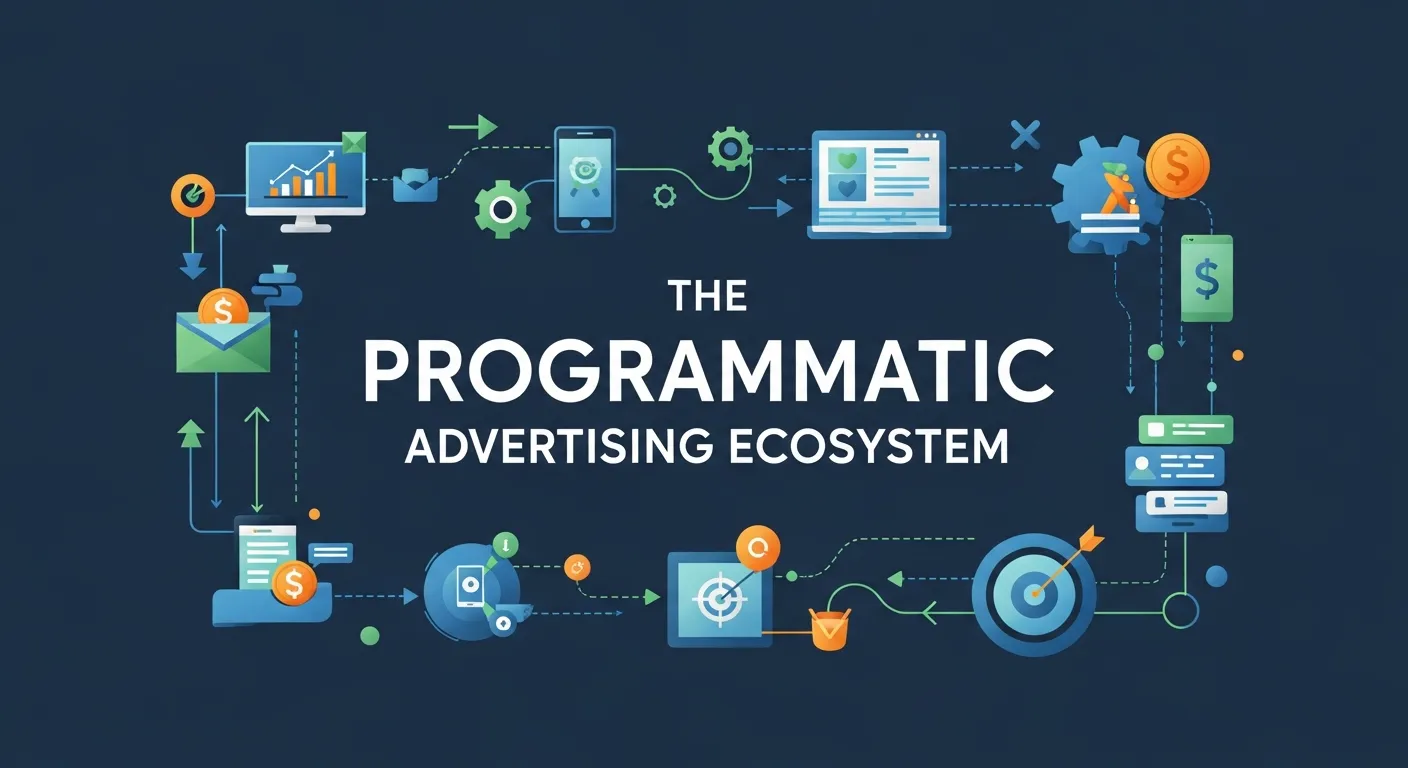
The programmatic ecosystem is a complex network of platforms that work together to facilitate automated ad transactions. Understanding each component and its role is crucial for anyone looking to run programmatic campaigns.
Demand-Side Platform (DSP)
A Demand-Side Platform (DSP) is the software advertisers use to buy ad inventory. It’s the central hub for managing and optimizing ad campaigns across multiple ad exchanges. A DSP allows advertisers to set targeting parameters, manage bids, and track performance. Think of it as the advertiser’s command center.
Key Functions:
- Campaign management and setup.
- Audience targeting based on data.
- Bidding on ad inventory.
- Performance reporting and analytics.
Examples: Google Display & Video 360, The Trade Desk, Adobe Advertising Cloud.
Ad Exchange
An ad exchange is a digital marketplace where publishers make their ad inventory available to advertisers. It acts as a massive pool of ad impressions from numerous websites and apps. DSPs plug into ad exchanges to bid on this inventory on behalf of advertisers in real time.
Key Functions:
- Connects publishers with multiple advertisers.
- Facilitates real-time auctions for ad impressions.
- Aggregates inventory from various sources.
Examples: Google Ad Exchange, OpenX, Magnite.
Supply-Side Platform (SSP)
A Supply-Side Platform (SSP) is the publisher’s equivalent of a DSP. Publishers use SSPs to manage and sell their ad inventory to the highest bidder. The goal of an SSP is to maximize the revenue a publisher earns from their ad space by connecting them to as many potential buyers as possible through multiple ad exchanges.
Key Functions:
- Manages a publisher’s ad inventory.
- Connects to multiple ad exchanges and DSPs.
- Sets “price floors,” the minimum price for an impression.
- Optimizes yield to maximize publisher revenue.
Examples: Google Ad Manager, Magnite, PubMatic.
Data Management Platform (DMP)
A Data Management Platform (DMP) is a software platform used for collecting, organizing, and activating large sets of audience data. DMPs gather first-party data (from your own website/CRM), second-party data (shared from a trusted partner), and third-party data (bought from data providers). Advertisers use this data within their DSP to create highly specific audience segments for targeting.
Key Functions:
- Collects and consolidates audience data from various sources.
- Creates detailed audience segments.
- Integrates with DSPs to enhance ad targeting.
Examples: Adobe Audience Manager, Salesforce Audience Studio, Oracle BlueKai.
The Ad Serving Process
When a user visits a website that uses programmatic advertising, a complex but nearly instantaneous process unfolds:
- User Visits a Page: A user loads a webpage with ad space.
- Ad Request is Sent: The publisher’s website sends an ad request to its SSP.
- SSP Initiates Auction: The SSP analyzes the user’s data (like location, device, and browsing history) and sends a bid request to multiple ad exchanges and DSPs.
- DSPs Evaluate and Bid: The DSPs evaluate the bid request against the advertiser’s campaign targeting criteria and budget. If it’s a match, the DSP submits a bid for the impression.
- Winner is Chosen: The ad exchange runs an auction. The highest bidder wins.
- Ad is Served: The winning advertiser’s ad creative is sent back through the chain and displayed to the user on the webpage.
This entire auction process, from ad request to display, happens in the time it takes for the page to load—typically under 200 milliseconds.
Types of Programmatic Deals
Programmatic advertising offers several ways to purchase ad inventory, each providing a different balance of scale, control, and price.
Open Auction (Real-Time Bidding – RTB)
The open auction, also known as real-time bidding (RTB), is the most common type of programmatic deal. It’s an open marketplace where any advertiser can bid on a publisher’s inventory. The highest bidder wins the impression.
Pros:
- Massive Scale: Access to a vast pool of inventory from thousands of publishers.
- Cost-Effective: Can acquire impressions at a lower cost.
Cons:
- Lack of Transparency: Advertisers may not always know exactly where their ads are appearing.
- Increased Competition: Bidding against a wide range of other advertisers.
Private Marketplace (PMP)
A Private Marketplace (PMP) is an invitation-only auction where a publisher makes its premium inventory available to a select group of advertisers. It offers more transparency and control than the open auction while still using a bidding model.
Pros:
- Premium Inventory: Access to higher-quality ad placements.
- Increased Transparency: Advertisers know which sites their ads will run on.
Cons:
- Higher CPMs: Costs are generally higher than in the open auction.
- Limited Scale: The pool of available inventory is smaller.
Programmatic Guaranteed (Programmatic Direct)
Programmatic Guaranteed, also known as Programmatic Direct, mimics the traditional direct ad buy. The advertiser and publisher negotiate a fixed price (CPM) for a guaranteed volume of impressions. The transaction is then automated through programmatic platforms.
Pros:
- Guaranteed Delivery: Ensures a specific number of impressions on premium sites.
- Full Transparency and Control: The highest level of control over placement and price.
Cons:
- Least Flexible: The terms are fixed, with little room for in-flight optimization.
- Highest Cost: Generally, the most expensive option.
Preferred Deals
Preferred Deals offer a “first look” opportunity. A publisher offers its inventory to a specific advertiser at a fixed price before it becomes available in the PMP or open auction. The advertiser is not obligated to buy the impressions, but if they choose to, they get priority access.
Pros:
- Priority Access: Opportunity to buy premium inventory before others.
- Flexibility: No commitment to purchase.
Cons:
- Non-Guaranteed: Inventory is not reserved.
- Fixed Price: Less opportunity for price optimization through bidding.
Key Benefits of Programmatic Advertising
Businesses are adopting programmatic advertising at a rapid pace because of its clear advantages over traditional methods.
- Efficiency and Scalability: Automation eliminates manual tasks, freeing up marketing teams to focus on strategy. Campaigns can be launched and scaled across millions of websites with minimal effort.
- Precise Audience Targeting: Leveraging data from DMPs allows advertisers to target users based on detailed demographic, psychographic, and behavioral attributes. This ensures ads are shown only to the most relevant audiences.
- Real-Time Optimization: Programmatic platforms provide immediate feedback on campaign performance. Advertisers can adjust bids, targeting, and creative in real time to improve results and maximize return on ad spend (ROAS).
- Greater Transparency and Control: While the open auction can lack transparency, PMPs and Programmatic Guaranteed deals provide full visibility into where ads are running. This helps protect brand safety and ensures ads appear in suitable environments.
- Access to a Wide Range of Formats: Programmatic technology supports a variety of ad formats, including display, video, native, audio, and even digital out-of-home (DOOH). This allows for a cohesive, cross-channel advertising strategy.
Key Performance Indicators (KPIs) to Track
To measure the success of your programmatic campaigns, it’s essential to track the right KPIs. The most important metrics will depend on your campaign goals (e.g., awareness, consideration, or conversion).
- Cost Per Mille (CPM): The cost for one thousand ad impressions. This is the standard pricing model in programmatic advertising sem and is a key metric for measuring the cost-efficiency of your ad buys.
- Click-Through Rate (CTR): The percentage of users who clicked on your ad after seeing it (Clicks ÷ Impressions). CTR is a primary indicator of ad engagement and creative effectiveness.
- Conversion Rate: The percentage of users who completed a desired action (like a purchase or sign-up) after clicking your ad. This is a critical metric for performance-focused campaigns.
- Cost Per Acquisition (CPA): The total cost of acquiring one new customer (Total Ad Spend ÷ Number of Conversions). CPA helps you understand the direct cost-effectiveness of your campaign in driving business outcomes.
- Viewability: The percentage of ad impressions that were actually seen by users according to industry standards (e.g., 50% of pixels in view for at least one second). Viewability ensures you’re paying for ads that have a chance to make an impact.
- Return on Ad Spend (ROAS): The revenue generated for every dollar spent on advertising (Revenue ÷ Ad Spend). ROAS is the ultimate measure of a campaign’s profitability.
Chart Your Course to Success
Programmatic advertising is a dynamic and powerful tool that empowers businesses to execute more intelligent, data-driven advertising strategies. Automating the ad buying process, it offers unparalleled efficiency, precise targeting, and real-time optimization capabilities. Understanding the ecosystem—from DSPs and SSPs to the various deal types—is the first step toward harnessing its full potential.
Whether you aim to build brand awareness at scale through open auctions or secure premium placements with programmatic direct deals, this technology provides the flexibility to meet your objectives. To get started, define your goals, identify your target audience, and choose the platforms and partners that align with your strategy. As you launch and monitor your campaigns, focus on the KPIs that matter most to your business and continuously optimize for better performance. The world of programmatic advertising is complex, but the rewards are well worth the journey.
Frequently Asked Questions (FAQs) About Programmatic Ads
1. What are programmatic ads?
Programmatic ads are digital advertisements bought and sold automatically using software and algorithms. Unlike traditional ad buying, programmatic ads use data and real-time bidding to target the right audience efficiently.
2. How do programmatic ads work?
Programmatic ads operate through automated platforms that connect advertisers with publishers. Advertisers set campaign goals, and algorithms bid for ad space in real-time, delivering ads to users based on behavior, demographics, and context.
3. What is programmatic TV advertising, and how does it work?
Programmatic TV advertising delivers ads on Connected TV (CTV) and Over-the-Top (OTT) platforms using data-driven automation. It enables precise household-level targeting and premium ad placements across streaming channels.
4. How can programmatic ads improve engagement?
Programmatic advertising for engagement focuses on metrics beyond clicks, such as time-on-site, video completion rate, interaction rate, and dynamic creative optimization, allowing brands to connect meaningfully with their audience.
5. What are the key strategies for programmatic advertising success?
Programmatic-advertising strategies for success include frequency capping, audience segmentation, creative testing, cross-channel targeting, and integrating programmatic with SEM campaigns to align messaging with user intent.
6. Can programmatic ads work with search engine marketing (SEM)?
Yes. A strong programmatic advertising SEM strategy uses insights from paid search campaigns to target high-intent users with display, video, or native ads, reinforcing brand messaging and boosting conversions.
7. What types of programmatic ads are available?
The main types include Open Auction (RTB), Private Marketplaces (PMP), Programmatic Direct, and Preferred Deals. Each type serves specific goals, ranging from cost-effective targeting to guaranteed premium placements.
8. How do programmatic ads differ from traditional digital advertising?
Unlike manual ad buying, programmatic ads rely on automation, real-time data, and AI-driven optimization. This allows faster campaign adjustments, precise targeting, and scalable omnichannel reach.
9. What platforms support programmatic ads?
Major platforms include Google Display & Video 360, Meta Programmatic Advertising, The Trade Desk, Amazon DSP, and other DSPs. These platforms allow advertisers to buy display, video, audio, and DOOH ads programmatically.
10. Are programmatic ads suitable for small businesses?
Yes. Small businesses can leverage programmatic ads to reach highly targeted audiences efficiently. Starting with small budgets, clear goals, and simple campaigns allows gradual scaling while maximizing ROI.
Digital programmatic advertising is the future—get ahead by reading How to Get Started with Programmatic Advertising and take your first steps today.