AI Knowledge Management: Transforming Business Information Into Intelligent Insights
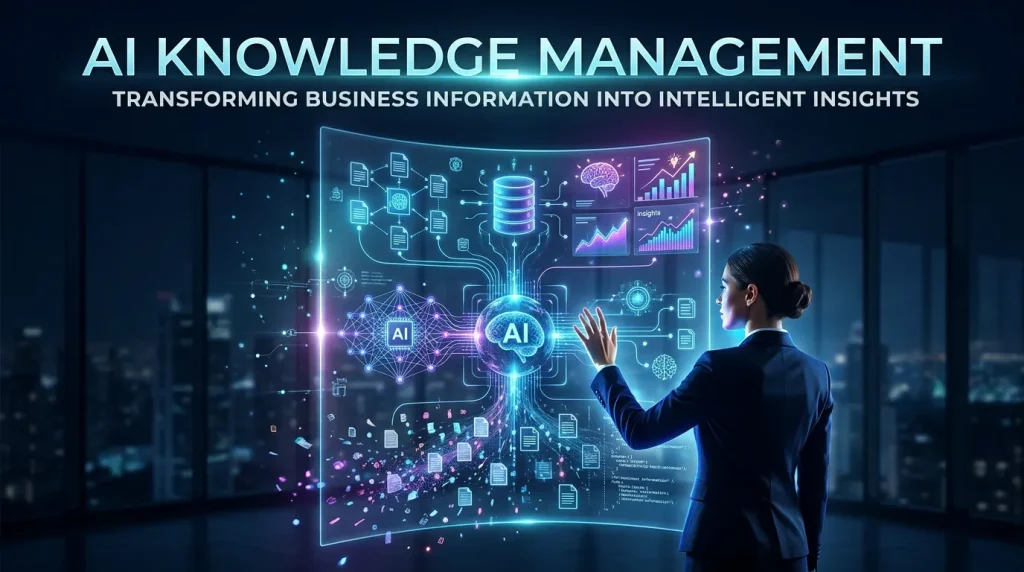
AI Knowledge Management uses artificial intelligence to organize, retrieve, analyze, and share organizational information. Through intelligent search, automated knowledge bases, machine learning, and natural language processing, businesses can improve information accessibility and reduce manual work. These technologies support employee collaboration, enterprise operations, customer service, and business decision-making. Successful implementation requires accurate data, strong security, and appropriate human oversight.
Every organization generates valuable information through daily operations, customer interactions, internal communication, research, and business activities. However, having access to large amounts of information does not automatically mean employees can find or use it effectively. Important documents may remain scattered across different platforms, outdated knowledge can create confusion, and employees may spend considerable time searching for answers that already exist somewhere within the organization. AI Knowledge Management is changing how businesses address these challenges by making organizational information easier to organize, discover, understand, and share.
Traditional knowledge management systems mainly depend on employees to create documents, categorize information, update records, and maintain knowledge bases. Although these systems provide a foundation for storing business knowledge, managing information manually becomes increasingly difficult as organizations grow. Artificial intelligence introduces a more intelligent approach by helping businesses analyze information, recognize patterns, automate repetitive activities, and deliver relevant knowledge when employees need it.
From customer support and employee training to business research and operational decision-making, AI-powered knowledge solutions are becoming useful across different industries. They help organizations turn scattered information into accessible resources while reducing the effort required to maintain internal knowledge systems.
Understanding how AI Knowledge Management works, where it creates value, and what businesses should consider when adopting it can help organizations build more efficient information environments.
Understanding the Role of AI in Knowledge Management
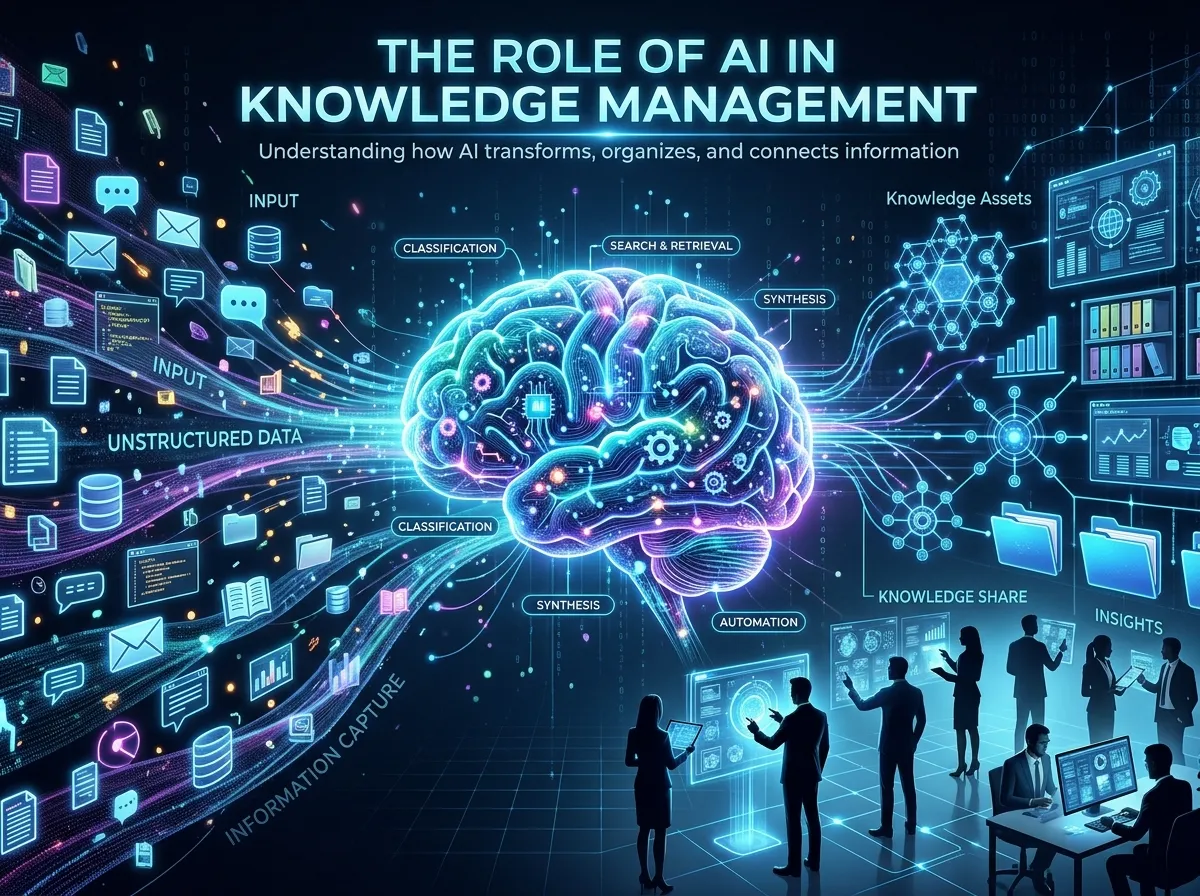
AI Knowledge Management refers to the use of artificial intelligence technologies to collect, organize, process, retrieve, and distribute knowledge within an organization. It combines traditional knowledge management practices with technologies such as machine learning, natural language processing, semantic search, and generative AI.
The main objective is to make organizational knowledge more accessible and useful. Instead of requiring employees to search through numerous folders, documents, and databases, AI can help identify relevant information based on the meaning and context of a question.
For example, an employee working in a customer service department may need information about a product’s refund policy. In a traditional system, finding the correct document could require navigating several categories or searching using specific keywords. An AI-enabled system can interpret the employee’s question, identify relevant policy information, and provide a useful response based on available organizational resources.
This capability changes the relationship between employees and business information. Knowledge becomes something people can interact with naturally rather than something they must locate manually.
AI can also support continuous knowledge improvement. It can identify frequently requested information, recognize missing documentation, and highlight content that may require updating. These capabilities help organizations maintain more useful and organized knowledge environments.
How AI-Powered Knowledge Management Changes Information Access
One of the biggest challenges in traditional knowledge management is information accessibility. Businesses may have thousands of documents, but employees cannot always identify which resources contain the answers they need.
AI-Powered Knowledge Management addresses this issue by improving how information is searched and retrieved. Natural language processing allows systems to understand everyday questions instead of depending entirely on exact keyword matches.
For instance, an employee might search for “How can I update a customer’s billing information?” even when the relevant document is titled “Customer Account Modification Procedure.” A traditional keyword search may struggle to connect these phrases, whereas an intelligent search system can recognize their related meaning.
Semantic search further improves this process by considering the context behind a query. It can identify information based on concepts, relationships, and relevance rather than simply matching identical words.
Generative AI can add another layer by summarizing relevant documents and presenting information in conversational language. This makes large collections of business knowledge easier to understand.
However, the quality of these responses depends on the accuracy of the underlying information. Businesses need reliable documentation, appropriate access permissions, and systems that identify trustworthy sources.
The Growing Importance of Intelligent Knowledge Management Systems
As organizations expand, their information becomes more complex. Different departments maintain separate records, employees develop specialized knowledge, and business processes change over time. Without an effective structure, valuable information can become difficult to locate or reuse.
Intelligent Knowledge Management Systems help businesses manage this complexity by combining information storage with automated analysis and retrieval capabilities.
These systems can connect information from different business applications, including document repositories, internal databases, customer relationship management platforms, and communication tools. When properly integrated, employees can access relevant knowledge without switching between multiple systems.
Another important capability is content classification. AI can analyze documents and assign categories based on their subject matter, purpose, and context. This reduces the need for employees to manually organize every resource.
Some systems can also identify relationships between documents. For example, a product specification may be connected to its troubleshooting instructions, customer support records, and training materials. These connections make it easier to understand how different pieces of information relate to one another.
Intelligent systems can also support organizational continuity. When experienced employees leave or change roles, their documented knowledge remains available to others. This helps reduce dependency on individual employees and preserves valuable business experience.
AI Knowledge Management Tools and Their Business Applications
The effectiveness of AI Knowledge Management often depends on selecting tools that match an organization’s information requirements. Different solutions focus on different capabilities, including enterprise search, document processing, conversational assistants, content management, and automated knowledge retrieval.
For example, an organization with extensive technical documentation may benefit from semantic search and AI-powered document analysis. A customer support business may prioritize conversational knowledge assistants that help agents locate accurate answers during customer interactions.
AI Knowledge Management Tools can also assist with summarizing lengthy reports, identifying important information within documents, extracting relevant details, and generating answers from approved knowledge sources.
In human resources departments, these tools can help employees find information about workplace policies, onboarding processes, and internal procedures. In sales teams, they can make product information, competitive research, and customer insights easier to access.
Their value becomes greater when they are integrated into existing workflows. Employees are more likely to use knowledge systems when relevant information appears within the applications they already work with.
However, businesses should evaluate more than the number of AI features offered by a platform. Security, integration options, information accuracy, administrative controls, and usability are equally important considerations.
Automated Knowledge Management and the Reduction of Manual Work
Maintaining a business knowledge base requires ongoing effort. Documents need to be categorized, information must be reviewed, outdated resources should be removed or replaced, and new knowledge needs to be added regularly.
Automated Knowledge Management helps reduce this administrative burden by using AI to support repetitive information-handling activities.
Document classification is one example. AI systems can examine uploaded files and identify their likely subjects, departments, or content categories. This makes it easier to organize large document collections without relying entirely on manual tagging.
Another application involves information extraction. Businesses often receive important details through reports, forms, emails, and other documents. AI can identify relevant information and make it available in structured formats.
Automated systems can also help identify duplicate documents, detect potentially outdated content, and highlight knowledge resources that have not been reviewed recently.
For example, a company may maintain several versions of an employee policy across different internal folders. An AI-enabled system can help identify similar documents and flag inconsistencies for review.
Importantly, automation should not remove human responsibility from knowledge management. Policies, technical instructions, financial information, and other critical resources may require approval from qualified employees before they become official organizational references.
The strongest systems combine automated assistance with clear human review processes.
Enterprise Knowledge Management AI: Connecting Information Across Departments
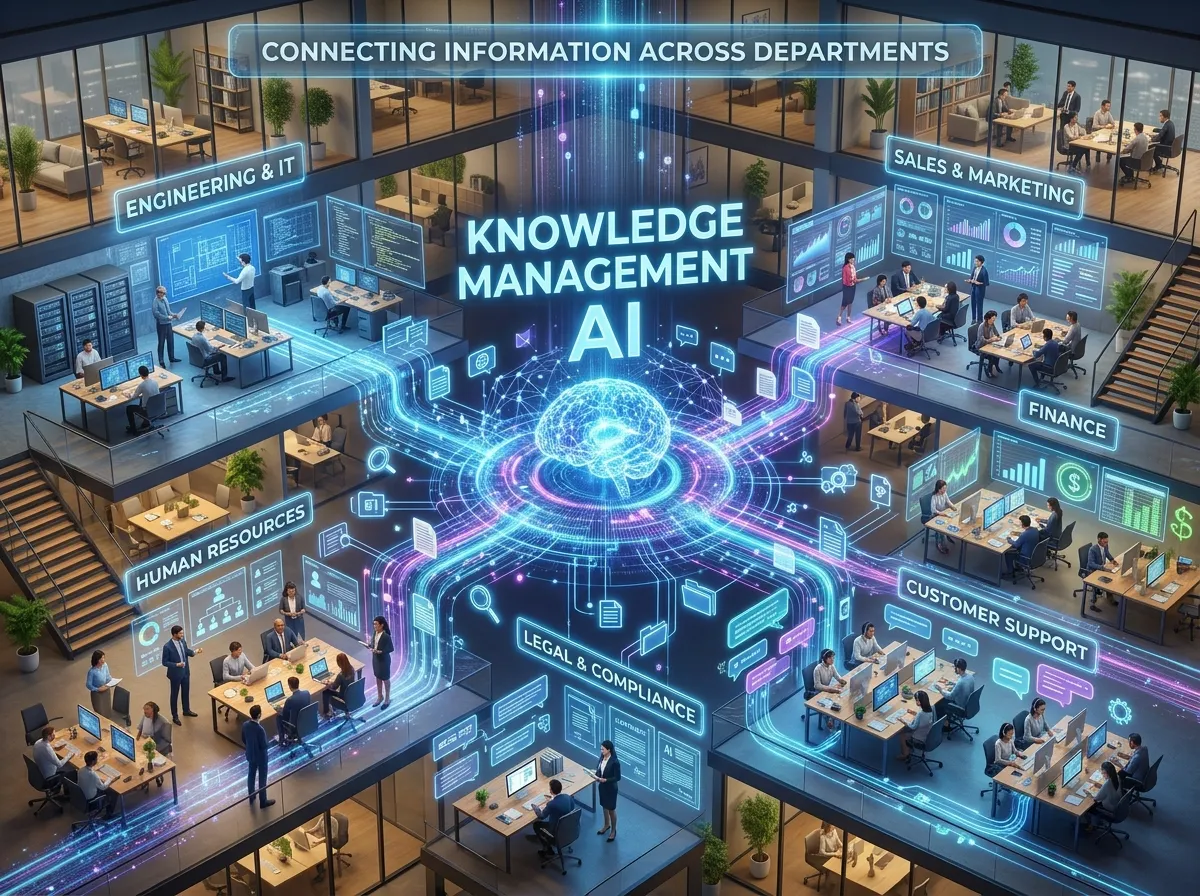
Large organizations often face a different knowledge challenge from smaller businesses. Their information is distributed across departments, geographical locations, business applications, and employee teams.
Enterprise Knowledge Management AI helps address this fragmentation by creating more connected information environments.
Consider a multinational company with separate departments for finance, operations, human resources, marketing, and customer support. Each department may maintain its own documents and databases. Although these resources contain valuable information, employees may struggle to find knowledge outside their immediate department.
AI can help connect these information sources through enterprise search, semantic indexing, and controlled information retrieval.
This creates opportunities for better cross-department collaboration. A customer support representative may access approved product information created by the technical department, while a sales professional may retrieve relevant case studies developed by the marketing team.
Enterprise AI systems can also apply role-based access controls. This is essential because not every employee should have access to confidential financial records, personal information, or restricted business documents.
Organizations should therefore establish clear permissions before connecting internal information sources to AI applications.
A successful enterprise knowledge environment is not simply a large collection of connected documents. It is a controlled system that helps authorized employees find the right information while protecting sensitive business resources.
AI Knowledge Discovery: Finding Insights Hidden Within Business Information
Organizations often possess valuable knowledge that is difficult to identify through ordinary searches. Important patterns may exist across customer feedback, research documents, internal reports, and historical business records.
AI Knowledge Discovery helps uncover these insights by analyzing information and identifying relationships that may not be immediately visible.
Machine learning models can examine large collections of data to recognize recurring themes, identify similar content, and detect patterns in organizational knowledge.
For example, a company reviewing customer support records may discover that several customers report similar problems with a particular product feature. AI can help identify these recurring issues and connect them with existing troubleshooting resources.
Similarly, a research team may use AI to examine a large collection of industry reports and identify common developments, emerging topics, or related findings.
Knowledge discovery can also help organizations identify information gaps. If employees repeatedly ask questions that are not answered by existing documentation, the system may highlight areas where additional resources are needed.
These capabilities make knowledge management more proactive. Rather than waiting for employees to discover information manually, businesses can use AI to identify useful connections and opportunities for improvement.
Knowledge Base Automation and the Evolution of Internal Support
A knowledge base is one of the most important components of an organization’s information environment. It stores frequently used answers, procedures, instructions, product details, and other resources that employees or customers may need.
However, traditional knowledge bases can become difficult to maintain when information grows rapidly.
Knowledge Base Automation uses AI to support the creation, organization, updating, and retrieval of knowledge resources.
For instance, customer support teams can analyze frequently asked questions and use those patterns to identify topics that need better documentation. AI can also help generate initial article drafts based on approved product information or existing support materials.
Conversational assistants can then use these resources to answer common questions and direct users toward relevant documentation.
The benefits extend beyond customer service. Internal knowledge assistants can help employees understand company policies, access training materials, and locate operational instructions without repeatedly contacting colleagues.
Nevertheless, automated responses must be monitored carefully. An outdated or incorrect answer can create confusion, especially when the information relates to compliance, technical procedures, or customer commitments.
Businesses should establish content ownership, review schedules, and approval processes to ensure that automated knowledge remains reliable.
AI Information Management and the Importance of Data Quality
AI Information Management involves using intelligent technologies to organize, analyze, retrieve, and maintain information across business environments.
Although AI can improve information accessibility, its performance depends heavily on the quality of the data it processes.
Duplicate records, incomplete documents, inconsistent terminology, and outdated information can reduce the usefulness of AI-powered knowledge systems. Even advanced models may produce unreliable answers when the underlying resources are inaccurate.
For this reason, businesses should treat information quality as a central part of their AI strategy.
Clear document naming conventions, consistent categories, accurate metadata, and regular content reviews create a stronger foundation for intelligent information management.
Data governance is equally important. Organizations need to understand where information comes from, who owns it, how it is updated, and which employees are permitted to access it.
Privacy protection should also be considered when AI systems process customer records, employee information, or confidential business documents.
Another important concern is AI-generated misinformation. Generative systems may sometimes produce answers that sound convincing but are not supported by available evidence. Grounding responses in approved documents, providing source references, and allowing human verification can reduce this risk.
Businesses should view AI as a tool for improving information management rather than an automatic replacement for data governance.
Machine Learning Knowledge Systems and Continuous Organizational Learning
Machine learning plays an important role in making knowledge systems more adaptive. Instead of depending entirely on predefined search rules, these technologies can identify patterns from information and improve certain capabilities through data-driven processes.
Machine Learning Knowledge Systems can help recognize relationships between documents, classify information, recommend relevant resources, and identify recurring knowledge requirements.
For example, if employees from a particular department frequently search for the same technical documents, an intelligent system may recommend those resources in similar situations.
Recommendation capabilities can also help employees discover information they might not have searched for directly. A person reading a product development report may receive suggestions for related research, testing documents, or operational records.
Over time, these features can make organizational knowledge more connected and easier to reuse.
However, machine learning recommendations should not be treated as guaranteed indicators of relevance. Organizations need to monitor system performance, evaluate recommendations, and address biases that may develop from incomplete or unbalanced data.
The larger opportunity is continuous organizational learning. When business knowledge is documented, connected, and accessible, employees can build on previous work instead of repeatedly solving the same problems.
AI-Powered Knowledge Sharing Across Teams
Knowledge sharing is essential for collaboration, innovation, and organizational growth. However, employees do not always have the time or resources to document everything they learn.
AI-Powered Knowledge Sharing helps make information exchange easier by supporting content discovery, summarization, recommendations, and conversational access.
For example, an employee completing a successful project may have useful reports, research, and practical insights that could benefit other teams. AI can help organize these materials and make them discoverable through relevant search queries.
Teams can also use AI assistants to summarize meeting discussions, extract important decisions, and identify follow-up information that should be documented. These activities can reduce the amount of knowledge lost through informal conversations.
Another benefit is improved access for remote and geographically distributed employees. Instead of relying on colleagues in the same office, team members can retrieve approved knowledge from shared organizational systems.
A strong knowledge-sharing environment also depends on company culture. Employees should be encouraged to document useful experiences, maintain accurate resources, and contribute information that benefits the wider organization.
Technology can make sharing easier, but meaningful participation remains an important part of the process.
How AI Knowledge Management Supports Modern Digital Marketing
AI Knowledge Management is also relevant to marketing teams, which regularly work with research, customer insights, campaign records, content resources, and performance information.
An organized knowledge environment can help marketers identify previous campaign findings, understand audience interests, and reuse valuable research when developing new content.
AI can summarize industry reports, identify recurring customer questions, and help teams locate information relevant to upcoming campaigns.
For example, a content team preparing an article may need information from previous research, customer feedback, and internal subject-matter experts. An AI-enabled knowledge system can help bring these resources together more efficiently.
However, access to information is only one part of an effective content process. Marketing teams also need a clear understanding of search intent, audience expectations, and content quality.
Businesses looking to connect intelligent information management with stronger organic visibility can explore SEO Content Strategy, which discusses the importance of developing relevant content for modern search environments.
Natural language processing is another important technology in this area. It helps AI systems interpret human language, understand questions, and identify relationships between different pieces of content. Readers interested in the underlying technology can explore Master Natural Language Processing for a deeper understanding of how language-based AI applications work.
AI Knowledge Management can also support advertising teams by organizing campaign information, audience research, and performance insights. However, organizations should maintain appropriate boundaries when working with personal information and advertising data. Understanding Programmatic Advertising Privacy can help businesses recognize the importance of responsible information practices in automated advertising environments.
As mobile marketing continues to develop, connected knowledge resources can also help teams coordinate campaign information across devices and channels. This makes the relationship between information management and advertising operations increasingly relevant, particularly for organizations exploring How Programmatic Advertising Works in Mobile Marketing.
What Businesses Should Consider Before Adopting AI Knowledge Management
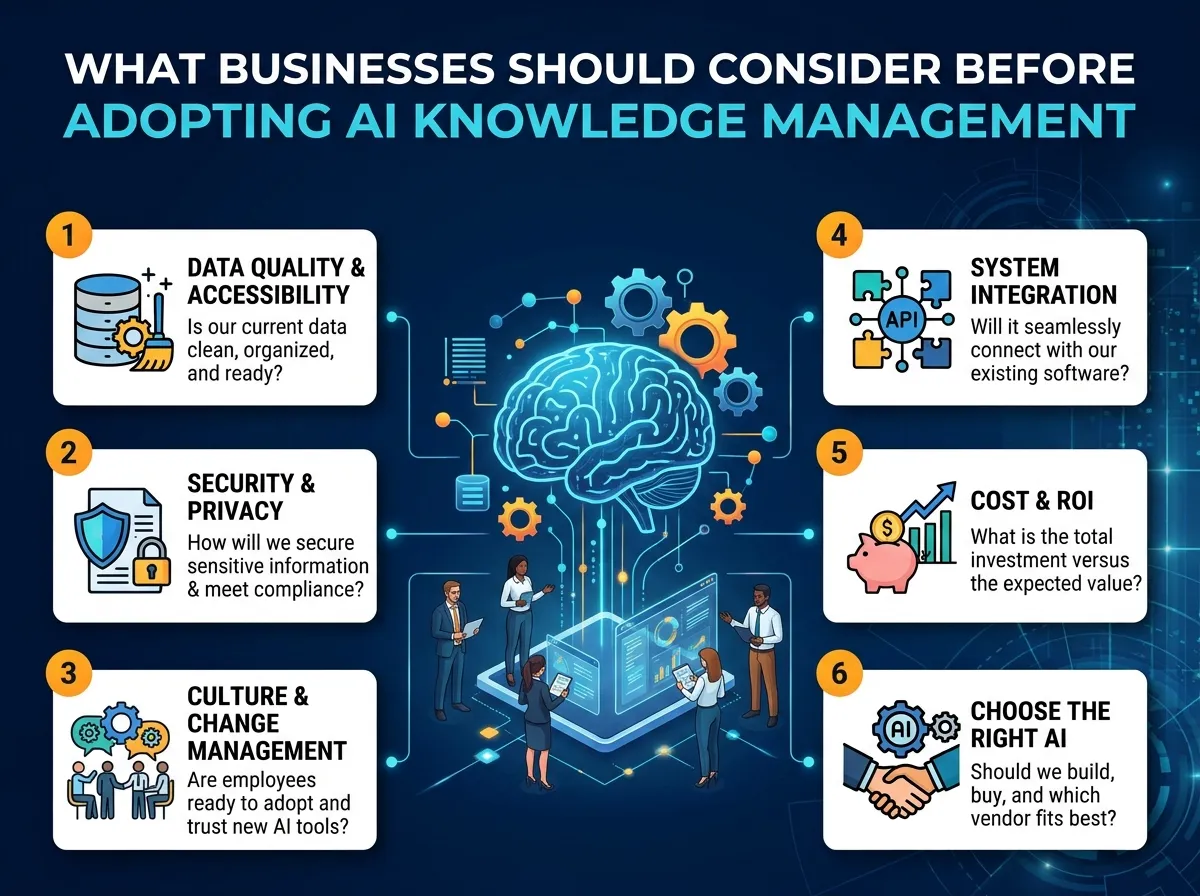
Introducing AI into an existing knowledge environment requires more than purchasing software. Organizations need to understand their current information challenges and determine which processes would benefit most from intelligent automation.
Information readiness is a useful starting point. Businesses should review where their documents are stored, whether important resources are up to date, and how employees currently access organizational knowledge.
Technology compatibility also matters. An AI solution should work effectively with the organization’s existing applications and information repositories. Poor integration may create additional complexity instead of improving accessibility.
Security requirements deserve particular attention. Access permissions, encryption, data retention, and privacy controls should be evaluated before sensitive business information is connected to AI systems.
Employee adoption is another important factor. Even a technically advanced system may deliver limited value if employees do not understand how to use it. Clear communication, practical training, and feedback opportunities can help encourage adoption.
Finally, organizations should evaluate performance using meaningful business outcomes. Reduced search time, faster employee onboarding, improved support response times, better information accuracy, and stronger knowledge reuse can provide useful indicators of progress.
Starting with a focused department or knowledge repository can also help businesses evaluate results before expanding AI capabilities across the entire organization.
Conclusion
AI Knowledge Management is changing how organizations collect, organize, discover, and share business information. By combining artificial intelligence, machine learning, natural language processing, and intelligent search, businesses can make valuable knowledge more accessible while reducing repetitive administrative work.
From automated knowledge bases and enterprise information systems to intelligent discovery and cross-team collaboration, these technologies offer opportunities to improve how employees interact with organizational knowledge.
However, successful adoption depends on more than advanced AI features. Accurate information, responsible data management, appropriate security controls, and human oversight remain essential.
Organizations that combine these foundations with practical AI applications can create knowledge environments that support better collaboration, informed decisions, and continuous learning.
10 Frequently Asked Questions About AI Knowledge Management
1. What is AI Knowledge Management?
AI Knowledge Management is the use of artificial intelligence to organize, analyze, retrieve, and distribute information within an organization. It helps employees access relevant knowledge more efficiently.
2. How does AI improve knowledge management?
AI improves knowledge management through intelligent search, automated document classification, content summarization, information discovery, and conversational assistants that make organizational knowledge easier to access.
3. What are AI-Powered Knowledge Management Systems?
These are software systems that combine traditional knowledge storage with AI capabilities. They help businesses organize information, understand user questions, retrieve relevant resources, and support knowledge sharing.
4. What are the benefits of automated knowledge management?
Automated knowledge management reduces repetitive administrative work, improves document organization, supports faster information retrieval, and helps businesses maintain more consistent knowledge resources.
5. Which AI Knowledge Management Tools do businesses use?
Businesses use AI-powered enterprise search platforms, document management systems, conversational assistants, knowledge base applications, and machine learning solutions to manage organizational information.
6. How does AI Knowledge Discovery work?
AI Knowledge Discovery analyzes documents, databases, and other information sources to identify patterns, relationships, recurring topics, and useful insights that may otherwise be difficult to find.
7. Is AI Knowledge Management suitable for small businesses?
Yes. Small businesses can use AI knowledge tools to organize internal documents, manage customer support information, improve employee onboarding, and make important resources easier to access.
8. What is the role of machine learning in knowledge management?
Machine learning helps systems recognize information patterns, classify documents, recommend relevant resources, and improve certain knowledge retrieval capabilities based on available data.
9. How does AI improve knowledge sharing between employees?
AI helps employees discover relevant documents, summarize discussions, recommend useful resources, and access information across departments, making organizational collaboration easier.
10. What challenges can businesses face when implementing AI Knowledge Management?
Common challenges include poor data quality, outdated documents, integration difficulties, privacy concerns, security requirements, inaccurate AI responses, and limited employee adoption.