Autonomous AI Agents: Transforming Business Automation
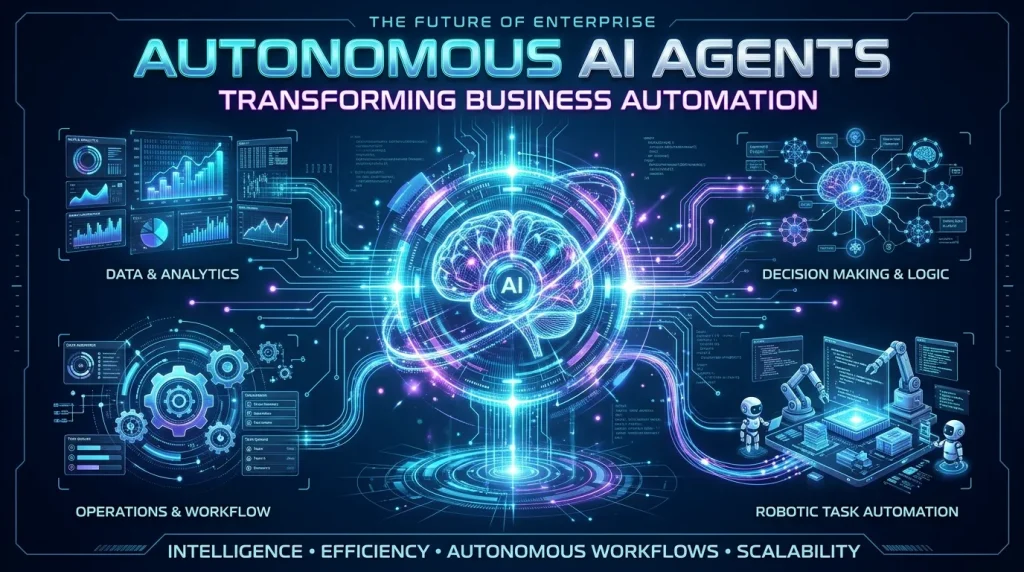
Autonomous AI Agents are intelligent systems that can understand objectives, make decisions, and complete tasks with limited human intervention. They support business automation, workflow management, research, customer service, and data analysis. By combining autonomous agents with traditional automation, reliable data, and human oversight, organizations can improve operational efficiency while maintaining control over important decisions.
Artificial intelligence is moving beyond systems that simply respond to commands or generate information. A new generation of AI technology is capable of understanding objectives, planning actions, interacting with digital tools, and adapting its approach as situations change. These systems are known as Autonomous AI Agents, and they are becoming an important part of modern business automation.
Unlike traditional software that follows a fixed sequence of instructions, autonomous agents can evaluate situations, make decisions, and complete tasks with varying levels of human supervision. Their ability to work toward defined goals makes them useful across marketing, customer service, data analysis, software development, and operational management.
As businesses look for more efficient ways to manage complex workflows, autonomous AI technology is creating opportunities to reduce repetitive work and improve decision-making. However, its real value depends on how intelligently these systems are designed, how reliably they operate, and how effectively they work alongside human teams.
Understanding the Concept of Autonomous AI Agents
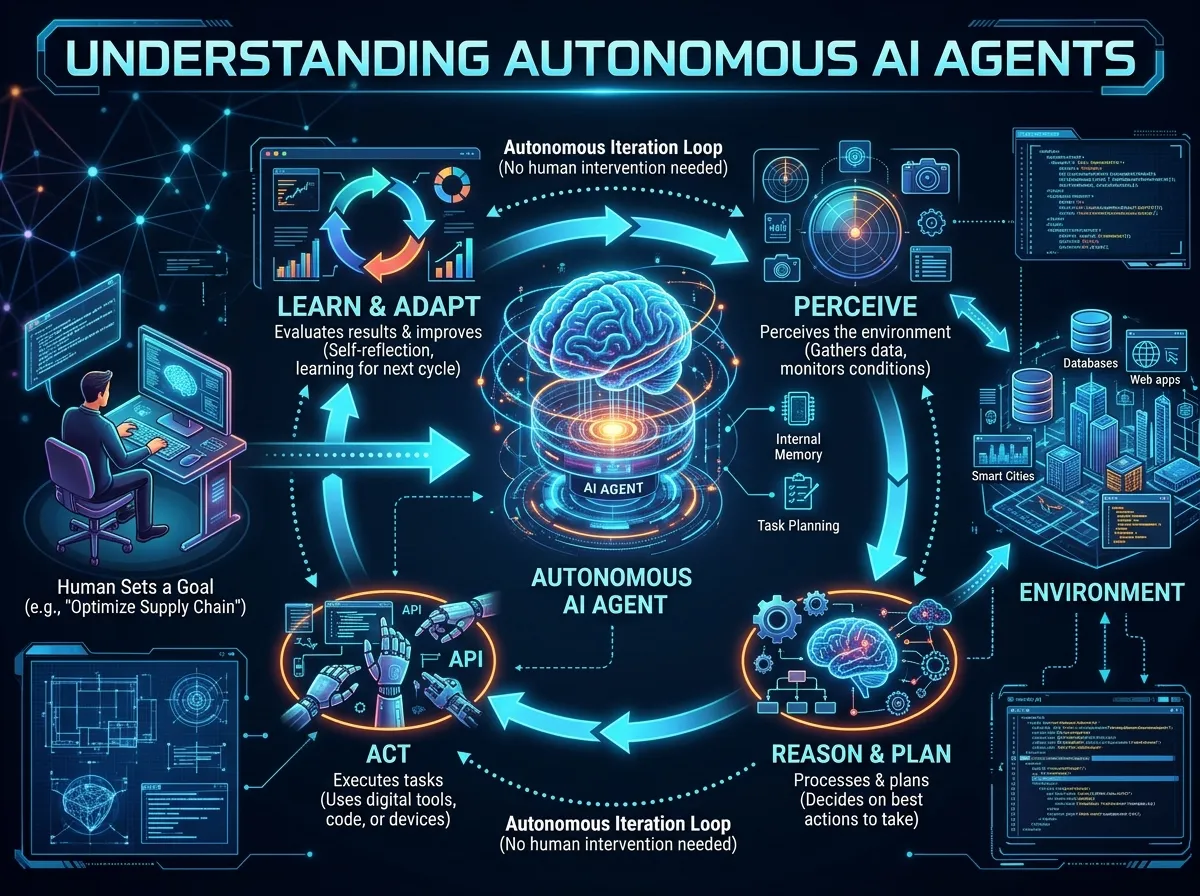
Autonomous AI Agents are intelligent software systems designed to pursue specific objectives by observing their environment, processing information, selecting actions, and evaluating results. They can operate independently within a defined scope instead of requiring a human to provide instructions for every individual step.
An autonomous agent typically receives a goal rather than a complete list of actions. It then determines which steps may be necessary to achieve that goal.
For example, a business might ask an AI agent to research potential customers within a particular industry. The agent could gather relevant information, organize company details, identify suitable prospects, and prepare a structured report for review.
This process differs from conventional automation because the agent can make decisions based on the information it encounters. If a source is unavailable or a particular detail is missing, it may adjust its approach rather than simply stopping at the first unexpected situation.
The growing interest in Autonomous Artificial Intelligence Agents reflects a broader shift toward software that can perform more complex tasks while maintaining a clear connection to business objectives.
From Traditional Automation to Intelligent Decision-Making
For many years, businesses relied on rule-based automation to improve efficiency. These systems performed repetitive tasks according to predefined conditions. When the correct input was available, the software followed an established process.
Although traditional automation remains valuable, it often struggles with situations that require interpretation or flexible decision-making.
Consider a simple workflow in which an application sends an email whenever a customer submits a form. The process works well because the conditions are predictable.
Now imagine a system that must understand the customer’s request, determine its urgency, identify the appropriate department, retrieve relevant information, and prepare a suitable response. This requires more than a fixed sequence of instructions.
AI Agent Automation Systems can support these more flexible workflows by combining language understanding, reasoning capabilities, tool access, and task planning.
They may interpret unstructured information, select appropriate actions, and adjust their next steps according to the results of previous actions.
This does not mean autonomous agents replace every traditional automation tool. In many business environments, combining established automation with intelligent agents produces a more reliable and efficient system.
For example, an agent may decide which customer request requires attention, while a conventional automation platform handles the predictable process of updating records or sending approved notifications.
How Autonomous AI Systems Operate
The behavior of Intelligent Autonomous AI Systems can be understood through a continuous interaction between goals, information, decisions, and actions.
An agent begins with an objective. It gathers information from its available environment, interprets the situation, and determines an appropriate next step.
After taking action, it evaluates the outcome. If the result does not meet the expected objective, the agent may revise its plan or attempt another permitted action.
This process allows autonomous systems to handle tasks that involve multiple stages.
For example, an AI research agent might begin by identifying reliable sources, extracting relevant information, comparing findings, and organizing the results into a summary.
The system does not necessarily need a separate human instruction for every stage. Instead, it uses the original objective and available context to guide its progress.
However, autonomy should always operate within clear boundaries. Businesses need to define which tools an agent can access, what information it can use, and which actions require approval.
A well-designed autonomous system is not simply one that acts independently. It is one that operates independently while remaining predictable, accountable, and aligned with its intended purpose.
Where AI Agents for Business Automation Create Value
The practical appeal of AI Agents for Business Automation lies in their ability to connect separate activities into a more coordinated workflow.
Many business processes involve information gathering, interpretation, communication, and follow-up. These activities often require employees to move between multiple applications and repeat similar decisions throughout the day.
Autonomous agents can help reduce this operational burden.
In customer service, an agent may review a support request, identify the issue, search an approved knowledge base, and prepare a response. More complicated cases can be transferred to a human representative with the relevant information already organized.
In marketing, agents may assist with campaign research, audience analysis, content planning, and performance reporting. Their ability to work with different data sources can help teams understand campaign activity without manually collecting every detail.
Sales departments can use agents to research accounts, summarize customer interactions, and prepare meeting briefs. These capabilities allow sales representatives to spend more time building relationships and less time performing repetitive administrative work.
Finance and operations teams may also benefit from agents that organize documents, identify inconsistencies, or support routine reporting.
The most effective applications usually begin with a clearly defined process rather than attempting to automate an entire department at once.
The Growing Role of Self-Learning AI Agents
One of the most discussed developments in artificial intelligence is the emergence of Self-Learning AI Agents.
The term generally describes systems that can improve their behavior through feedback, experience, or updated information. However, it is important to understand that not every autonomous agent continuously learns from its own actions.
Some agents rely on a fixed language model and improve their performance by using better instructions, memory systems, or external knowledge. Others may incorporate feedback mechanisms, evaluation processes, or specialized learning techniques.
For example, an agent responsible for categorizing customer inquiries may receive feedback when its classification is incorrect. That feedback can help improve future performance if the system has an appropriate learning or optimization mechanism.
In business settings, continuous improvement must be carefully managed. An agent should not automatically change important business rules or learn from unreliable information without oversight.
Organizations need to distinguish between systems that adapt their task execution and systems that genuinely update their underlying behavior through learning.
This distinction helps businesses set realistic expectations and choose appropriate technology for their needs.
Autonomous AI Agent Applications Across Industries
The range of Autonomous AI Agent Applications continues to expand as organizations explore new ways to combine intelligence with operational processes.
In healthcare administration, agents may help organize records, support appointment coordination, and summarize approved information for administrative teams. Clinical decisions still require appropriate professional oversight.
In financial services, autonomous systems can assist with document review, transaction analysis, customer support, and internal reporting. Sensitive financial actions should remain subject to strict authorization and compliance controls.
Manufacturing businesses may use agents to analyze production information, identify possible maintenance concerns, and support inventory planning.
Retail organizations can apply autonomous technology to customer inquiries, product information management, and demand analysis.
Software development is another area where agents are gaining attention. They can assist with code research, testing, documentation, and debugging by interacting with development tools.
These examples demonstrate that autonomous technology is not limited to a single industry. Its usefulness depends on whether a task involves information processing, decision support, or a sequence of actions that can be safely delegated.
AI Agent Decision-Making Capabilities and Their Limitations
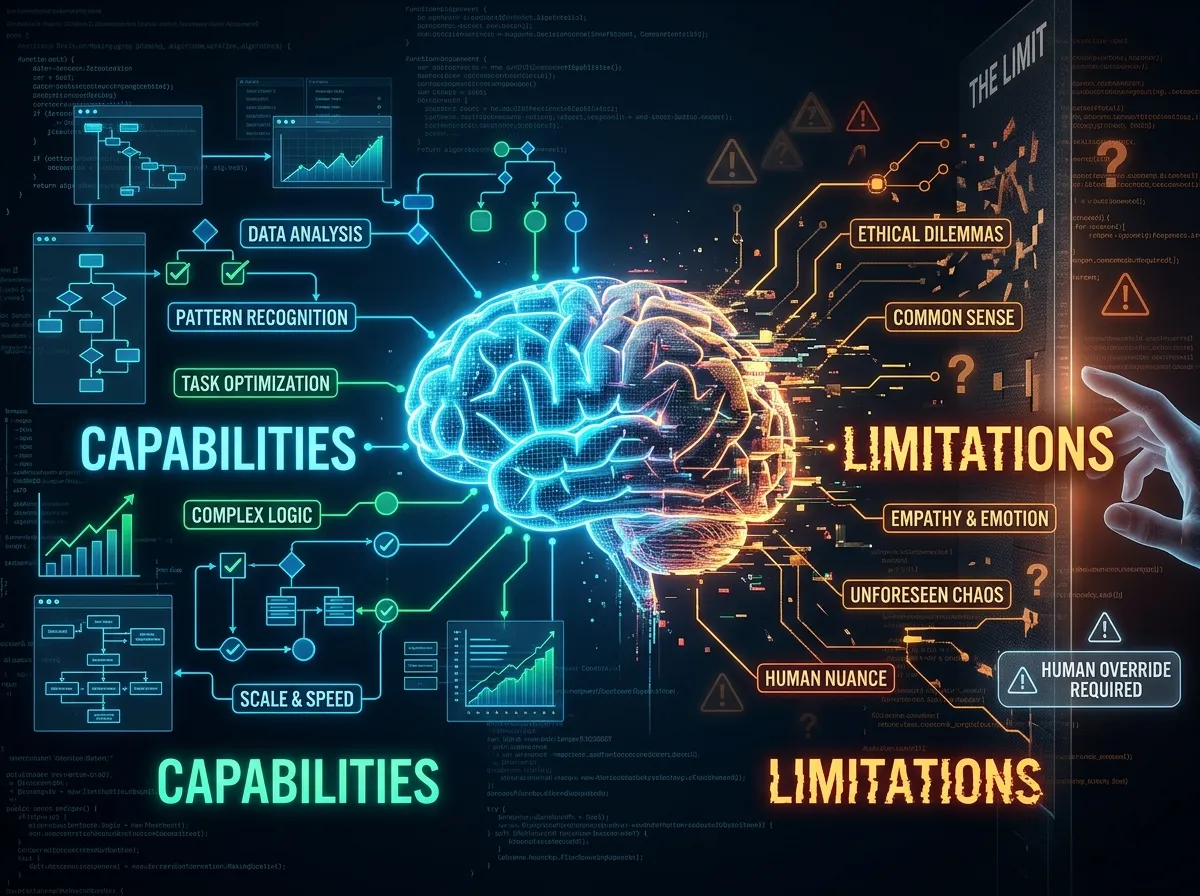
The AI Agent Decision-Making Capabilities of an autonomous system determine how effectively it can respond to changing conditions.
An agent may compare available options, consider constraints, and select an action based on its objective. Some systems can also break a complex task into smaller steps and evaluate the results of each stage.
Nevertheless, AI-generated decisions are not always correct.
Agents can misunderstand instructions, rely on incomplete information, or produce inaccurate conclusions. Their performance may also be affected by ambiguous objectives or unexpected changes in the environment.
This is why businesses should avoid treating autonomous agents as completely independent authorities.
Important decisions involving legal obligations, financial commitments, customer privacy, or significant operational consequences should include appropriate human review.
A reliable system also needs a way to recognize when it cannot complete a task safely. In such situations, it should request clarification, escalate the issue, or stop rather than continue making unsupported decisions.
The goal is not unlimited autonomy. It is dependable decision-making within a controlled environment.
Multi-Agent AI Systems: When One Agent Is Not Enough
Some complex workflows require more than one autonomous agent. Multi-Agent AI Systems involve multiple agents working together, with each system performing a particular role or contributing a different capability.
For example, a market research workflow might include one agent responsible for gathering information, another for analyzing competitors, and a third for organizing findings into a report.
These agents can exchange information and coordinate their activities to complete a larger objective.
A multi-agent approach may improve flexibility because individual agents can focus on specialized tasks. It can also make complex processes easier to organize when responsibilities are clearly separated.
However, coordination introduces additional challenges.
Agents may produce conflicting results, repeat the same work, or pass inaccurate information between one another. The system therefore needs clear communication rules, shared context, and a mechanism for resolving disagreements.
Multi-agent architecture is most useful when a task genuinely benefits from separate responsibilities. Adding more agents to a simple workflow can increase complexity without improving the outcome.
AI Agents for Workflow Automation and Process Efficiency
AI Agents for Workflow Automation are particularly useful when business processes involve multiple applications, changing information, and decisions that cannot be fully described through simple rules.
A workflow might begin when a customer submits a request. An agent can interpret the message, determine the appropriate category, retrieve relevant details, and prepare the next action.
It may then interact with approved business tools to update records, create a task, or notify the appropriate team.
This approach can reduce the need for employees to manually transfer information between systems.
Traditional workflow automation remains an important part of the process. For example, Robotic Process Automation can handle structured, repetitive activities such as copying data, processing forms, or moving information between applications.
Autonomous agents can complement these systems by handling interpretation and decision-making before a predictable automation process begins.
The combination of intelligent agents and established automation creates a practical foundation for more flexible business operations.
Privacy, Data Quality, and Responsible Automation
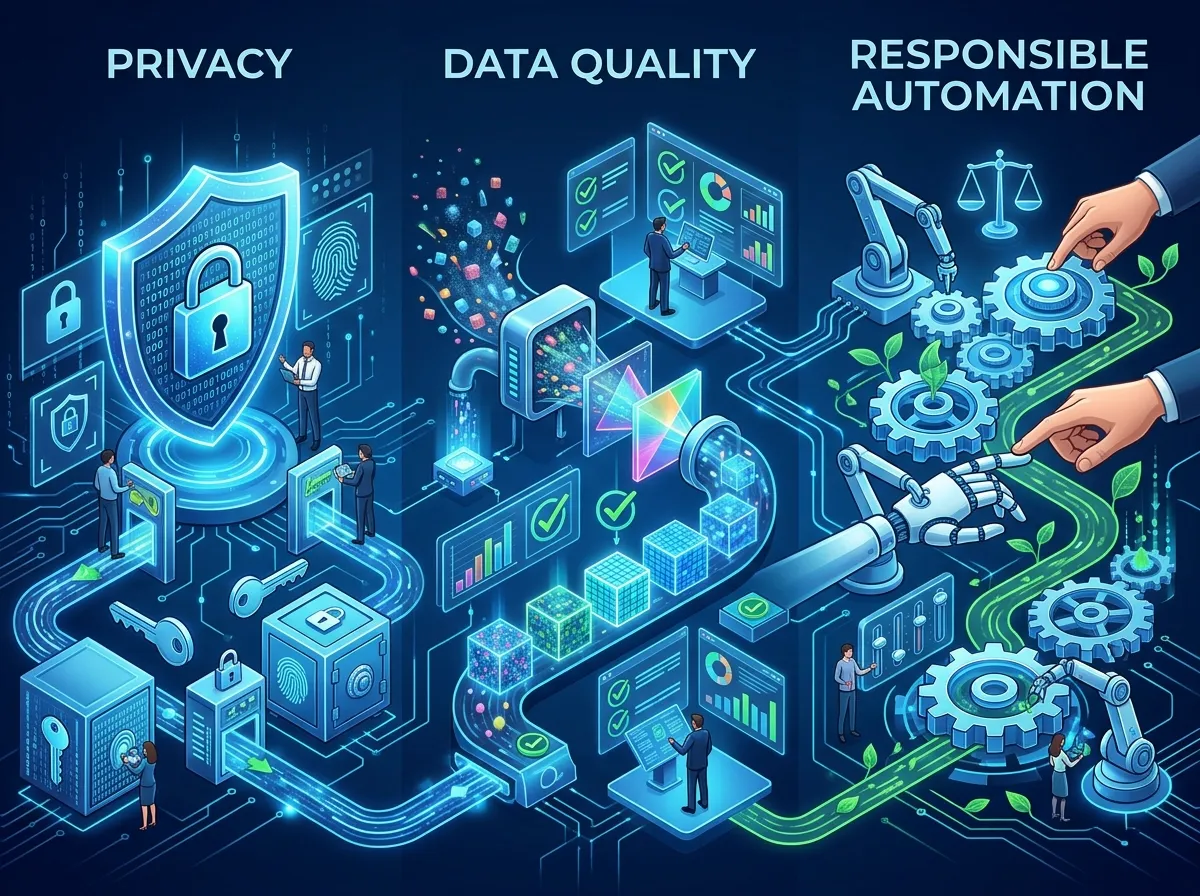
Autonomous AI technology depends heavily on the information it receives. Poor-quality data can lead to inaccurate decisions, while excessive access to sensitive information can create serious security concerns.
Businesses should establish clear data governance practices before deploying autonomous agents.
Agents should only access information that is necessary for their assigned responsibilities. Sensitive records should be protected through appropriate permissions, encryption, and monitoring.
Privacy requirements are also becoming increasingly important as digital advertising and customer tracking practices evolve. Organizations operating in the Cookieless Era need to consider how data availability and consent affect their marketing systems.
Context is equally valuable. Autonomous agents working with advertising or customer research may produce more relevant insights when they understand the surrounding information rather than relying on isolated signals.
This is reflected in Contextual Programmatic Advertising, where relevance is connected to the content and environment in which an advertisement appears.
Responsible automation requires businesses to balance efficiency with transparency, privacy, and appropriate human control.
Autonomous AI Technology Solutions and the Future of Work
The development of Autonomous AI Technology Solutions signals a move toward more capable digital systems that can support entire business processes rather than isolated tasks.
As models improve and software integrations become more accessible, autonomous agents are likely to become increasingly common in everyday business operations.
Their future value will depend on more than technical capability. Organizations will need to design workflows that combine machine efficiency with human judgment, establish clear accountability, and measure performance against meaningful business outcomes. Businesses can also use Webinar Conversion Tracking to understand how webinar campaigns contribute to audience engagement and marketing goals.
Autonomous agents may help employees manage repetitive activities, explore information more efficiently, and respond to operational changes with greater flexibility.
At the same time, human expertise will remain essential for setting objectives, interpreting complex situations, managing relationships, and making decisions that require responsibility or judgment.
The most successful businesses will not necessarily be those that automate everything. They will be those that identify where autonomy creates genuine value and introduce it in a thoughtful, controlled way.
Autonomous AI Agents represent an important development in the evolution of business technology. By combining intelligent decision-making with practical automation, they offer organizations a new way to improve efficiency, support innovation, and build more responsive operations.
Frequently Asked Questions
1. What are Autonomous AI Agents?
Autonomous AI Agents are software systems that can pursue defined goals by gathering information, making decisions, and taking actions with limited human supervision.
2. How do autonomous AI agents work?
They receive an objective, analyze available information, plan suitable actions, use approved tools, and evaluate the results to determine their next steps.
3. What is the difference between AI agents and traditional automation?
Traditional automation generally follows predefined rules and workflows. AI agents can interpret information, make context-based decisions, and adapt their actions within defined limits.
4. How can AI agents help businesses?
They can support customer service, marketing research, sales operations, reporting, document processing, and other workflows that involve repetitive tasks or information-based decisions.
5. What are self-learning AI agents?
Self-learning AI agents are systems that can improve their behavior through feedback, experience, or learning mechanisms. Not all autonomous agents continuously update their underlying models.
6. What are multi-agent AI systems?
Multi-agent AI systems involve multiple agents working together. Each agent may perform a specialized task while coordinating with others to achieve a larger objective.
7. Can autonomous AI agents automate complete workflows?
Yes, they can support multi-step workflows by connecting information gathering, decision-making, and tool-based actions. However, complex or sensitive processes may still require human approval.
8. Are autonomous AI agents reliable?
Their reliability depends on model quality, data accuracy, task design, tool permissions, and monitoring. Human oversight is important for high-impact decisions.
9. What industries use autonomous AI agent applications?
Common applications include marketing, finance, healthcare administration, manufacturing, retail, customer service, and software development.
10. What is the future of autonomous AI technology?
Autonomous AI technology is expected to support more complex business workflows, improve coordination between digital tools, and help employees focus on tasks that require creativity, expertise, and human judgment.