Robotic Process Automation: Transforming Repetitive Work Into Smarter Operations

Robotic Process Automation uses software robots to perform repetitive, rule-based digital tasks across business applications. It helps organizations improve efficiency, reduce manual errors, streamline workflows, and free employees to focus on higher-value responsibilities. With suitable RPA software, clear implementation strategies, strong governance, and ongoing performance monitoring, businesses can automate routine operations and build more productive, reliable processes.
When Routine Work Becomes a Business Bottleneck
Every business depends on processes that must be completed accurately and consistently. Employees send emails, update spreadsheets, enter customer information, process invoices, prepare reports, and transfer data between different systems. Although these activities are necessary, many of them consume valuable time without requiring significant human judgment.
As organizations grow, repetitive work can become a serious operational challenge. Employees may spend hours completing administrative tasks instead of focusing on customer relationships, business development, problem-solving, and strategic decisions. Small errors can also create delays, increase operating costs, and affect the quality of business information.
Robotic Process Automation (RPA) offers a practical way to address these challenges. It uses software-based robots to perform structured digital tasks by interacting with applications, websites, databases, and business systems. These software robots can follow predefined instructions to complete activities that would otherwise require manual effort.
Unlike physical robots used in manufacturing, RPA software operates within digital environments. It can copy information from one system to another, validate records, generate reports, process transactions, and perform other repetitive activities according to established rules.
The value of Robotic Process Automation extends beyond simply completing tasks faster. It helps businesses create more consistent workflows, reduce avoidable mistakes, and use employee time more effectively.
As digital operations become increasingly complex, automation is becoming an important part of how organizations improve efficiency and maintain competitive performance.
Understanding How Robotic Process Automation Works
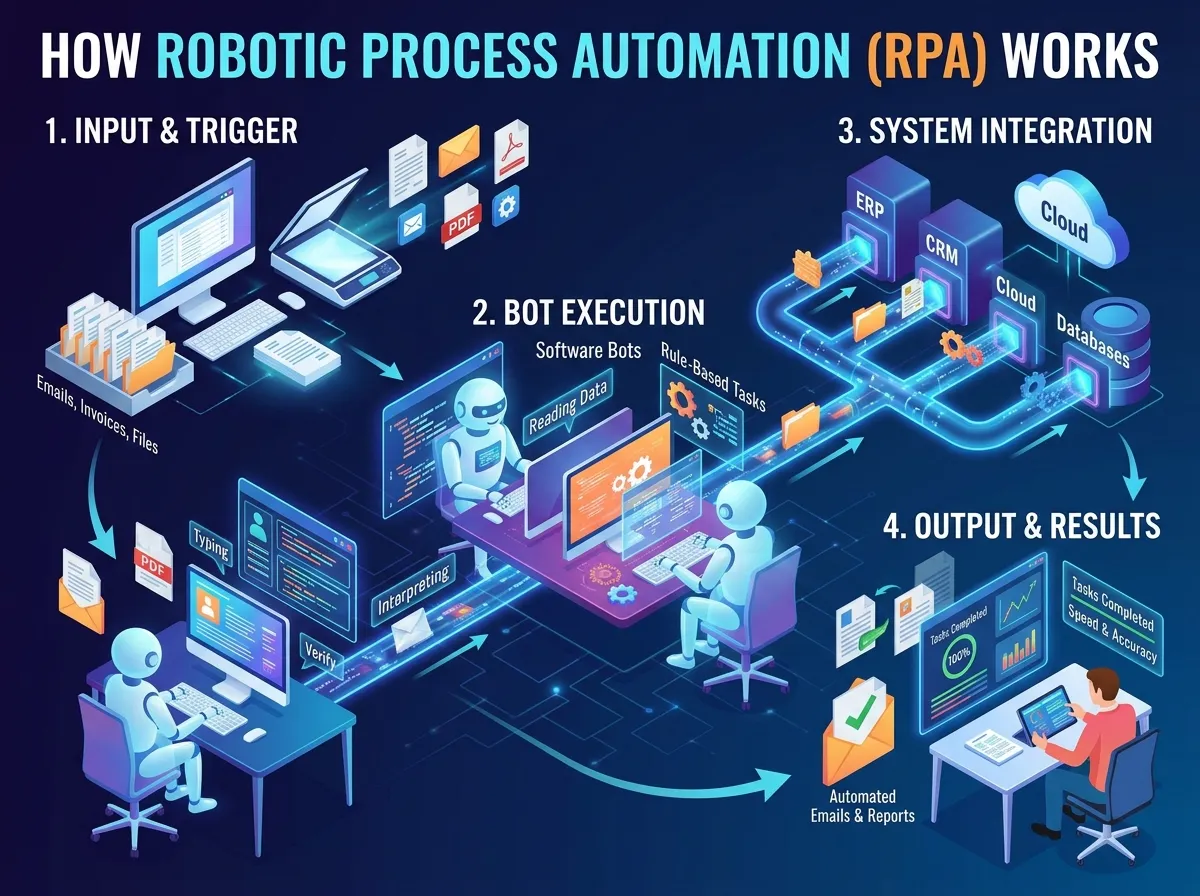
Robotic Process Automation works by using software robots to imitate specific actions performed by human users on digital systems.
A typical automation process begins with a clearly defined task. The software robot receives instructions about what information to collect, which applications to access, what actions to perform, and how to handle the results.
For example, a business may receive customer inquiries through an online form. An RPA bot can collect the submitted information, check whether required fields are complete, enter the details into a customer management system, and notify the appropriate department.
The automation follows predefined rules rather than making independent decisions about every situation.
Many RPA systems interact with applications through user interfaces, while others use APIs or direct system integrations when available. The method depends on the software environment and the requirements of the workflow.
This flexibility allows businesses to automate tasks across different applications without necessarily replacing their existing technology infrastructure.
However, successful automation requires more than creating a bot. The underlying process must be understood, documented, and structured properly. If a workflow contains unclear rules or frequent exceptions, those problems should be addressed before automation begins.
When the process is stable and well-defined, RPA can provide a reliable way to reduce manual workload.
Why Businesses Are Adopting Business Process Automation
Business Process Automation has become increasingly important as organizations look for ways to improve productivity without continuously expanding their workforce.
Many companies rely on multiple software platforms to manage operations. Employees may use separate systems for accounting, customer communication, inventory, reporting, and order processing. Moving information between these platforms can create unnecessary complexity.
Automation helps connect these activities by handling routine steps within the workflow.
Consider an accounting department that receives hundreds of invoices each month. Employees may need to review invoice details, enter amounts into financial software, match records, and prepare payment information.
A suitable automation process can perform many of these structured activities automatically, allowing employees to focus on exceptions, approvals, and financial decisions.
Business Process Automation can also improve consistency. A software robot follows the same defined rules every time it performs a task, reducing the variation that may occur during manual processing.
This does not mean every business activity should be automated. Processes involving complex judgment, sensitive customer interactions, or unpredictable decisions may require human involvement.
The strongest automation strategies identify where software can handle routine work while employees retain responsibility for activities that require expertise and discretion.
Robotic Process Automation Software and Its Practical Capabilities
Robotic Process Automation Software provides the environment businesses use to design, manage, and monitor software robots.
These platforms typically include tools for workflow creation, task scheduling, application interaction, exception handling, and performance monitoring.
Some solutions use visual interfaces that allow users to build automation workflows through drag-and-drop components. Others provide more advanced development capabilities for technical teams that need customized processes.
The capabilities of RPA software vary, but common applications include:
-
Transferring information between business applications.
-
Processing structured documents and records.
-
Updating customer or employee databases.
-
Generating routine reports.
-
Sending notifications and follow-up messages.
-
Validating information against predefined rules.
-
Performing repetitive administrative activities.
Businesses should evaluate software according to their actual operational requirements rather than selecting a platform simply because it offers a large number of features.
For example, a small organization may need a straightforward automation tool for spreadsheet processing and email workflows. A larger enterprise may require centralized bot management, access controls, audit trails, and integration with multiple business systems.
The right platform should support the organization’s current processes while providing enough flexibility for future automation opportunities.
RPA Workflow Automation: Connecting Tasks Into Complete Processes
RPA Workflow Automation becomes more valuable when individual automated tasks are connected into a larger operational process.
A single bot may perform one action, such as extracting information from a document. A complete workflow can coordinate several actions, including validation, data entry, approval requests, and record updates.
For example, an employee onboarding process may involve creating an employee record, preparing account requests, sending welcome information, and updating internal systems.
An automation workflow can handle the structured portions of these activities while directing tasks that require approval to the appropriate person.
This creates a more connected process and reduces the need for employees to manually coordinate every step.
Workflow automation also makes it easier to identify where delays occur. If a process consistently pauses during approval or validation, managers can examine that stage and determine whether the issue is related to system access, unclear responsibilities, or incomplete information.
The objective is not merely to automate individual actions. It is to create a smoother operational experience in which routine tasks move forward consistently and exceptions receive appropriate attention.
Intelligent Process Automation: Combining RPA With Advanced Technologies

Traditional RPA is particularly effective when tasks follow predictable rules and involve structured information. However, modern business environments often contain documents, messages, and data that require additional interpretation.
Intelligent Process Automation expands automation capabilities by combining RPA with technologies such as artificial intelligence, machine learning, natural language processing, and document recognition.
These technologies can help systems interpret information that does not always follow a fixed format.
For example, a traditional bot may transfer invoice data when the document follows a consistent template. An intelligent automation solution may use document recognition to identify invoice numbers, dates, and payment amounts across different layouts.
Similarly, AI-supported systems can help classify customer messages, identify relevant information, or recommend the next step in a workflow.
The distinction is important because RPA itself does not automatically provide human-like understanding. Its core strength is executing defined digital actions. Intelligent technologies can add interpretation and decision support where the process requires more flexibility.
Businesses should introduce these capabilities carefully. Automated decisions involving financial transactions, sensitive information, or customer outcomes may require human review and appropriate controls.
Combining automation with intelligent technologies can create more adaptable workflows, but reliability and accountability should remain central to implementation.
Automated Business Operations and the Changing Role of Employees
Automated Business Operations can change how employees spend their working hours.
When routine administrative tasks are handled by software, employees may have more time to focus on activities that require communication, creativity, analysis, and judgment.
For example, a sales team might spend less time updating customer records and more time preparing for meetings or understanding client requirements.
A marketing department may automate repetitive reporting while concentrating on campaign planning, audience research, and content development.
Automation can also support customer service teams by handling routine information requests and organizing incoming inquiries. Employees can then focus on complex situations that require personal attention.
However, successful automation should not be viewed as a replacement for employee expertise.
Businesses need people who can monitor automated workflows, review exceptions, maintain process quality, and improve the systems over time.
When organizations introduce automation thoughtfully, it can support a more productive relationship between employees and technology.
RPA Implementation Strategies That Support Long-Term Success
RPA Implementation Strategies should begin with understanding the business problem rather than immediately selecting software.
Many automation projects fail to deliver expected results because organizations attempt to automate processes that are poorly documented, unnecessarily complicated, or frequently changing.
A better approach begins with identifying tasks that are repetitive, rule-based, digitally accessible, and performed regularly.
Businesses should also evaluate the amount of time spent on each activity, the frequency of errors, and the potential value of automation.
Once a suitable process is identified, it should be documented in enough detail to explain every important step, decision, and exception.
A small pilot project can help test the workflow before it is introduced across the organization. During this stage, teams can identify technical problems, verify output accuracy, and understand how employees interact with the automated process.
After the pilot demonstrates reliable performance, the business can gradually expand automation to additional tasks.
Employee involvement is particularly important. People who currently perform the process often understand its practical challenges better than anyone else. Their feedback can help identify exceptions that might otherwise be overlooked.
Implementation should also include clear ownership, maintenance responsibilities, and a process for reviewing automation performance.
A successful RPA project is not simply a technical installation. It is an operational improvement that requires planning, testing, and ongoing management.
Robotic Process Automation Tools: Choosing the Right Solution
Robotic Process Automation Tools differ in their development environments, integration options, management capabilities, and pricing structures.
Businesses should consider several factors when evaluating an automation platform.
First, the tool should support the applications used within the organization. If a workflow depends on accounting software, customer databases, or internal portals, the automation platform must interact reliably with those systems.
Second, usability matters. A platform that allows business teams to design straightforward workflows may reduce dependence on specialized developers for routine automation tasks.
Third, security and governance should be evaluated carefully. Automated processes often access business records, customer information, or financial data. Organizations need appropriate permissions, activity logs, and monitoring capabilities.
Scalability is another consideration. A solution that works for a few automated tasks may eventually need to support multiple departments and larger volumes of activity.
Businesses should also examine how the platform handles errors. When a bot encounters missing information or an unexpected system response, it should stop safely, record the issue, or direct the task for human review.
Selecting the right tool requires balancing technical capabilities with operational needs.
Enterprise Process Automation and the Importance of Governance
Enterprise Process Automation involves coordinating automation across multiple departments, applications, and business functions.
As organizations expand their automation programs, they need a consistent approach to managing software robots.
Without proper governance, departments may create separate bots with overlapping responsibilities, inconsistent security settings, or limited documentation.
A centralized governance framework helps establish standards for automation development, deployment, monitoring, and maintenance.
It can also define which processes are suitable for automation and which require additional approval before implementation.
Security is particularly important in enterprise environments. Bots should receive only the permissions required to complete their assigned tasks. Access credentials must be protected, and automated actions should be traceable.
Regular monitoring can identify unusual behavior, failed transactions, or changes in application interfaces that affect bot performance.
Businesses should also maintain documentation describing how each automated process works and who is responsible for it.
Strong governance allows organizations to expand automation without losing control over operational quality, security, and accountability.
RPA Productivity Solutions and Measuring Business Value
RPA Productivity Solutions should be evaluated through meaningful operational outcomes rather than the number of bots deployed.
A business may automate dozens of tasks without achieving significant improvement if those tasks are low-value or poorly designed.
Useful performance indicators include processing time, error frequency, task completion rates, employee time saved, and the cost of handling individual transactions.
For example, a company may previously require 15 minutes to process a standard record manually. After automation, the same task may take only a few minutes of system processing time, with employees reviewing exceptions when necessary.
The business can then evaluate how much capacity has been released and whether that capacity supports more valuable activities.
Productivity measurement should also consider reliability. A bot that processes tasks quickly but frequently produces errors may create additional work rather than reducing it.
The most meaningful results combine speed, accuracy, consistency, and business impact.
Organizations should establish a baseline before introducing automation so they can compare performance fairly. Similar to maintaining consistent standards through Influencer Approvals, a structured review process helps businesses monitor quality and ensure that automated workflows meet their operational expectations.
Automation of Repetitive Tasks Across Different Business Functions
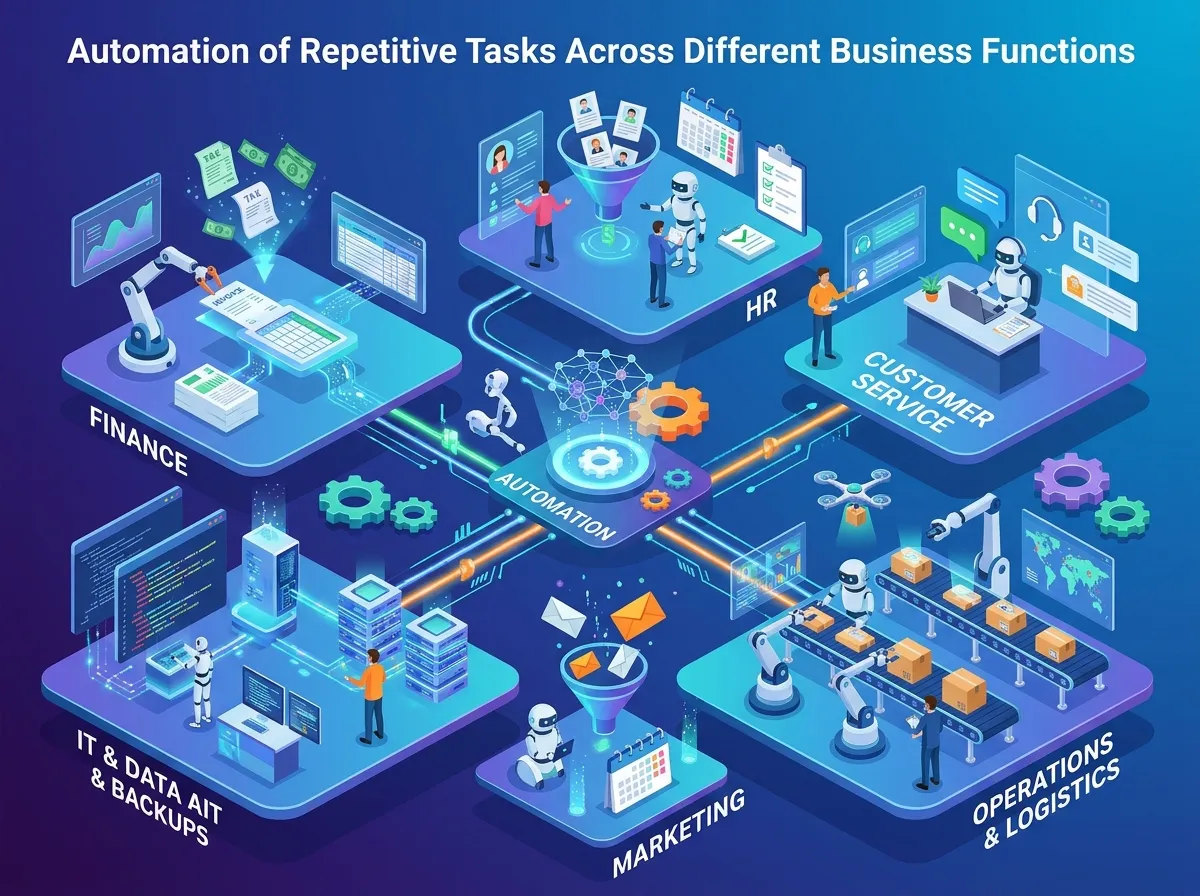
Automation of Repetitive Tasks can support a wide range of departments because many business functions depend on structured digital activities.
In finance, RPA can assist with invoice processing, transaction reconciliation, and routine report preparation.
In human resources, it can support employee record updates, document distribution, and onboarding administration.
In sales, software robots can help organize customer information, update records, and prepare routine notifications.
Marketing teams may use automation to collect campaign data, organize reports, and transfer information between platforms.
For example, digital advertising operations involve multiple systems, campaign records, and performance reports. Businesses that manage Programmatic Advertising for Customer Acquisition may use automation to support structured reporting and data management activities around their advertising workflows.
Automation can also assist with information collection in advertising environments that use Cookieless Programmatic Advertising, provided that the processes respect privacy requirements and applicable data policies.
For teams developing their advertising knowledge, resources such as Master Programmatic Advertising can provide additional context about the broader technology and operational environment in which automation may be used.
These examples demonstrate that RPA is not limited to one industry. Its usefulness depends on whether a process contains repeatable digital activities that can be handled reliably.
Conclusion: Creating More Efficient Businesses With RPA
Robotic Process Automation provides businesses with a practical way to reduce repetitive digital work, improve process consistency, and make better use of employee time.
Its value comes from identifying the right tasks and designing reliable workflows rather than automating every available activity.
When organizations combine suitable software, clear implementation strategies, effective governance, and meaningful performance measurement, RPA can become an important part of their operational improvement efforts.
The technology is particularly useful for structured processes that involve predictable rules and frequent interactions with digital systems. More complex activities may benefit from intelligent automation or continued human involvement.
As businesses continue to adopt digital tools, automation will play an increasingly important role in connecting systems and simplifying routine operations.
Ultimately, successful RPA is not about replacing the human contribution. It is about allowing technology to handle repetitive work so people can focus on decisions, relationships, and activities that create greater business value.
10 Frequently Asked Questions
1. What is Robotic Process Automation?
Robotic Process Automation is a technology that uses software robots to perform repetitive digital tasks by following predefined rules and interacting with business applications.
2. How does RPA work?
RPA software follows programmed instructions to access systems, collect or transfer information, complete tasks, and report results. It can interact with applications through user interfaces, APIs, or other supported integrations.
3. What are the main benefits of Robotic Process Automation?
RPA can reduce repetitive manual work, improve processing consistency, minimize certain errors, increase productivity, and help businesses use employee time more effectively.
4. What is the difference between RPA and business process automation?
RPA focuses on software robots performing specific digital tasks. Business Process Automation is a broader concept that includes improving and automating entire business workflows through technology.
5. Which business processes are suitable for RPA?
Suitable processes are usually repetitive, rule-based, digitally accessible, and performed frequently. Examples include data entry, invoice processing, report generation, and routine record updates.
6. What is Intelligent Process Automation?
Intelligent Process Automation combines RPA with technologies such as artificial intelligence, machine learning, and document recognition to support workflows involving more complex information.
7. Is RPA suitable for small businesses?
Yes. Small businesses can use RPA to automate routine administrative tasks, manage information more efficiently, and reduce repetitive workloads. The selected solution should match their operational needs and budget.
8. How should businesses implement RPA?
Businesses should identify suitable processes, document workflows, select appropriate software, test a pilot project, train employees, and monitor performance before expanding automation.
9. What are the common challenges of RPA implementation?
Common challenges include poorly documented processes, changing application interfaces, inadequate testing, security concerns, limited employee involvement, and insufficient maintenance.
10. How can businesses measure RPA success?
Businesses can measure success through processing time, task accuracy, completion rates, employee time saved, operational costs, and the overall value created by automated workflows.