Shaping the Future of Advertising with Programmatic Advertising News

Shaping the Future of Advertising with Programmatic Advertising News highlights how real-time, automated ad technologies and data-driven insights are transforming marketing strategies, improving targeting, engagement, and ROI across digital platforms.
Nor is programmatic advertising a code word anymore; it is leading businesses to consider how they approach all issues and strategies where customer interfacing relies on the tip of one’s tongue. It requires an understanding not only of what’s happening now, but some guess as to where things might be headed in the future when equipped with innovative technology strategies. From advancements in AI to real-time bidding revolutions, the evolution of programmatic advertising is a fast-moving train that no business can afford to miss.
What is Programmatic Advertising
Before you delve into the latest trend, you need to know what programmatic advertising is. It is simply the use of technology and math equations for the purchase and sale of advertising space in real time. Think buying or selling an ad digitally, but on steroids: much faster and far more efficient due to automated formulas.
Programmatic platforms use AI and real-time data instead of traditional negotiations to deliver highly responsive ads to their target audiences. Optimization tools allow advertisers more efficiency, and thus a higher ROI.
Current Innovations in Programmatic Advertising
The Powerhouse of Artificial Intelligence
Artificial intelligence (AI) is taking programmatic advertising to unprecedented levels. By analyzing data sets in real time, AI tools can better predict consumer behavior, automate targeting adjustments, and recommend optimal budget spending.
Recommended Example: Google’s DV360 now uses AI to identify ad placement opportunities that are likely to achieve the highest user engagement. AI not only helps with ad placements but also predicts potential consumers who would interact the most with an ad.
Connected TV and Programmatic Advertising
The rise of connected TV (CTV) has brought programmatic advertising into living rooms. Unlike linear TV, where the same ad is shown to everyone, programmatic CTV lets advertisers deliver more targeted messaging to specific audiences based on viewing data. This allows brands to bridge the gap between traditional TV viewers and digital platforms, making campaigns smarter and measurable. According to eMarketer, programmatic ad spending on CTV jumped by over 30% last year and is expected to grow even more as streaming platforms increase their advertising inventories.
The Shift Towards Privacy-First Ad Strategies
With changes in data privacy policies, advertisers are moving away from relying on third-party cookies. Tools like contextual advertising and first-party data collection are becoming key pillars of programmatic advertising.
New technologies are rising to take center stage, such as Apple’s SKAdNetwork and Google’s Privacy Sandbox, allowing for effective advertising while safely protecting consumers’ privacy.
Programmatic Advertising Meets Blockchain for Transparency
The world of ad buying often suffers from issues of fraud, lack of transparency, and hidden fees. Blockchain technology steps in to offer a transparent, decentralized system where advertisers, publishers, and even consumers can track advertising.
Several networks today are experimenting with blockchain-based solutions to display which inventory is genuine and whether the metrics reported are accurate.
Example to Watch: MAD Network is one blockchain-based initiative gaining momentum by guaranteeing transparency for programmatic advertisers.
Programmatic Advertising’s Application Across Industries
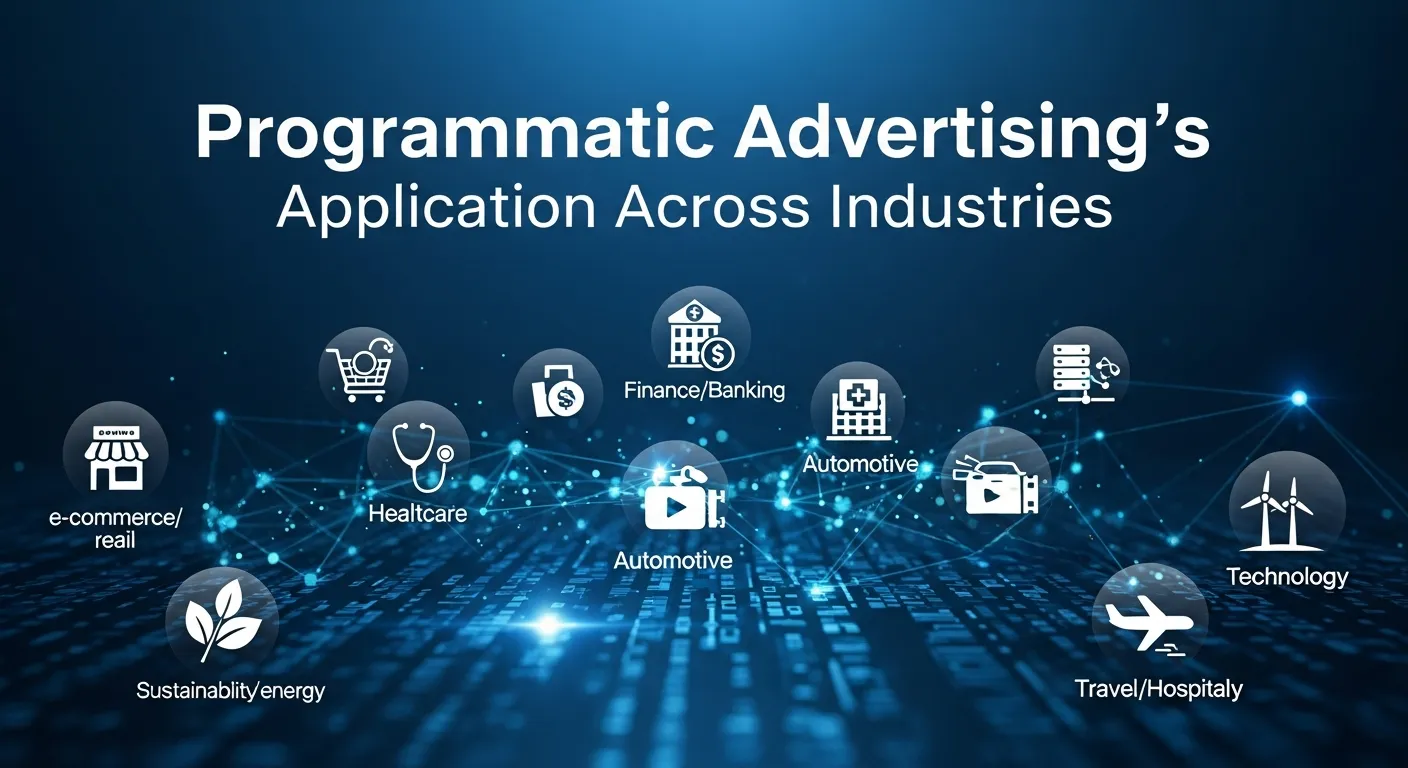
Almost every sector is benefiting from programmatic advertising. Here’s a spotlight on three key industries:
Retail
- Retail marketers are using programmatic platforms to serve dynamic ads showcasing products consumers have viewed or added to their carts.
- With predictive AI, they’re even suggesting complementary products in ads, increasing upselling opportunities.
Travel
- The travel industry relies heavily on data to attract customers.
- Programmatic advertising allows businesses to show personalized pricing and promotions based on a visitor’s browsing history and location.
- This makes offers highly relevant to their audience.
Healthcare
- While healthcare is traditionally cautious with digital advertising due to regulations, programmatic advertising allows the targeting of specific health audiences based on anonymized data.
- For example, ads for specialists like telemedicine services now reach the people who need them most.
Key Challenges Facing Programmatic Advertising
Programmatic advertising is brimming with potential, but its adoption comes with challenges:
Ad Fraud
- Click fraud and bot traffic remain the primary concerns for advertisers.
- While new tools like ads.txt and Supply Path Optimization are combating fraud, brands must maintain vigilance.
Privacy Regulations
- With the increasing need to comply with GDPR, CCPA, and other regulations, advertisers need to rethink their user-data strategies.
- Ensuring compliance without sacrificing targeting capabilities is a fine balance.
Complexity for Beginners
- Programmatic advertising platforms often require specialized skills to operate effectively.
- Understanding how to set up campaigns, manage bids, and monitor performance can overwhelm smaller businesses and newcomers to the space.
Solution in Progress
-
Agencies and platforms are now combining training resources with user-friendly dashboards to make programmatic advertising more accessible even to those with limited experience.
Programmatic Audio Advertising: Reaching Audiences Through Sound
While programmatic TV and display are well-known, programmatic audio advertising is emerging as a powerful channel for marketers. This approach leverages streaming platforms, podcasts, and digital radio to deliver ads automatically to listeners based on demographic, behavioral, and contextual data.
Key Benefits:
- Highly targeted engagement: Ads reach listeners who match specific interests, locations, or listening habits.
- Dynamic creative insertion: Ads can adapt in real-time to listener behavior or context.
- Cross-device reach: Audio ads complement mobile, desktop, and smart speaker environments.
Example Applications:
- A fitness brand targeting users of workout playlists on streaming platforms.
- A travel company promoting last-minute deals during travel podcasts.
- Local restaurants running geo-targeted audio promotions to nearby listeners.
This section introduces a fresh dimension of programmatic advertising for engagement that extends beyond visual channels.
Programmatic Advertising ROI Measurement and Optimization

Many marketers underestimate the complexity of measuring and optimizing ROI in programmatic campaigns. A dedicated section on programmatic-advertising strategies for success can help readers navigate this challenge.
Key Steps:
- Set clear KPIs: CTR, viewability, conversions, and cost per acquisition (CPA).
- Use multi-touch attribution models: Track consumer interaction across display, video, audio, and CTV.
- Leverage AI-driven insights: Platforms like DV360 or Google Ads can recommend bid adjustments and audience refinements automatically.
- A/B Test creative and targeting: Continuously test messaging, formats, and placements.
ROI Comparison Programmatic vs Traditional Media
| Metric | Programmatic Advertising | Traditional Media Buying |
|---|---|---|
| Targeting | Highly granular & data-driven | Broad and generalized |
| Cost Efficiency | Pay for actual impressions or clicks | Fixed upfront costs |
| Optimization | Real-time adjustments | Post-campaign analysis |
| Reporting | Detailed analytics, dashboards | Limited insights |
| Engagement | Interactive and dynamic | Passive, static ads |
This table highlights how digital programmatic advertising maximizes ROI compared to older advertising methods.
Cross-Device Programmatic Strategies for a Connected Audience
Consumers no longer interact with a single device. Understanding programmatic advertising SEM strategy across devices can elevate campaign effectiveness.
Key Insights:
- Unified Audience Profiles: Merge desktop, mobile, tablet, and CTV behavior for cohesive targeting.
- Sequential Messaging: Show different ad creatives across devices to guide users along the conversion funnel.
- Frequency Management: Prevent overexposure by tracking impressions across devices.
- Attribution Accuracy: Ensure each device interaction contributes correctly to conversion reporting.
Best Practices:
- Use programmatic dashboards that integrate cross-device data.
- Align creative formats to device context (shorter videos for mobile, interactive ads for desktop).
- Apply AI to optimize bidding across devices simultaneously.
This section addresses the future trend of cross-device programmatic advertising, an area not covered in your original article but critical for holistic campaigns.
The Future of Programmatic Advertising
The future of programmatic advertising is poised for tremendous growth, driven by rapid technological advancements, evolving consumer behavior, and a strong shift toward data-driven marketing. As brands and marketers continue to adopt programmatic strategies, the landscape will become increasingly dynamic, personalized, and cross-channel.
AI-Powered Hyper-Personalization
- Artificial intelligence and machine learning will continue to enhance targeting capabilities.
- Ads will be dynamically tailored to each consumer’s preferences, behavior, location, and device.
- Predictive analytics will allow advertisers to anticipate audience needs before they actively search, boosting engagement and conversions.
Cross-Device and Omnichannel Campaigns
- Consumers interact with brands across multiple devices — smartphones, tablets, desktops, smart TVs, and IoT devices.
- Future programmatic campaigns will unify these interactions into a single coherent experience.
- Sequential messaging across devices will guide users through the marketing funnel seamlessly.
Enhanced Privacy and Compliance-First Advertising
- With stricter regulations like GDPR, CCPA, and browser-level cookie restrictions, advertisers will need privacy-first solutions.
- First-party data, contextual targeting, and privacy-safe modeling will dominate programmatic campaigns.
- This ensures relevance while respecting consumer data, building trust and brand loyalty.
Integration of Emerging Technologies
- Technologies such as blockchain may be used to ensure transparency in ad placements and metrics.
- Augmented reality (AR) and virtual reality (VR) ads could be integrated programmatically, especially for immersive brand experiences.
- Connected TV and programmatic audio will continue expanding, giving advertisers new channels to reach niche audiences.
Real-Time Optimization and Automation
- Programmatic platforms will increasingly rely on AI to automatically adjust bids, creative formats, and targeting in real time.
- Campaigns will optimize continuously, ensuring higher ROI and minimizing wasted spend.
- Performance metrics will become more predictive rather than reactive, enabling smarter decision-making.
Why Early Adoption Matters:
- Competitive Advantage: Brands that implement programmatic advertising now will have the data, audience insights, and optimized workflows in place before competitors catch up.
- Data Mastery: Early adopters will accumulate first-party data faster, enabling better personalization and smarter targeting.
- Adaptability: Companies familiar with AI-driven and cross-device programmatic strategies will be more agile in responding to new technologies or privacy changes.
Actionable Takeaways:
- Invest in AI tools that enhance personalization and real-time optimization.
- Develop cross-device marketing strategies to create unified consumer experiences.
- Prioritize privacy-safe data collection methods and comply with evolving regulations.
- Test emerging channels such as programmatic audio, AR/VR ads, and connected TV placements.
In short, the future of programmatic advertising is highly personalized, fully automated, privacy-conscious, and omnichannel-focused, offering brands unprecedented opportunities to reach the right audience at the right moment. Businesses that embrace these trends now will not only stay ahead of the curve but also build long-term competitive advantages in the evolving digital landscape.
Actionable Next Steps
Want to stay ahead of the curve in programmatic advertising?
- Keep track of the latest industry updates. Platforms like eMarketer and Digiday often analyze upcoming trends in advertising technology.
- Experiment with new tools like AI-driven ad platforms.
- Partner with a trusted programmatic provider to assess your ad strategy and ROI potential.
Stay informed, adapt to changes, and boldly invest in programmatic strategies to maximize your advertising game.
Frequently Asked Questions (FAQs) on Programmatic Advertising News
1. What is programmatic advertising?
Programmatic advertising is the automated buying and selling of digital ad space using AI and real-time bidding, allowing brands to target audiences efficiently and optimize campaigns for higher ROI.
2. How does programmatic advertising work?
Programmatic advertising uses algorithms, AI, and data analytics to automatically purchase ad inventory and deliver the right message to the right audience at the right time across digital platforms.
3. What is programmatic-audio-advertising?
Programmatic audio advertising delivers targeted ads on streaming platforms, podcasts, and digital radio. It enables dynamic, real-time insertion based on listener demographics, behavior, and context, enhancing engagement.
4. How does programmatic display advertising differ from traditional advertising?
Programmatic display advertising leverages data-driven targeting, real-time optimization, and AI insights, while traditional media buying relies on fixed schedules and broader audience segments with limited real-time adjustments.
5. How does programmatic TV advertising work?
Programmatic TV advertising targets viewers on connected TV (CTV) and streaming platforms using real-time bidding and audience data. It enables precise targeting and measurable results compared to linear TV ads.
6. What are the main benefits of programmatic advertising for engagement?
Programmatic advertising enhances engagement by delivering highly relevant ads across multiple channels, personalizing messaging, optimizing in real time, and reaching audiences across devices like mobile, desktop, CTV, and audio.
7. How can I measure ROI in programmatic advertising campaigns?
Marketers can track ROI using metrics such as CTR, conversions, CPA, and viewability. Multi-touch attribution, AI-driven insights, and continuous A/B testing further help optimize performance across channels.
8. What are common challenges in programmatic advertising?
Challenges include ad fraud, compliance with privacy regulations (GDPR, CCPA), and complexity in managing automated campaigns. Using verification tools, privacy-safe methods, and expert support can mitigate these risks.
9. Why is programmatic buying better than traditional media buying?
Programmatic buying offers precision targeting, dynamic optimization, cost efficiency, real-time reporting, and cross-channel reach, giving advertisers better ROI and campaign performance than traditional media buying.
10. Why is it important to follow programmatic advertising news?
Programmatic advertising news keeps marketers updated on AI innovations, emerging channels (CTV, audio, AR/VR), privacy regulations, and best practices, ensuring campaigns remain competitive and effective in a fast-evolving landscape.
New to the concept of automated ad buying? Don’t miss our full breakdown on Mastering Real Time Bidding in Programmatic Advertising