Programmatic Guaranteed Buying: A Smarter Way to Secure Ad Inventory

Programmatic Guaranteed Buying allows advertisers to reserve digital advertising inventory through automated agreements with publishers. By confirming pricing, placements, and impression commitments in advance, businesses gain greater campaign predictability and access to selected inventory. This approach combines the reliability of direct advertising with programmatic technology, making it valuable for premium placements, retail media campaigns, and structured digital advertising strategies.
Digital advertising has changed significantly as businesses look for more reliable ways to reach their target audiences. Traditional media buying often involves lengthy negotiations, manual agreements, and uncertainty around available advertising placements. Programmatic technology has simplified many of these processes by allowing advertisers and publishers to manage transactions through automated platforms.
However, not every advertising campaign benefits from purchasing inventory through open auctions. Some brands require greater control over where their advertisements appear, how many impressions they receive, and when their campaigns are delivered. This is where Programmatic Guaranteed Buying becomes particularly valuable.
Programmatic Guaranteed Buying is an advertising arrangement in which advertisers and publishers agree on inventory, pricing, and delivery conditions before campaign execution. The transaction is then managed through programmatic technology, reducing manual work while providing greater certainty around advertising placements.
For advertisers, this approach offers predictable inventory access and improved campaign planning. Publishers benefit from secured demand and more organized inventory management. Both parties can establish clear expectations before advertisements begin running.
As digital advertising becomes more sophisticated, understanding how guaranteed buying works can help businesses make better media investment decisions. From automated media buying to reserved advertising inventory, this model provides a structured way to combine the efficiency of programmatic technology with the reliability of direct advertising agreements.
What Makes Programmatic Guaranteed Buying Different?
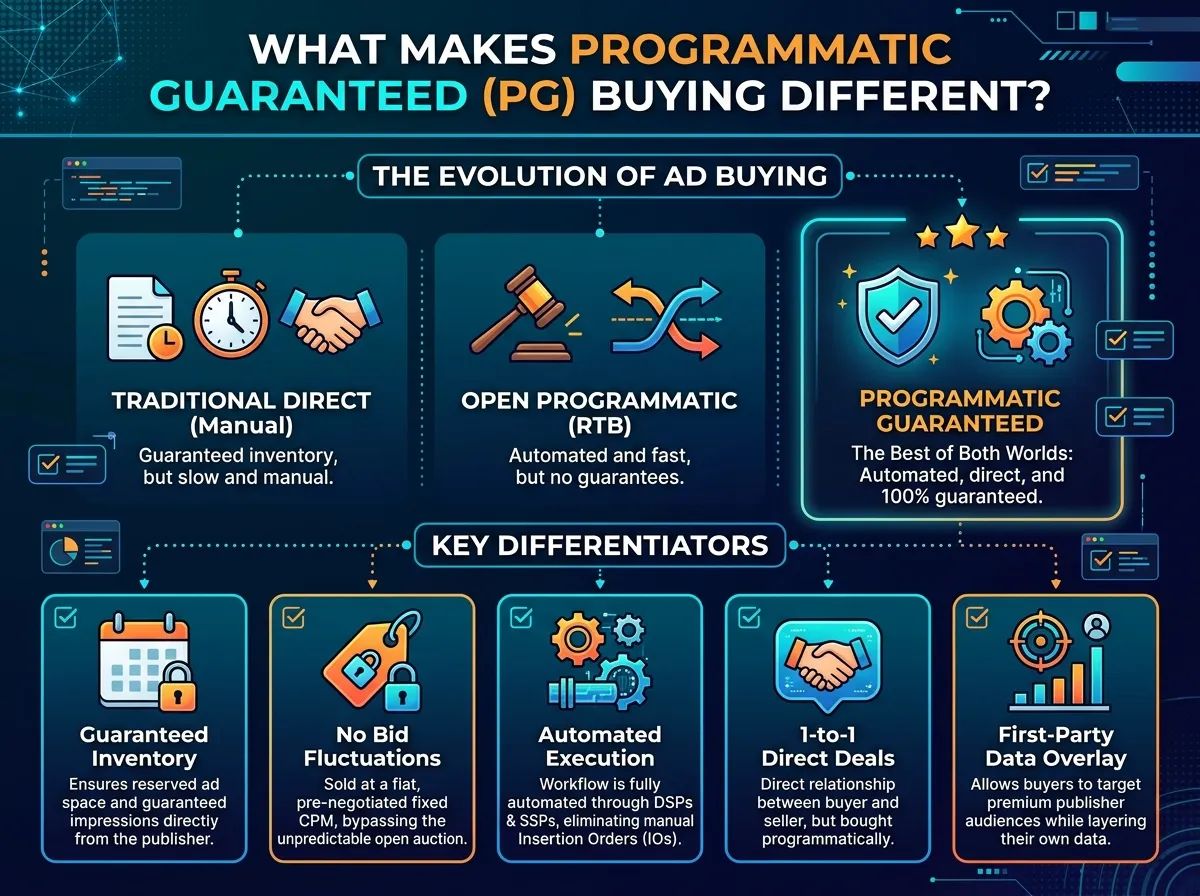
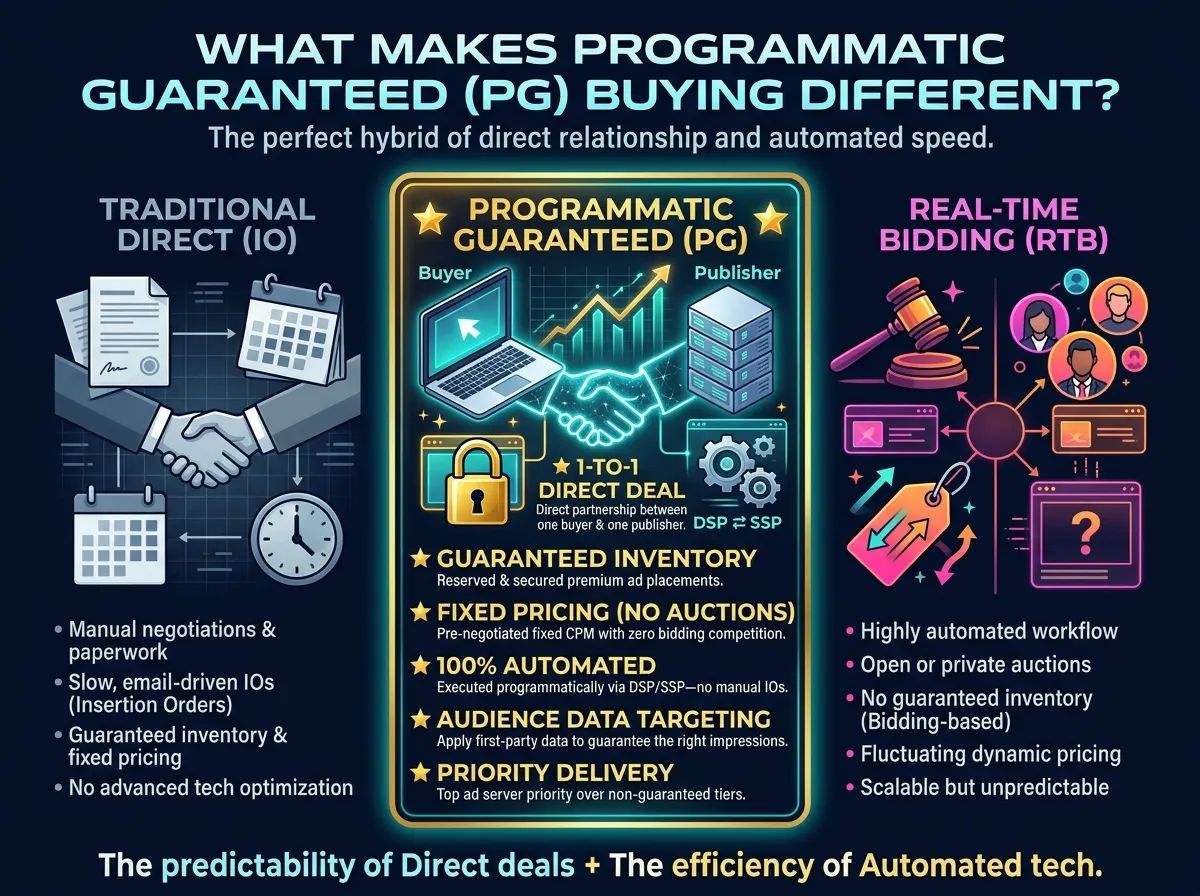
Programmatic Guaranteed Buying combines the certainty of traditional direct media agreements with the automation of modern advertising technology.
In a conventional direct advertising arrangement, an advertiser negotiates with a publisher to secure specific placements. Both parties agree on pricing, campaign duration, and expected delivery. Programmatic Guaranteed Buying follows a similar commercial structure, but the transaction is executed through an advertising platform.
The important distinction is that inventory is reserved in advance. Advertisers and publishers establish the terms of the agreement before impressions are delivered.
For example, a financial services company may want to reach business professionals through a well-known industry publication. Instead of competing for impressions through an open auction, the advertiser can arrange a guaranteed deal with the publisher. The agreement specifies the inventory, price, audience requirements, and delivery period.
Once the agreement is established, the programmatic platform handles the advertising transaction automatically.
This approach is particularly useful when campaigns require specific placements, predictable delivery, or access to premium publisher inventory.
Unlike open-market advertising, where impression availability and pricing can change during bidding, guaranteed buying provides a more structured purchasing environment.
Why Advertisers Are Moving Toward Guaranteed Ad Inventory
Advertising budgets need to deliver measurable results. However, campaigns that depend entirely on open auctions can sometimes create uncertainty around inventory availability, placement quality, and delivery consistency.
Guaranteed ad inventory addresses some of these concerns by allowing advertisers to secure placements before campaigns begin.
One important advantage is improved campaign predictability. Advertisers can plan around agreed inventory volumes instead of depending entirely on auction availability. This is especially useful for seasonal campaigns, product launches, and major promotional activities.
Another benefit is greater control over publisher selection. Brands can establish agreements with publishers whose audiences closely match their target markets. This makes it easier to maintain relevance and consistency across advertising placements.
Inventory reservation can also support better budget planning. When pricing and delivery expectations are agreed upon in advance, advertisers can allocate campaign budgets with greater confidence.
For publishers, guaranteed agreements create more predictable revenue opportunities. Instead of relying exclusively on available auction demand, publishers can reserve portions of their advertising inventory for confirmed campaigns.
This arrangement creates value for both sides, provided that the agreed delivery requirements and campaign conditions are properly managed.
How Programmatic Direct Advertising Works
Programmatic direct advertising describes the broader process of buying advertising inventory directly from publishers through programmatic technology.
Rather than manually coordinating every impression, advertisers and publishers use advertising platforms to establish and execute their agreements.
The process generally begins when an advertiser identifies a publisher or inventory source that matches its campaign objectives. Both parties then discuss important commercial details, including pricing, audience requirements, impression volume, and campaign duration.
Once the terms are agreed upon, the publisher makes the selected inventory available through the programmatic platform.
The advertiser’s demand-side platform (DSP) and the publisher’s supply-side platform (SSP) communicate to facilitate the transaction. When an eligible advertising opportunity becomes available, the system checks the agreement and serves the appropriate advertisement.
This automated process reduces the administrative workload associated with traditional media buying.
It is important to understand that programmatic direct advertising includes more than one type of buying arrangement. Programmatic Guaranteed is one model, while Preferred Deals offer negotiated access to inventory without guaranteed impression delivery.
The distinction matters because advertisers need to select the purchasing method that matches their campaign requirements.
The Relationship Between Guaranteed Buying and Private Marketplace Advertising
Private marketplace advertising is another important part of the programmatic ecosystem. Although it can offer advertisers access to premium publisher inventory, it does not automatically provide guaranteed delivery.
A private marketplace (PMP) is an invitation-based advertising environment where selected advertisers can access inventory through a controlled auction.
Publishers use these arrangements to maintain greater control over which advertisers can purchase their inventory. Advertisers benefit from access to selected publishers, potentially higher-quality placements, and more controlled buying environments.
Programmatic Guaranteed Buying works differently because the advertiser and publisher agree on inventory and delivery conditions in advance.
Consider a brand planning a large advertising campaign around a major sporting event. The advertiser may need a specific number of impressions across selected publisher placements. A guaranteed agreement can secure that inventory before the event begins.
By comparison, a private marketplace deal may provide access to similar premium placements, but impressions are generally purchased through an auction and are not necessarily guaranteed.
Both approaches have useful applications. The right choice depends on whether the campaign prioritizes guaranteed delivery or auction-based access to selected inventory.
Automated Media Buying and the Role of Advertising Technology
Automation is one of the biggest advantages of programmatic advertising. It allows advertisers and publishers to manage complex transactions without relying on manual processes for every advertising opportunity.
In guaranteed buying, automation begins after the commercial agreement has been established.
Advertising platforms help manage campaign activation, impression eligibility, creative delivery, and reporting. These capabilities make it easier to execute large advertising agreements across multiple digital properties.
For advertisers, demand-side platforms provide centralized campaign management. Teams can coordinate their creative assets, targeting requirements, budgets, and delivery expectations from one environment.
Publishers use supply-side platforms to manage available inventory, establish deal terms, and connect advertising opportunities with eligible buyers.
Automation also improves operational visibility. Campaign teams can monitor impression delivery, identify pacing problems, and review performance information throughout the campaign.
However, automation does not eliminate the need for human oversight. Incorrect targeting settings, creative problems, inventory limitations, or poorly configured deal terms can still affect campaign performance.
The strongest automated media buying strategies combine efficient technology with careful planning and ongoing campaign management.
Planning Programmatic Ad Deals Around Campaign Objectives
Not every advertising campaign needs the same type of inventory agreement. Some brands prioritize reach, while others focus on specific audience segments, premium placements, or consistent visibility throughout a particular period.
Programmatic ad deals should reflect these differences.
For example, an established consumer brand preparing for a seasonal promotion may need high impression volumes during a limited advertising window. A B2B company, on the other hand, may prioritize a smaller number of carefully selected publisher placements that attract industry professionals.
Before finalizing an agreement, advertisers should consider several commercial and operational factors.
The first is audience relevance. Inventory should provide access to users who are likely to be interested in the advertised products or services.
The second is placement quality. Advertisers need to understand where their creatives will appear and whether those environments align with their brand expectations.
Delivery requirements are equally important. Impression commitments should be realistic and supported by the publisher’s available inventory.
Pricing should also reflect the value of the placement, audience, and campaign requirements. A premium publisher may charge higher rates, but the additional investment should support a meaningful advertising objective.
When these considerations are aligned, programmatic guaranteed agreements become more effective and easier to manage.
Reserved Advertising Inventory and Campaign Reliability
Reserved advertising inventory gives advertisers greater certainty about future placements. It is particularly valuable when campaigns depend on reaching audiences during specific periods.
Imagine an online retailer preparing for a major shopping season. The company expects increased competition for advertising placements and wants to secure visibility across relevant digital publications.
By arranging reserved inventory in advance, the retailer can establish a delivery agreement before demand increases.
This provides an advantage when advertising opportunities become more competitive.
Reserved inventory also supports better coordination between creative production and campaign scheduling. Marketing teams can prepare their advertisements based on confirmed campaign dates and placements.
For publishers, inventory reservation helps organize future demand and allocate available advertising space more effectively.
However, reservation does not mean that every possible campaign outcome is guaranteed. Advertisers should distinguish between guaranteed impression delivery and business performance. A publisher may commit to delivering impressions, but it cannot guarantee conversions, purchases, or revenue.
Clear agreements help both parties understand exactly what is being secured.
Managing Real-Time Ad Buying Alongside Guaranteed Campaigns
Real-time ad buying is commonly associated with real-time bidding (RTB), where advertising impressions are purchased through automated auctions.
Although Programmatic Guaranteed Buying and RTB use similar advertising infrastructure, their purchasing mechanisms are different.
In RTB, advertisers compete for individual impressions based on their bidding strategies. Pricing and availability depend on auction conditions.
In guaranteed buying, the advertiser and publisher have already agreed on the commercial terms and inventory commitments. The system executes the deal according to those conditions rather than conducting a new competitive auction for each impression.
This difference does not mean that guaranteed campaigns operate without real-time technology. Programmatic platforms still use automated processes to identify eligible opportunities and deliver advertisements.
Many advertisers combine both approaches within the same media strategy.
For instance, a company may reserve premium placements through guaranteed deals while using real-time auctions to reach additional audiences across the open advertising market.
This combination provides a balance between predictable inventory access and flexible campaign reach.
Programmatic Campaign Management: Maintaining Delivery and Performance
Securing advertising inventory is only one part of a successful campaign. Advertisers must also ensure that the agreed impressions are delivered properly and that campaign activity remains aligned with business objectives.
Programmatic campaign management involves monitoring delivery, reviewing performance, coordinating creatives, and resolving technical issues.
One important consideration is campaign pacing. Advertisers need to understand whether impressions are being delivered according to the agreed schedule. If delivery is too slow, the campaign may struggle to meet its commitment before the end date.
Creative management is another essential responsibility. Advertisements should meet publisher specifications and display correctly across supported devices and placements.
Advertisers should also monitor viewability, invalid traffic, brand safety, and audience quality. Guaranteed impression delivery does not automatically mean that every impression provides equal value.
Reporting helps teams understand campaign progress and identify areas that require attention. When delivery problems appear, advertisers and publishers can review the agreement, inventory availability, and technical settings.
Clear communication between both parties is important throughout this process.
Effective campaign management ensures that the guaranteed buying arrangement delivers the inventory it promises while supporting broader advertising objectives.
The Importance of Digital Ad Inventory Reservation in a Cookieless Environment
Privacy changes are reshaping the way digital advertisers identify audiences and plan campaigns. Restrictions on third-party cookies, browser privacy controls, and changing data regulations have encouraged marketers to explore alternative targeting approaches.
These developments also influence how advertisers evaluate publisher relationships.
In a cookieless environment, publishers with strong first-party data, contextual information, and direct audience relationships may become particularly valuable.
Guaranteed buying can help advertisers establish direct commercial relationships with publishers while securing access to selected inventory.
However, securing inventory does not automatically solve audience targeting challenges. Advertisers still need appropriate targeting methods that respect applicable privacy requirements.
Contextual targeting is one useful approach. It allows advertisements to be matched with the subject matter of a webpage rather than depending exclusively on individual tracking information.
Publishers may also use consented first-party data to create relevant audience segments.
Businesses exploring this changing environment can learn more through Cookieless Programmatic Advertising, which discusses advertising approaches designed for a privacy-focused digital ecosystem.
The combination of publisher relationships, contextual relevance, and responsible data practices can help advertisers build more sustainable media strategies.
How Retail Media Is Creating New Opportunities for Guaranteed Buying
Retail media networks have become an increasingly important part of digital advertising. Retailers can offer brands advertising opportunities across their websites, applications, and other digital properties.
These environments are valuable because retailers often have direct relationships with shoppers and access to purchase-related insights.
For brands, retail media can provide opportunities to connect with consumers closer to their purchasing decisions.
Programmatic Guaranteed Buying may support these relationships when advertisers want to reserve specific placements or secure inventory for important promotional periods.
For example, a consumer goods brand may arrange guaranteed advertising placements on a retailer’s website before a major seasonal shopping event. The agreement can establish campaign timing, inventory volume, and pricing in advance.
This creates a more organized way to coordinate advertising activities with retail promotions.
However, retail media inventory can vary considerably between networks. Advertisers should evaluate audience relevance, measurement capabilities, available placements, and reporting standards before committing to an agreement.
To understand this advertising category further, explore Retail Media Advertising, which explains how brands can use retail environments to connect with shoppers.
As retail media networks continue developing their programmatic capabilities, direct and guaranteed buying arrangements may become increasingly useful for advertisers seeking more predictable campaign access.
Common Challenges in Programmatic Guaranteed Buying
Despite its advantages, guaranteed buying requires careful coordination between advertisers, publishers, and technology providers.
One challenge is inaccurate inventory forecasting. Publishers must ensure they can deliver the agreed impression volume within the specified campaign period. If inventory estimates are unrealistic, delivery problems may occur.
Another issue involves targeting restrictions. Highly specific audience requirements can limit the number of eligible impressions available. Advertisers may need to balance audience precision with realistic delivery expectations.
Technical compatibility can also affect campaign execution. Different platforms may use different deal identifiers, creative requirements, reporting formats, and integration processes.
Measurement is another consideration. Advertisers should understand how impressions, viewability, invalid traffic, and campaign outcomes will be reported.
Finally, guaranteed buying can create opportunity costs. Because inventory is reserved in advance, advertisers may have less flexibility to change campaign priorities or redirect spending compared with some auction-based arrangements.
These challenges can be reduced through transparent agreements, accurate forecasting, appropriate targeting, and regular communication.
The goal is not simply to secure advertising space but to establish a buying arrangement that both parties can execute successfully.
The Future of Programmatic Guaranteed Buying

Programmatic advertising continues to evolve as artificial intelligence, privacy technology, and digital media platforms introduce new capabilities.
Automated systems are becoming more sophisticated at analyzing campaign requirements, identifying suitable inventory, and supporting advertising decisions.
Artificial intelligence may also improve forecasting by helping publishers estimate inventory availability and helping advertisers understand expected campaign delivery. These capabilities can also support mobile marketing campaigns looking to Boost App Installations through more targeted cross-channel advertising strategies.
At the same time, advertisers are paying closer attention to transparency, placement quality, and the value of publisher relationships.
These developments may increase the importance of structured buying arrangements, particularly for brands that require predictable access to premium inventory.
The broader programmatic advertising ecosystem will likely continue supporting multiple purchasing models rather than relying on a single approach.
Open auctions will remain useful for flexible reach, private marketplaces will provide controlled access to selected inventory, and guaranteed buying will support campaigns that require confirmed delivery.
Understanding how these models work together will help advertisers make more informed media investment decisions.
Conclusion
Programmatic Guaranteed Buying offers advertisers and publishers a practical way to combine automated advertising technology with the certainty of pre-negotiated inventory agreements. By establishing pricing, placements, and delivery commitments in advance, businesses can create more predictable campaigns while reducing manual media buying activities.
Its value extends beyond inventory reservation. It supports better campaign planning, stronger publisher relationships, improved operational coordination, and more structured advertising investments.
Whether businesses are investing in retail media, premium publisher placements, or broader digital campaigns, guaranteed buying can provide an important part of their programmatic strategy.
Ultimately, successful advertising depends on selecting the right purchasing model for each campaign. When guaranteed inventory is combined with relevant targeting, effective campaign management, and reliable measurement, advertisers can build more organized and dependable digital advertising operations.
Frequently Asked Questions (FAQs)
1. What is Programmatic Guaranteed Buying?
Programmatic Guaranteed Buying is an automated advertising arrangement where advertisers and publishers agree on inventory, pricing, and impression delivery before a campaign begins.
2. How does Programmatic Guaranteed Buying work?
Advertisers and publishers negotiate campaign terms, reserve inventory, and establish a deal through programmatic platforms. The technology then automatically manages eligible impression delivery.
3. What is the difference between programmatic guaranteed and real-time bidding?
Programmatic Guaranteed Buying secures inventory and delivery commitments in advance, while real-time bidding purchases individual impressions through automated auctions.
4. What are the main benefits of guaranteed ad inventory?
It offers predictable inventory access, pre-agreed pricing, improved campaign planning, greater placement control, and more reliable impression delivery.
5. How is programmatic direct advertising different from private marketplace advertising?
Programmatic direct advertising includes direct publisher agreements, including guaranteed deals. Private marketplace advertising generally involves invitation-based auctions where impression delivery is not guaranteed.
6. What role do DSPs and SSPs play in guaranteed buying?
Demand-side platforms help advertisers manage and execute deals, while supply-side platforms allow publishers to manage inventory and make advertising opportunities available.
7. Is Programmatic Guaranteed Buying suitable for small businesses?
Yes, although suitability depends on campaign budgets, inventory requirements, and available publisher agreements. Smaller businesses should evaluate whether the reserved inventory justifies the investment.
8. Can guaranteed buying improve brand safety?
It can provide greater control over publisher selection and placement environments. However, advertisers should still use appropriate brand safety and inventory verification measures.
9. How does guaranteed buying support retail media advertising?
It allows brands to reserve advertising placements across retail media networks, helping coordinate campaigns with product promotions and important shopping periods.
10. What should advertisers consider before signing a guaranteed deal?
Advertisers should evaluate impression commitments, pricing, audience requirements, placement quality, campaign duration, measurement standards, and delivery conditions.