What is Google Ads Programmatic Advertising? A Clear Explanation
Google Ads programmatic advertising uses automated, data-driven bidding to buy ad placements in real time, helping advertisers reach the right audience efficiently across Google’s digital networks.
programmatic advertising is frequently used interchangeably, leaving many entrepreneurs and enterprise proprietors stressed. Are they equal? Do they work collectively? And most significantly, which one is proper for your commercial enterprise?
What Is Google Ads?
Before we examine the two, let’s understand what Google Ads is.
Google advertising is an internet marketing platform developed by Google. This enables outfits and advertisers to display ads in Google’s important environment, including Search Network (Google Search and Associate Search Engine) and Display Network (websites, YouTube,e and Gmail).
Key Features of Google Ads
- Search Ads: Target specific keywords to appear in Google search results, helping businesses capture demand from users actively searching for their products or services.
- Display Ads: Place banner and visual ads across Google’s network of partner websites, reaching passive audiences.
- YouTube Ads: Advertise video-based content to YouTube’s huge audience base.
- Audience Targeting: Use demographic, geographic, and interest-based targeting to deliver ads to specific user groups.
- Bidding Strategies: Choose from manual or automated bidding strategies to optimize costs and conversions.
Google Ads relies on pay-per-click (PPC), meaning you pay only when someone interacts with your ad by clicking it or taking a desired action.
Google Ads Automated?
Yes, Google Ads offers automation tools, including Smart Bidding, automated ad placements, and responsive ad formats. These tools rely on Google’s algorithms to optimize performance, but there’s still a significant amount of manual input required to set up and manage campaigns.
What Is Programmatic Advertising?
On the other hand, programmatic advertising, artificial intelligence (AI), and real -time Boli (RTB) are a completely automated process of buying and optimizing digital advertising areas. This allows advertisers to buy advertising areas in milliseconds on various platforms over Google’s networks, such as other search engines, social media channels, and independent websites.
Key Features of Programmatic Advertising
- Real-Time Bidding (RTB): Advertisers bid for ad placements in real-time, ensuring efficient use of ad budgets.
- Omnichannel Reach: Programmatic ads appear across multiple devices and platforms, including video, mobile, and connected TV.
- Data-Driven Targeting: Uses behavioral, contextual, and audience data to deliver highly personalized ads.
- Dynamic Creatives: Automatically adapts ad creative variations to different audiences for better relevance and engagement.
- Efficient Ad Buying: Replaces traditional manual negotiations with AI-powered, real-time transactions.
Programmatic advertising simplifies media buying, offering more efficiency and better precision than traditional digital advertising methods.
Is Google Ads the Same as Programmatic Advertising?
Short answer? No. Google Ads is not programmatic advertising, but there’s an overlap.
Here’s how they differ:
1. Platforms & Ecosystems
- Google Ads operates solely within Google’s ecosystem. While this ecosystem is vast (including Search, Display, YouTube, and Gmail), its scope doesn’t extend to the broader internet.
- Programmatic Advertising, in contrast, provides access to various platforms and channels owned by other companies. These might include Amazon, Hulu, The New York Times, and independent publishers.
2. Ad Buying Process
- Google Ads combines manual and semi-automated ad-buying. You set up campaigns, choose targeting options, and determine budgets and bidding strategies. Google’s machine learning tools optimize your campaigns but within the parameters you define.
- Programmatic Advertising is almost entirely automated. The process of buying, placing, and optimizing ads happens through demand-side platforms (DSPs) and supply-side platforms (SSPs) within milliseconds.
3. Targeting Capabilities
While both Google Ads and programmatic advertising allow targeting, programmatic takes this to another level.
- Google Ads focuses on Google’s proprietary user data (e.g., search terms, video watch history).
- Programmatic Advertising taps into a wealth of third-party data, combining it with AI to deliver even more granular audience targeting.
4. Creativity
Both systems allow you to create ads, but programmatic ads often integrate dynamic creative optimization (DCO). This means ads adjust in real-time based on user behavior, location, or device. Google Ads, while advanced, doesn’t yet leverage the same level of dynamic ad customization.
5. Cost Structure
- Google Ads typically operates on a PPC basis or through cost-per-thousand-impressions (CPM).
- Programmatic Advertising focuses heavily on CPM but allows advertisers to continuously optimize costs through various real-time bidding methods.
The Role of Data & Privacy in Google Ads Programmatic Advertising
Why Data Governance Matters More Than Ever
As automation increases, data quality and privacy compliance have become critical success factors in programmatic advertising. With third-party cookies declining and regulations like GDPR and CCPA tightening, advertisers must rethink how they collect, activate, and protect audience data.
Google Ads primarily relies on first-party and consented Google user data, while programmatic platforms increasingly depend on contextual targeting, clean rooms, and privacy-safe identifiers. Brands that prioritize ethical data usage not only stay compliant but also earn long-term consumer trust.
Key Data & Privacy Considerations
- First-party data activation through CRM, website behavior, and conversions
- Consent-based targeting aligned with global privacy laws
- Contextual targeting as a cookie-less alternative
- Google Privacy Sandbox initiatives shaping future targeting
- Secure data onboarding via CDPs and data clean rooms
Data & Privacy Comparison
| Aspect | Google Ads Programmatic Advertising | Open Web Programmatic Advertising |
|---|---|---|
| Primary data source | Google first-party data | First-party + contextual data |
| Cookie dependency | Limited and declining | Rapidly shifting to cookieless |
| Privacy compliance | Built-in Google safeguards | Depends on DSP/SSP setup |
| Targeting future | Privacy Sandbox-based | Contextual + identity solutions |
| Consumer trust impact | High due to Google ecosystem | High when transparency is enforced |
This section strengthens your programmatic advertising guide and positions privacy as a competitive advantage
How Google Ads & Programmatic Advertising Work Together
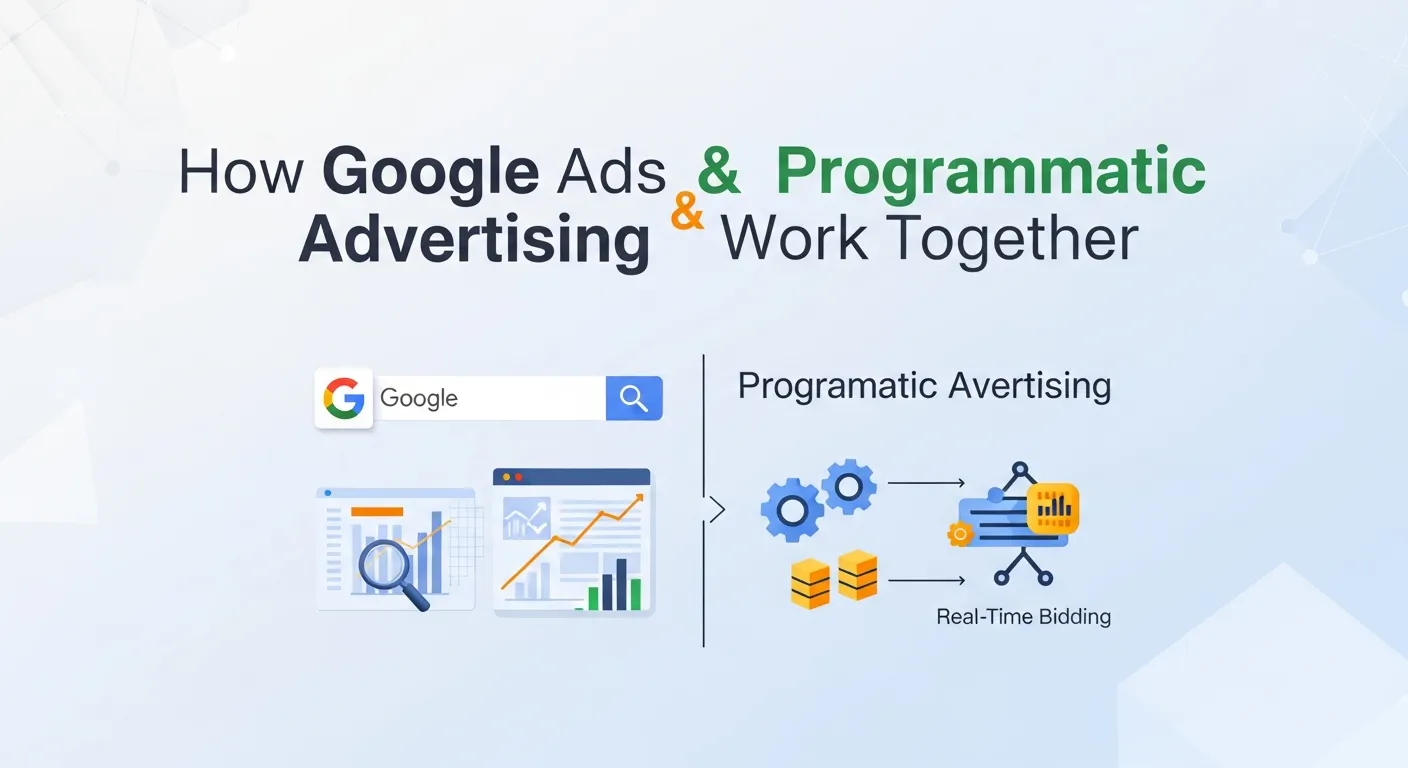
Although they differ in scope, tools, and automation levels, many savvy marketers find that Google Ads and programmatic advertising complement each other to build robust campaigns.
For example, you can use Google Ads to target users within the highly searchable ecosystem of Google Search, while programmatic can expand your reach to other channels like native advertising on independent platforms or in-app ads on mobile games.
Benefits of combining both approaches include improved reach, precision targeting, and better control of your advertising funnel across multiple marketing touchpoints.
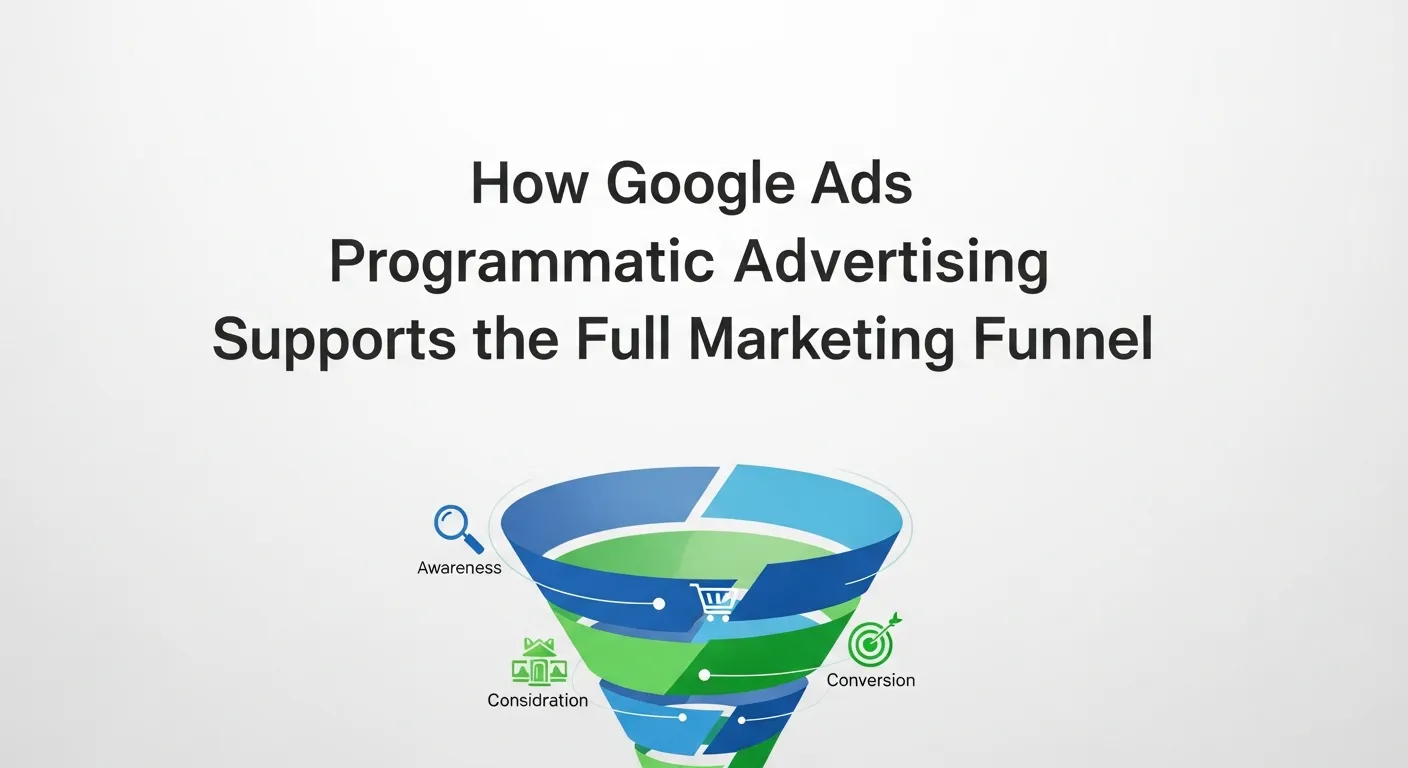
How Google Ads Programmatic Advertising Supports the Full Marketing Funnel
Beyond Clicks: Funnel-Based Programmatic Strategy
Google Ads programmatic advertising isn’t just about clicks or conversions—it supports every stage of the marketing funnel, from awareness to retention. When combined with programmatic-advertising strategies for success, brands can guide users seamlessly across touchpoints.
Unlike traditional PPC thinking, programmatic funnels focus on sequencing messages, adapting creative formats, and retargeting users based on intent signals rather than single interactions.
Funnel Stages & Use Cases
- Top-of-Funnel (Awareness): YouTube video ads, Display reach campaigns
- Mid-Funnel (Consideration): In-market audiences, remarketing lists
- Bottom-Funnel (Conversion): Smart bidding, Performance Max, search intent
- Post-Conversion (Retention): Customer match, loyalty-based messaging
Funnel Mapping in Google Ads Programmatic
| Funnel Stage | Objective | Google Ads Format | Programmatic Benefit |
|---|---|---|---|
| Awareness | Brand visibility | YouTube, Display | Massive scalable reach |
| Consideration | Engagement | Discovery, Display | Intent-based messaging |
| Conversion | Sales/leads | Search, PMax | High-intent targeting |
| Retention | Loyalty | Customer Match | Lifetime value growth |
This aligns strongly with programmatic advertising for engagement and SEM strategy integration.
Which Is Right for Your Business?
Choosing between Google Ads and programmatic advertising depends on your goals, audience, and budget.
- Opt for Google Ads if you want to appear in front of high-intent audiences actively searching for products or services you offer. It’s also ideal for small to medium-sized businesses just starting their digital marketing journeys.
- Opt for Programmatic Advertising if your goal is to scale campaigns on a larger scale, reach diverse audiences, and target multiple devices and platforms with precision.
Both tools require strategic planning and optimization, but when used effectively, they can deliver exceptional results individually or together.
Measuring Success in Google Ads Programmatic Advertising
Why Measurement Goes Beyond CPC
Success in the Google Ads programmatic advertising isn’t measured by clicks alone. Modern advertisers track incrementality, attention, and lifetime value, especially when campaigns rely on automation and AI-driven bidding.
By combining Google Ads reporting with programmatic attribution models, businesses gain clearer insights into what actually drives growth.
Key Metrics That Matter
- View-through conversions for awareness campaigns
- Incremental lift vs baseline performance
- Customer acquisition cost (CAC)
- Lifetime value (LTV)
- Cross-channel attribution modeling
Performance Metrics & Their Purpose
| Metric | What It Measures | Why It Matters |
|---|---|---|
| ROAS | Revenue efficiency | Determines profitability |
| CPA | Cost per action | Controls budget efficiency |
| Incrementality | True impact | Avoids over-attribution |
| Engagement rate | Audience interest | Signals creative relevance |
| LTV | Long-term value | Supports sustainable growth |
This section reinforces programmatic-advertising strategies for success and elevates the article beyond basic explanations.
Take Control of Your Ad Strategy
Programmatic advertising and Google Ads represent two effective tools inside the current marketer’s toolkit. While they range in scope and application, information about their strengths permits you to create a properly-rounded, ROI-focused marketing strategy.
The secret’s finding balance. Start with one platform, refine your abilities, and enlarge as your business and advertising dreams evolve. Want to take your advert campaigns to the next level? Reach out for a session on how to combine Google Ads and programmatic advertising into your advertising approach today.
Frequently Asked Questions (FAQs) on Google Ads Programmatic Advertising
1. What is Google Ads programmatic advertising?
Google Ads programmatic advertising refers to using automated bidding, machine learning, and data-driven targeting within Google’s ecosystem to buy and optimize ad placements in real time.
2. Is Google Ads considered true programmatic advertising?
Not entirely. Google Ads includes programmatic elements like automation and Smart Bidding, but full programmatic advertising extends beyond Google’s ecosystem to the open web via DSPs and SSPs.
3. How does Google Ads programmatic advertising differ from traditional PPC?
Traditional PPC relies heavily on manual keyword bidding and setup, while Google Ads programmatic advertising uses AI-driven automation, audience signals, and real-time optimization to improve efficiency and scale.
4. What types of campaigns support programmatic features in Google Ads?
Campaigns such as Performance Max, Display, YouTube, Discovery, and Smart Shopping use programmatic automation for bidding, targeting, and creative optimization.
5. Can Google Ads programmatic advertising work without third-party cookies?
Yes. Google Ads increasingly relies on first-party data, contextual targeting, modeled conversions, and Privacy Sandbox solutions to support cookie-less advertising environments.
6. How does Google Ads programmatic advertising support engagement?
By using audience signals, dynamic creatives, and cross-channel delivery, Google Ads programmatic advertising improves relevance and engagement across search, video, display, and discovery formats.
7. Is Google Ads programmatic advertising suitable for small businesses?
Yes. Small and mid-sized businesses can benefit from automated bidding, simplified campaign management, and scalable budgets while maintaining control within Google’s platform.
8. How is success measured in Google Ads programmatic advertising?
Success is measured using metrics like ROAS, CPA, view-through conversions, incrementality, engagement rate, and lifetime value rather than clicks alone.
9. Can Google Ads and open-web programmatic advertising be used together?
Absolutely. Many brands use Google Ads for high-intent demand capture while leveraging open-web programmatic platforms for broader reach, awareness, and omnichannel strategy.
10. Is Google Ads programmatic advertising future-proof?
Yes. With continuous investment in AI, privacy-safe targeting, and automation, Google Ads programmatic advertising remains a core component of modern, scalable digital marketing strategies.
Learn more…New to the concept of automated ad buying? Don’t miss our full breakdown on Unlocking the Benefits of Programmatic Advertising for Your Business