Master Programmatic Advertising: Free Course Guide
Digital advertising has transformed dramatically over the past decade. Gone are the days when marketers manually negotiated ad placements and hoped for the best. Enter programmatic advertising—a revolutionary approach that automates the buying and selling of digital ad space in real-time.
If you’re looking to advance your marketing career or improve your company’s advertising efficiency, understanding programmatic advertising is no longer optional. This comprehensive guide will walk you through everything you need to know about programmatic advertising and point you toward the best free resources to master this essential skill.
What is Programmatic Advertising?
Programmatic advertising uses automated technology to purchase digital advertising space. Instead of traditional methods involving human negotiations and manual insertions, programmatic platforms use algorithms and real-time bidding to buy and place ads within milliseconds.
The process works like this: when a user visits a website, an auction begins instantly. Advertisers bid on that specific ad space based on the user’s profile, browsing history, and other data points. The highest bidder wins, and their ad appears on the page, all before the webpage fully loads.
This automation brings several key advantages:
Speed and Efficiency: Transactions happen in real-time, eliminating lengthy negotiation processes.
Precision Targeting: Advanced algorithms analyze user data to serve ads to the most relevant audiences.
Cost Effectiveness: Automated bidding helps optimize ad spend by targeting users most likely to convert.
Scale: Advertisers can reach audiences across thousands of websites simultaneously.
Why Learn Programmatic Advertising?

The programmatic advertising market continues to expand rapidly. According to industry reports, programmatic ad spending accounts for over 80% of all digital display advertising in the United States. This growth creates significant opportunities for marketing professionals who understand how to leverage these platforms effectively.
Learning programmatic advertising offers several career benefits:
High Demand Skills: Companies actively seek marketers with programmatic expertise to manage their digital advertising strategies.
Better ROI: Understanding programmatic mechanics helps optimize campaigns for maximum return on investment.
Career Advancement: Programmatic knowledge positions you for senior marketing roles and specialized positions in ad tech companies.
Industry Relevance: As traditional advertising methods become obsolete, programmatic skills ensure your expertise remains current.
Types of Programmatic Advertising
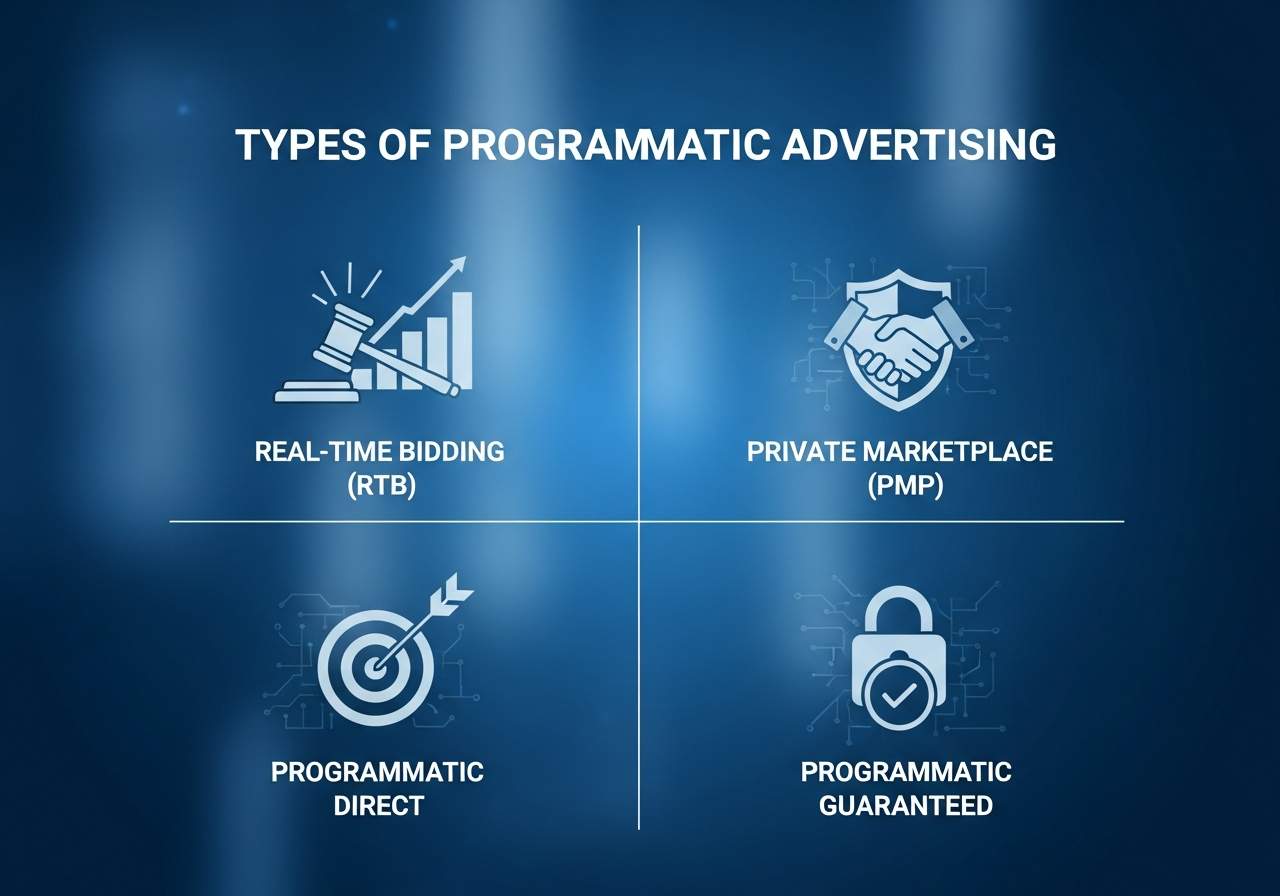
Programmatic advertising isn’t a one-size-fits-all approach. It includes multiple types such as Real-Time Bidding (RTB), Programmatic Direct, Private Marketplaces (PMPs), and Preferred Deals. RTB involves open auctions where advertisers bid in real-time for impressions, allowing flexibility and competitive pricing. Programmatic Direct, on the other hand, enables direct deals with premium publishers at fixed prices, offering guaranteed inventory and control. PMPs combine benefits of both, providing invitation-only auctions for high-quality inventory. Understanding these different types helps marketers choose the right strategy for their campaigns, balancing cost efficiency, reach, and brand safety, while achieving targeted engagement across diverse digital channels.
Role of First-Party Data in Programmatic Advertising

As privacy regulations evolve, first-party data has become a cornerstone of effective programmatic campaigns. This data, collected directly from your website, CRM, or app, allows advertisers to understand audience behavior, preferences, and engagement patterns. Leveraging first-party data enhances targeting accuracy, improves personalization, and ensures compliance with data privacy laws like GDPR and CCPA. Using this data, brands can create high-value audience segments for retargeting, cross-selling, or nurturing campaigns. With third-party cookies being phased out, first-party data is no longer optional—it’s critical for maintaining ad relevance, efficiency, and measurable ROI while building long-term relationships with users who already interact with your brand.
Programmatic Advertising and Privacy Regulations
Privacy regulations such as GDPR, CCPA, and ePrivacy significantly impact programmatic advertising. Advertisers must now prioritize user consent, data transparency, and ethical targeting practices to remain compliant. Platforms are increasingly offering privacy-first solutions like contextual targeting, first-party data utilization, and consent management tools to address these challenges. Brands ignoring privacy compliance risk legal penalties and damage to reputation. By aligning programmatic strategies with evolving regulations, marketers can continue reaching relevant audiences effectively while maintaining trust. Understanding the nuances of privacy laws, transparent data usage, and user consent is essential for any programmatic campaign in the modern digital landscape, ensuring campaigns remain ethical and legally sound.
Common Challenges in Programmatic Advertising
While programmatic advertising offers speed and efficiency, it also comes with challenges. Ad fraud, low-quality inventory, and non-human traffic can waste budgets if not monitored. Brand safety is another concern, as ads might appear alongside inappropriate or irrelevant content. Additionally, campaign measurement can be complex due to multiple channels, attribution models, and large datasets. Lack of alignment between marketing analytics teams may further complicate optimization. To overcome these obstacles, marketers need to implement verification tools, choose trusted ad exchanges, and define clear KPIs. Proactive monitoring and continuous optimization ensure campaigns deliver measurable ROI and maintain credibility in a competitive digital ecosystem.
Programmatic Advertising Across Channels
Programmatic advertising isn’t limited to display ads. It extends to video, connected TV (CTV), mobile, native, and digital audio. Each channel provides unique opportunities and challenges, requiring different creative formats, targeting strategies, and performance metrics. Video and CTV are excellent for brand awareness campaigns, while mobile programmatic can leverage location-based targeting and push notifications. Native advertising integrates seamlessly with content, providing a non-intrusive user experience. Understanding the nuances of each channel allows marketers to create integrated campaigns that reach audiences wherever they consume content, increasing engagement, conversions, and overall campaign effectiveness in a multi-device, multi-platform digital landscape.
Measuring Success in Programmatic Campaigns

Measuring programmatic campaign success goes beyond basic metrics like clicks and impressions. Effective evaluation requires analyzing engagement, conversion rates, cost per acquisition, return on ad spend, and audience quality. Multi-touch attribution models help understand the customer journey, showing how different touchpoints contribute to conversions. Real-time analytics allows marketers to optimize bidding strategies, creatives, and targeting on the fly. By continuously monitoring performance, campaigns can adapt to changing audience behavior, market trends, and competitor activity. A structured measurement framework ensures programmatic campaigns not only reach the right audiences but also align with broader business objectives and deliver meaningful ROI.
Key Concepts to Master
Before diving into free courses, familiarize yourself with these fundamental programmatic advertising concepts:
Real-Time Bidding (RTB)
RTB forms the backbone of programmatic advertising. This auction-based system allows advertisers to bid on individual ad impressions as they become available. The entire process—from bid submission to ad display—occurs within 100 milliseconds.
Demand-Side Platforms (DSPs)
DSPs enable advertisers to purchase ad inventory from multiple ad exchanges through a single interface. These platforms provide targeting options, bidding strategies, and campaign management tools.
Supply-Side Platforms (SSPs)
Publishers use SSPs to sell their ad inventory to advertisers. These platforms help maximize revenue by connecting publishers with multiple ad exchanges and demand sources.
Ad Exchanges
Ad exchanges serve as digital marketplaces where advertisers and publishers trade ad inventory. They facilitate the auction process and ensure transactions occur smoothly.
Data Management Platforms (DMPs)
DMPs collect, organize, and analyze audience data from various sources. This information helps advertisers make informed targeting decisions and improve campaign performance.
Free Programmatic Advertising Courses
Several reputable organizations offer comprehensive programmatic advertising training at no cost:
Google’s Display & Video 360 Academy
Google provides extensive training materials for its programmatic platform. The academy covers campaign setup, targeting strategies, and optimization techniques. The courses include practical exercises and real-world examples.
The Trade Desk’s Edge Academy
Edge Academy offers structured learning paths for programmatic advertising. Their curriculum covers both beginner and advanced topics, including audience targeting, creative optimization, and campaign measurement.
Interactive Advertising Bureau (IAB) Education
IAB provides foundational programmatic courses that cover industry standards and best practices. Their materials help learners understand the broader programmatic ecosystem and regulatory considerations.
Amazon DSP Learning Console
Amazon’s training platform focuses on retail media and programmatic advertising within the Amazon ecosystem. The courses cover unique aspects of advertising on Amazon properties and third-party sites.
Building Practical Skills
Theoretical knowledge alone won’t make you proficient in programmatic advertising. Focus on developing these practical skills:
Campaign Strategy Development
Learn to create comprehensive programmatic strategies that align with business objectives. This includes defining target audiences, selecting appropriate channels, and setting realistic performance goals.
Data Analysis and Interpretation
Programmatic campaigns generate vast amounts of data. Develop skills in analyzing campaign metrics, identifying optimization opportunities, and making data-driven decisions.
Creative Optimization
Understand how different creative formats perform across various programmatic channels. Learn to test and optimize ad creatives for maximum engagement and conversion.
Budget Management
Master the art of budget allocation across different programmatic channels and campaigns. Learn to adjust bids and budgets based on performance data and market conditions.
Getting Started with Your Learning Journey
Begin your programmatic advertising education with these actionable steps:
Start with Fundamentals: Complete introductory courses that cover basic concepts and terminology before advancing to specialized topics.
Practice Regularly: Many platforms offer sandbox environments where you can experiment with campaign setups without spending real money.
Join Industry Communities: Participate in programmatic advertising forums and groups to learn from practitioners and stay updated on industry trends.
Follow Industry Publications: Subscribe to trade publications and blogs that cover programmatic advertising news and best practices.
Seek Mentorship: Connect with experienced programmatic professionals who can provide guidance and insights based on real-world experience.
Transform Your Marketing Career Today
Programmatic advertising represents the future of digital marketing. By investing time in learning these skills through free courses, you’re positioning yourself for success in an increasingly automated advertising landscape.
The resources mentioned above provide comprehensive training without financial investment. Start with one platform that aligns with your current knowledge level, then gradually expand your learning to cover different aspects of programmatic advertising.
Remember that mastering programmatic advertising requires continuous learning. The technology evolves rapidly, and staying current with new features, regulations, and best practices is essential for long-term success.
Take the first step today by enrolling in a free programmatic advertising course. Your future self—and your marketing campaigns—will thank you for the investment in this valuable skill set.
Future Trends in Programmatic Advertising
Programmatic advertising is evolving rapidly, with AI, machine learning, and automation shaping its future. Cookieless targeting, contextual advertising, and first-party data strategies are gaining prominence due to privacy regulations. Connected TV (CTV) and digital audio are emerging as new high-impact channels. Predictive analytics and dynamic creative optimization enable more personalized, real-time ad experiences. Automation tools continue to streamline campaign management, making strategies more efficient and scalable. Marketers who stay informed about these trends can adapt quickly, maintain competitive advantage, and design forward-looking campaigns that leverage emerging technologies, ensuring programmatic advertising remains effective, relevant, and ROI-driven in the coming years.
Frequently Asked Questions (FAQ)
1. What is programmatic advertising in simple terms?
Programmatic advertising is an automated way of buying and selling digital ads. Instead of manually negotiating ad placements, software and algorithms purchase ad space in real time based on audience data, ensuring ads reach the right users at the right moment.
2. How is programmatic advertising different from traditional digital advertising?
Traditional digital advertising often involves manual processes such as direct deals and fixed placements. Programmatic advertising uses automation, real-time bidding, and data-driven targeting, making campaigns faster, more efficient, and more precise.
3. Is programmatic advertising only for large companies?
No. While large brands widely use programmatic advertising, small and mid-sized businesses can also benefit. With proper budget control and targeting, programmatic platforms allow advertisers of all sizes to reach relevant audiences efficiently.
4. Do I need technical skills to learn programmatic advertising?
Basic technical knowledge helps, but deep coding skills are not required. Most programmatic platforms are user-friendly and focus on strategy, targeting, and data analysis rather than programming.
5. How long does it take to learn programmatic advertising?
You can grasp the fundamentals within a few weeks through free courses. However, becoming proficient usually takes a few months of hands-on practice, testing campaigns, and analyzing performance data.
6. Are free programmatic advertising courses enough to get started?
Yes. Free courses from platforms like Google, The Trade Desk, IAB, and Amazon provide strong foundational knowledge. Pairing these courses with practical experience will significantly accelerate your learning.
7. What are the most important metrics in programmatic advertising?
Key metrics include impressions, click-through rate (CTR), cost per mille (CPM), cost per acquisition (CPA), conversion rate, and return on ad spend (ROAS). These help measure campaign effectiveness and optimize performance.
8. Is programmatic advertising safe and transparent?
Programmatic advertising has improved significantly in transparency. Using trusted platforms, verified inventory, brand safety tools, and proper measurement practices helps minimize risks such as ad fraud and low-quality placements.
9. Can programmatic advertising work without cookies?
Yes. With increasing privacy regulations, programmatic advertising is shifting toward contextual targeting, first-party data, and privacy-friendly solutions that do not rely heavily on third-party cookies.
10. Is programmatic advertising a good career choice?
Absolutely. Programmatic advertising skills are in high demand across agencies, brands, and ad-tech companies. Mastery of programmatic platforms can open doors to advanced digital marketing and performance marketing roles.