What Is Facebook Programmatic Advertising
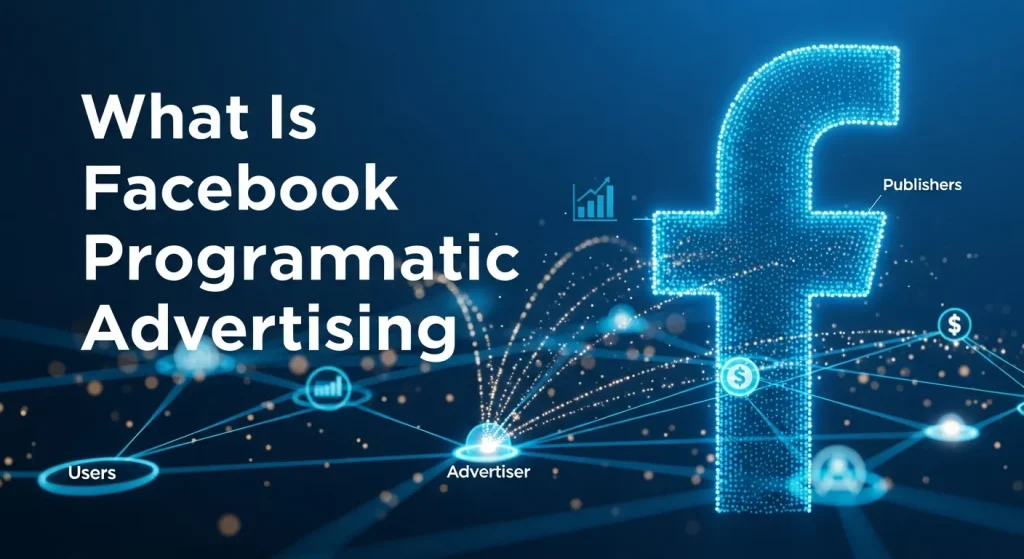
Facebook Programmatic Advertising uses automated, data-driven technology to buy and optimize ads on Facebook platforms in real time, enabling precise audience targeting, efficient bidding, and improved campaign performance.
What Is Facebook Programmatic Advertising
Facebook programmatic, arguably the second biggest growth area this year behind video advertising, is what exactly? Though when discussing methods of advertising, one question that many marketers and business owners encounter is: Is Facebook programmatic advertising? With numerous technical terms surrounding Internet ads, it can be easy for the debate to become muddled.
This article aims to clarify the issue by examining what programmatic advertising is, where Facebook fits into this context, and its implications for your marketing strategy. When you finish reading, you’ll be better able to discern whether or not Facebook is a programmatic advertiser and how best to leverage that fact in your company’s favor.
What Is Programmatic Advertising?
Now, before we answer that very question, we need to know what programmatic advertising means in reality.
Programmatic advertising is a way of buying and selling ad space, making use of advanced algorithms and automation technology. Instead, sellers have to take stock across several devices or manually facilitate the process; programmatic advertising employs software that automatically doles out digital inventory in real time without any human intervention.
Programmatic Advertising’s Defining Characteristics
- Real-time Bidding (RTB) – This is the most popular form of programmatic advertising and the most familiar to many people. This system sets up automated auctions for ad impressions as fast as possible, enabling advertisers to bid on them in milliseconds.
- Direct To Precision — Programmatic advertising makes use of behavioral data-driven programmatic advertising the role of big data, demographics, location, and context to serve targeted audiences with the most appropriate, compliant content in real-time.
- All-Everything Reach – We are able to easily run across multiple platforms with programmatic advertising, from websites to mobile apps to streaming services.
- Automation eliminates manual tasks such as negotiations with publishers to place ads and greatly improves efficiency and cost-effectiveness.
Programmatic advertising rests on a combination of demand-side platforms (DSPs), which enable advertisers to administer ad transactions, and supply-side platforms (SSPs), which match publishers offering ad space.
That’s Why Facebook Isn’t “100% Programmatic” Right Now
To understand Facebook’s position in modern digital advertising, it’s important to compare how its ad system works against the core structure of Programmatic Advertising. While Facebook relies heavily on automation and data, it does not fully align with how open, exchange-based programmatic systems operate.
Facebook’s Ads Manager Isn’t a True DSP
Facebook Ads Manager is a powerful, automated platform designed to simplify ad buying for businesses. However, it does not function as a traditional demand-side platform like those used in open programmatic environments. Advertisers cannot use it to purchase inventory across multiple publishers, websites, or ad exchanges.
Instead, Facebook controls the entire buying, targeting, and delivery process within its own closed ecosystem. This “walled garden” approach limits cross-channel flexibility but enables Facebook Programmatic Advertising–style efficiency through machine learning and internal data.
Key limitations include:
- No access to external publishers or open exchanges
- Inventory is owned and controlled by Meta
- No interoperability with third-party DSPs
This structure makes Ads Manager automated—but not fully programmatic in the traditional sense.
Limited Reach Outside the Meta Ecosystem
One defining strength of programmatic systems is omnichannel reach. Advertisers can place ads across websites, apps, video platforms, and connected TV from a single interface. Facebook ads, however, are limited to Meta-owned properties and select partner placements.
Although the Audience Network extends delivery beyond Facebook and Instagram, it does not offer the scale or diversity found in open marketplaces used in a typical programmatic advertising sem strategy.
What this means for advertisers:
- Strong engagement within Meta platforms
- Limited exposure to premium publishers
- Less control over where ads appear externally
Lack of Full RTB Transparency
Facebook uses an internal auction model that operates in real time, but advertisers have limited visibility into how bids compete, how pricing is finalized, or how impressions are prioritized.
In contrast, open real-time bidding environments allow advertisers to:
- See auction mechanics
- Adjust bid logic dynamically
- Analyze inventory-level performance
This reduced transparency is a major reason Facebook does not qualify as a fully open system under most programmatic advertising guide definitions.
Facebook vs Traditional Programmatic Platforms
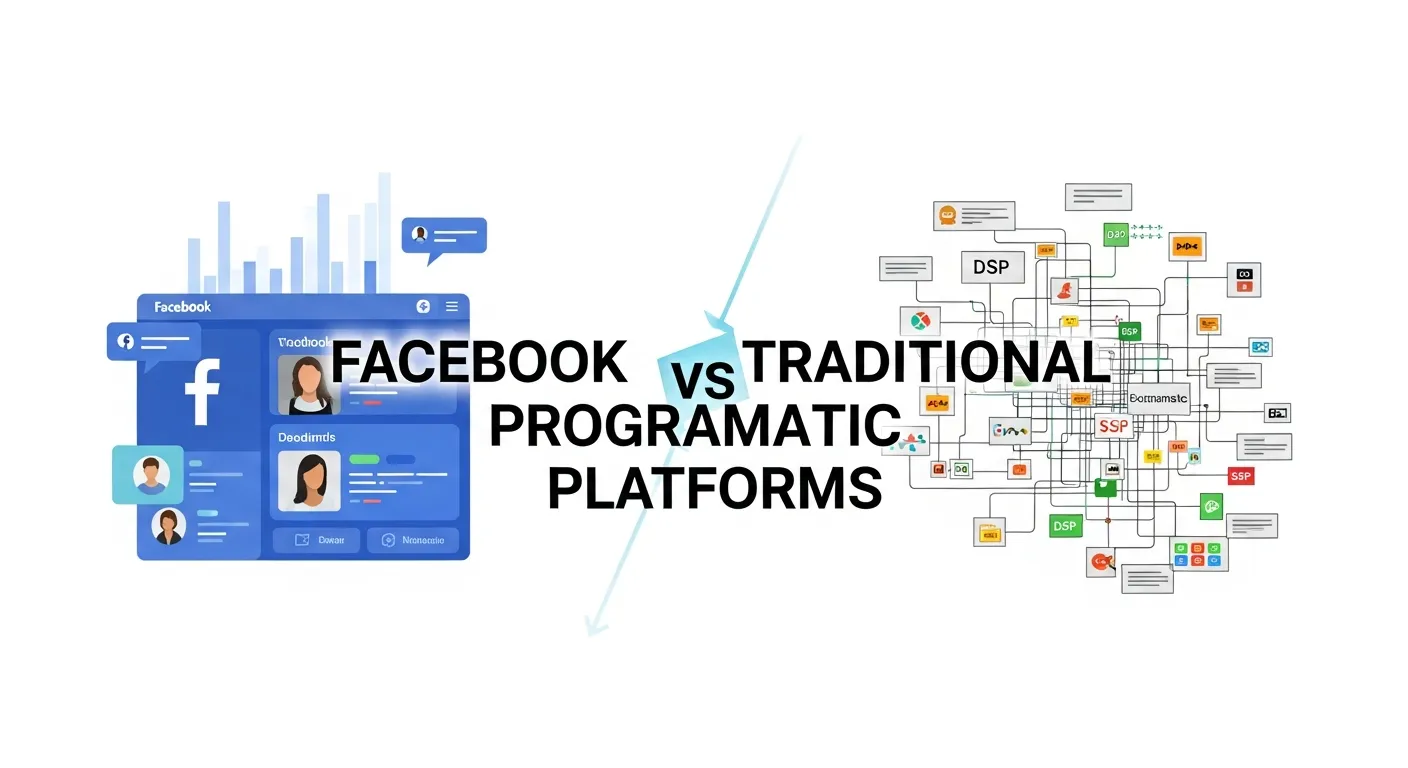
| Feature | Facebook Ads Manager | Open Programmatic DSPs |
|---|---|---|
| Inventory Access | Meta-owned platforms only | Multiple publishers & exchanges |
| Auction Transparency | Limited | High |
| Cross-Channel Reach | Restricted | Web, app, video, CTV |
| Data Usage | First-party user data | First + third-party data |
| Reporting Depth | Platform-level insights | Advanced, granular reporting |
Strategic Takeaway for Marketers
Facebook excels at automation, targeting, and optimization, making it ideal for advertisers focused on engagement and conversion within social environments. However, brands seeking broader reach, deeper insights, and publisher-level control often rely on solutions featured in advanced programmatic advertising articles and platforms, such as programmatic advertising on Google or Google Ads programmatic advertising.
When combined strategically, Meta campaigns and open-market solutions supported by programmatic advertising analytics can complement each other—balancing precision with scale.
How Facebook Ads Mimic Programmatic Features
While Facebook does not operate as an open exchange, it closely mirrors many core characteristics of Programmatic Advertising through automation, data-driven decision-making, and real-time optimization. This makes Facebook an attractive option for advertisers who want efficiency and precision without the technical complexity of traditional DSPs.
Facebook Programmatic Advertising works within a controlled environment, allowing brands to benefit from sophisticated technology while maintaining simplicity and ease of use.
Hyper-Targeting Capabilities
One of Facebook’s strongest similarities to programmatic systems is its advanced audience targeting. The platform leverages massive volumes of first-party user data to create highly specific audience segments based on real behavior and engagement patterns.
Key targeting strengths include:
- Interest and behavior-based segmentation
- Location, age, and demographic targeting
- Custom and lookalike audiences
- Continuous audience refinement using engagement data
This depth of targeting closely aligns with the logic found in a modern programmatic advertising guide, even though it remains platform-specific.
Automation and Machine Learning
Facebook Ads Manager relies heavily on automation powered by machine learning. Once a campaign goal is defined, the system automatically determines where, when, and how ads are delivered for optimal results.
Automation benefits for advertisers:
- Reduced manual campaign adjustments
- Smart budget and bid optimization
- Automatic placement selection
- Faster performance optimization cycles
These features make Facebook especially appealing for businesses implementing a streamlined programmatic advertising sem strategy without managing external platforms.
Real-Time Performance Insights
Like open programmatic systems, Facebook provides real-time access to performance metrics. Advertisers can instantly monitor how campaigns are performing and make data-backed adjustments without delays.
Available insights include:
- Impressions, clicks, and conversions
- Cost and return on ad spend
- Audience engagement patterns
- Creative performance breakdowns
This immediacy allows marketers to respond quickly to trends and audience behavior shifts.
Dynamic Creative Optimization (DCO)
Facebook’s dynamic creative feature closely resembles DCO used in enterprise programmatic platforms. Advertisers can upload multiple variations of headlines, images, and calls to action, allowing the system to automatically serve the best-performing combinations.
How dynamic creative helps:
- Tests multiple creative variations simultaneously
- Optimizes messaging in real time
- Reduces creative testing time and cost
- Improves overall campaign efficiency
These capabilities are a core part of meta programmatic advertising functionality, adapted for a closed ecosystem.
Facebook Ads vs Traditional Programmatic Features
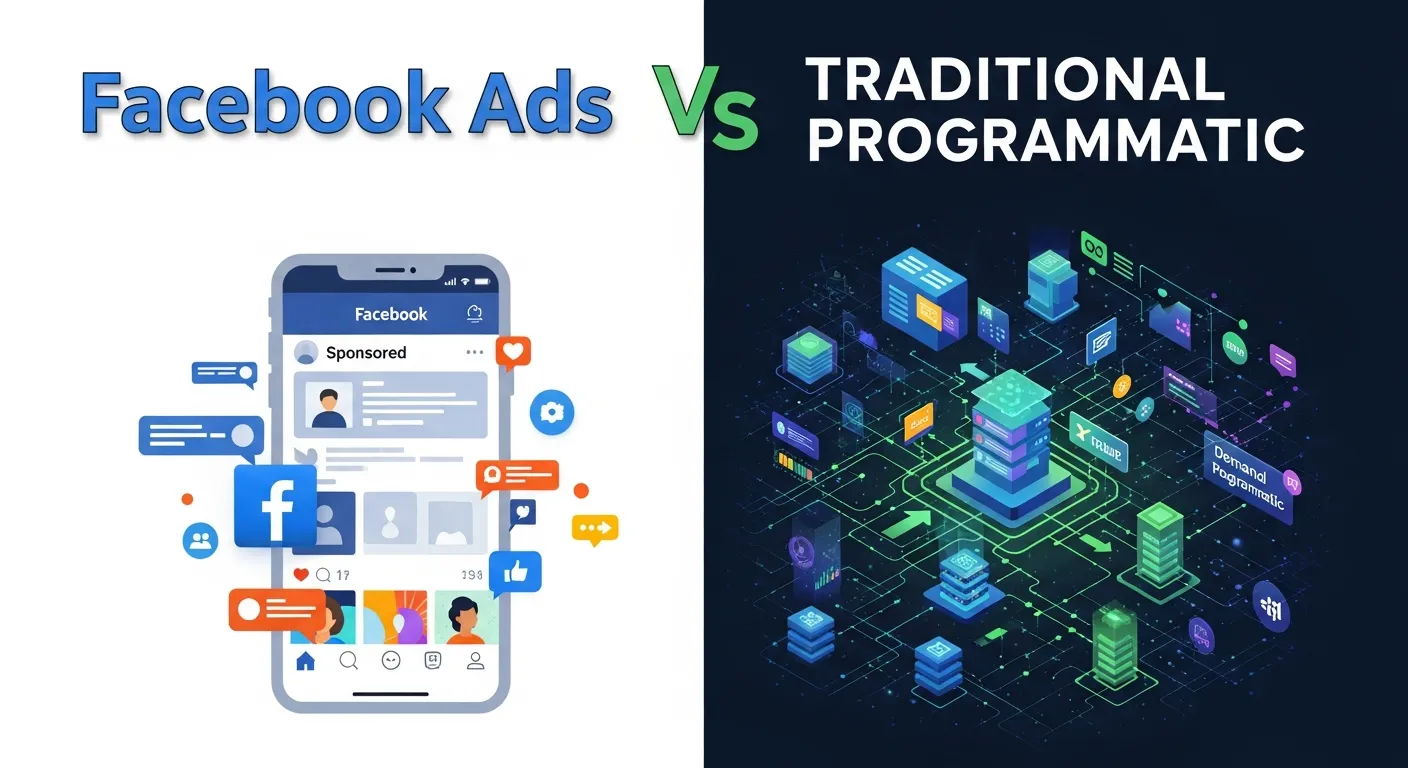
| Feature | Facebook Ads Manager | Open Programmatic Platforms |
| Audience Data | First-party social data | First & third-party data |
| Automation Level | High | High |
| Creative Optimization | Built-in dynamic creative | Advanced DCO tools |
| Campaign Complexity | Low to moderate | Moderate to high |
| Ecosystem | Closed (Meta platforms) | Open, multi-publisher |
Key Takeaway
Facebook successfully replicates many programmatic features through automation, targeting, and optimization. While it lacks open-market flexibility, its ease of use and powerful data capabilities make it a strong complement—or entry point—within a broader digital advertising strategy.
Should Your Business Focus on Facebook Ads or Programmatic Advertising
Choosing between Facebook ads and Programmatic Advertising isn’t about which option is better overall—it’s about which aligns best with your business objectives, target audience, and marketing maturity. Each approach offers distinct advantages, and understanding those differences helps marketers invest more strategically.
Facebook Programmatic Advertising–style campaigns excel in audience precision and ease of use, while open programmatic platforms provide unmatched scale, flexibility, and channel diversity.
When Facebook Ads Are the Right Choice
Facebook ads are ideal for businesses that want fast deployment, strong targeting, and minimal technical complexity. The platform’s self-contained environment makes it especially appealing to growing brands.
Facebook ads work best when:
- Your audience is highly active on Facebook, Instagram, or Messenger
- You want granular interest- and behavior-based targeting
- You operate a small-to-medium-sized business with limited resources
- You prefer a self-serve platform without managing DSPs or exchanges
- You want automation to handle bidding, placements, and optimization
For many advertisers, Facebook acts as a practical starting point before moving toward a more advanced programmatic advertising sem strategy.
When Investing in Programmatic Advertising Makes Sense
Open programmatic platforms are better suited for advertisers seeking reach beyond social media and deeper control over campaign execution.
Programmatic advertising is ideal if:
- You need a truly cross-channel strategy (web, mobile, video, CTV)
- Your brand targets international or multi-market audiences
- You require advanced reporting, insights, and optimization controls
- You want to reach users outside the Meta ecosystem
- You have the expertise or partners to manage complex platforms
These capabilities are typically highlighted in any advanced programmatic advertising guide, especially for enterprise or rapidly scaling brands.
Having the Best of Both Worlds
The most effective digital strategies often combine both approaches rather than choosing one exclusively. By integrating Facebook ads with open-market buying, advertisers benefit from precision targeting and broad reach at the same time.
How a combined strategy works:
- Use Facebook Ads Manager to retarget engaged users and drive conversions
- Deploy programmatic campaigns to scale awareness across websites, apps, video platforms, and connected TVs
- Align messaging and creatives across channels for consistency
- Use insights from both platforms to refine audience and budget allocation
This hybrid approach allows businesses to balance performance and scale while leveraging the strengths of each system.
Facebook Ads vs Programmatic Advertising: Key Differences
| Aspect | Facebook Ads | Open Programmatic Platforms |
| Reach | Meta-owned platforms | Web, apps, video, CTV |
| Ease of Use | Very user-friendly | Requires expertise |
| Targeting Data | First-party social data | First & third-party data |
| Reporting Depth | Platform-level insights | Advanced, granular analytics |
| Best For | Engagement & conversions | Scale & omnichannel reach |
Final Takeaway
Facebook ads deliver simplicity, speed, and powerful targeting, while programmatic platforms offer scale, flexibility, and advanced controls. When aligned correctly—especially within a meta-driven ecosystem—using both together creates a more resilient and performance-driven digital advertising strategy.
Frequently Asked Questions (FAQs)
1. What is programmatic advertising in simple terms?
It is an automated way of buying and selling digital ad space using technology, algorithms, and data instead of manual negotiations.
2. Is Facebook considered a programmatic advertising platform?
Facebook uses automation and data-driven targeting similar to programmatic methods, but it operates within its own ecosystem rather than an open ad exchange.
3. How does Facebook Programmatic Advertising differ from traditional DSPs?
Traditional DSPs allow advertisers to buy ads across multiple publishers and channels, while Facebook ads are limited to Meta-owned platforms and select partner networks.
4. Does Facebook use real-time bidding (RTB)?
Facebook uses an internal auction system that functions in real time, but it does not provide the same level of bidding transparency as open RTB marketplaces.
5. What data does Facebook use for ad targeting?
Facebook relies on user behavior, interests, demographics, location, and engagement data to deliver highly targeted ads.
6. Can programmatic advertising work alongside Facebook ads?
Yes, many brands combine Facebook ads with programmatic campaigns to maximize reach, performance, and audience coverage across different digital channels.
7. Is programmatic advertising suitable for small businesses?
It can be, but it often requires more expertise and budget. Facebook ads are usually more beginner-friendly for small and medium businesses.
8. How is performance measured in automated ad buying?
Advertisers track impressions, clicks, conversions, engagement, and return on ad spend through real-time dashboards and analytics tools.
9. What are the main benefits of automation in digital advertising?
Automation improves efficiency, reduces manual effort, optimizes targeting, and adjusts campaigns in real time for better performance.
10. Should businesses choose programmatic advertising or Facebook ads?
The best results often come from using both together—leveraging Facebook’s strong audience targeting and programmatic advertising analytics for broader, multi-channel reach.
New to the concept of automated ad buying? Don’t miss our full breakdown on How to Get Started with Programmatic Advertising.