How to Use Programmatic Advertising to Grow Your Business

Programmatic advertising has transformed the way companies do advertising campaigns. For marketers who want to increase their scale and run on racing car tracks, it is essential to know this tool well. But exactly what is programmatic advertising, and how can you make use of it in your own campaigns?
This guide will break down the core elements of programmatic advertising — what it is and why it should be considered, its main benefits, and effective strategies to make this tool part of your overall marketing plan. Whether you are new to the concept or just looking for implementation tips, get everything you need from this comprehensive guide’s clear directions!
What Is Programmatic Advertising?
Programmatic advertising is, in essence, an automated, real-time method of purchasing and optimizing digital ad spaces. It replaces the traditional way of negotiating or buying ad space, using algorithms and data to make smarter decisions faster. With programmatic, your ad inventory is presented to just the right audience at precisely that moment: you can place this process in milliseconds or even microseconds.
This whole process happens on various platforms such as websites and mobile apps, video streaming services, and connected TVs. Demodside platforms (DSPs) and real-time bidding (RTB) tools enable this automation, while at the same time offering very detailed targeting capabilities.
Why Does Programmatic Advertising Matter?
Programmatic advertising has seen rapid growth over the past two years. All kinds of corporations allocate significant sections of their advertising budgets to this technology.
According to Statista, global programmatic ad spending is set to exceed the $150 billion mark this year. Efficient, scalable, and capable of delivering highly personalized messages. This overdose of transformation and marketing leadership has unique advantages–it only becomes possible because, through our research with stakeholders, we found that it absolutely does present possibilities.
Key Benefits of Programmatic Advertising
Accurate Audience Targeting
Programmatic ads let you nail down exactly who you want to reach. By using information such as age, gender, location, and even the kind of phone someone’s using, you can ensure that your advertising reaches in fact, precisely those people it’s meant for.
For example, if you produce sporting goods, programmatic advertising will find users who recently searched for gym memberships or visited health-related websites, users who use fitness apps, and so on.
Real-Time Optimization
With programmatic, you’re not creating static campaigns; instead, you live with them in action. Ads are constantly optimized as per performance statistics tracked in real time.
For example, if one advertising section has particular appeal to a specific audience segment, the system automatically assigns more budget to reach out to similar audiences. This dynamic method not only frees up staff time but also gets higher profits from less input.
Cost-Effective
Traditionally bought media space, rarely lower than the price or transfer of title in most cases, was always running overhead because of the “hand is faster than the eye” bargaining methods.
With programmatic advertising, you’re not going ahead and shelling money out the door with nothing to show for it. Billing is straightforward, and accountability between buyer and seller has increased.
Coverage on Multiple Platforms
Programmatic is more than just search engines and social media platforms. It enables you to purchase advertising at other channels such as website videos, mobile applications, connected TVs, connected set top boxes, or audio equipment, which can be used where needed,d like Spotify. This multi-dimensional buying strategy helps achieve a wider spread while still maintaining more accurate segmentation.
Greater Transparency
With programmatic advertising, advertisers receive detailed reports that clearly document where ads are running and how they fare. This transparency is found invaluable when it comes to sniffing out advantages and for gaining trust within the ad-buying process.
Programmatic TV & Connected TV (CTV): How It Actually Works and Why It’s Different
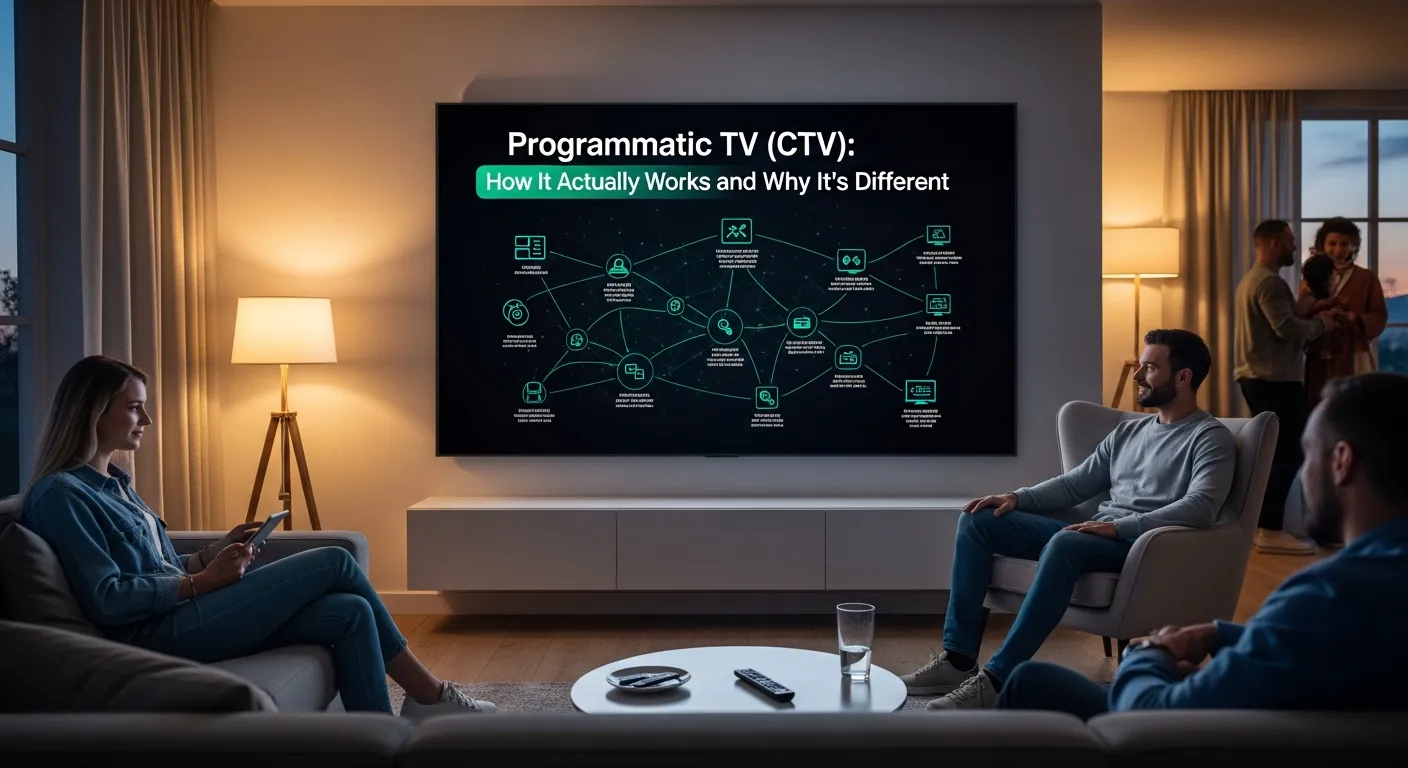
Programmatic TV advertising is one of the fastest-growing segments of digital media buying, yet it operates very differently from traditional display or mobile programmatic.
Unlike linear TV, programmatic TV and CTV ads are bought impression-by-impression, allowing advertisers to target households instead of broad demographics.
Programmatic TV works by combining data signals (viewing behavior, device type, household attributes) with automated bidding across streaming environments such as smart TVs, streaming apps, and set-top boxes. Ads are served during live streams or on-demand content, ensuring brands reach viewers who have already cut the cord.
Why Programmatic TV Matters for Advertisers
- Access to premium, brand-safe inventory
- Precise household and audience targeting
- Reduced ad waste compared to linear TV
- Measurable outcomes such as completed views and incremental lift
Key Differences Between Traditional TV and Programmatic TV
| Aspect | Traditional TV Advertising | Programmatic TV Advertising |
|---|---|---|
| Buying Method | Manual negotiations | Automated, real-time bidding |
| Targeting | Broad demographics | Household & behavioral data |
| Measurement | Estimated reach | Deterministic performance data |
| Optimization | Post-campaign | Real-time optimization |
| Cost Control | Fixed upfront spend | Flexible, bid-based pricing |
This evolution makes programmatic TV advertising for engagement especially effective for brands seeking both reach and accountability.
Getting Started: Step-by-Step Implementation
Having learned the benefits, let’s get down to some step-by-step examples of successful programmatic campaigns.
For example, designating Clear targets will guide the direction of messaging, targeting, and platform selection.
So, what are clearly defined goals? You should work out these for your programmatic ads. Are you trying to enhance brand awareness, attract more users from the website, or get an increase in conversions?
Step 1: Define Your Campaign Goals
Begin by defining your goals. What would you like to accomplish with programmatic ads? Do you want to increase brand awareness, drive traffic to your website, and then convert these visitors into customers again?
Achievable goals will inform your targeting, messaging, and platform selection.
An example:
- Awareness Campaigns focus on reaching a broad audience.
- Conversion Campaigns target high-intent users who are likely to take a specific action, like making a purchase.
Step 2: Choose the Right DSP
A demand-side platform (DSP) is the heart of programmatic advertising. With it, advertisers can buy ad inventory across different platforms.
Some popular DSPs are:
- Google Display & Video 360
- Amazon DSP
- The Trade Desk
- MediaMath
Research these options to see which suits your needs and fits your budget. Many DSPs also integrate with third-party data providers to improve their targeting capabilities still further.
Budgeting, Bidding Models, and Cost Control in Programmatic Advertising

While programmatic advertising is often described as cost-effective, results depend heavily on how budgets and bids are structured. Understanding bidding models allows advertisers to control spend while maximizing performance.
Programmatic platforms offer multiple pricing models, each suited to different campaign goals. Selecting the wrong one can lead to inefficiencies even with perfect targeting.
Common Programmatic Bidding Models
- CPM (Cost Per Mille) – Ideal for awareness campaigns
- CPC (Cost Per Click) – Suitable for traffic-driven objectives
- CPA (Cost Per Acquisition) – Best for performance and conversions
- Dynamic bidding – Adjusts bids automatically based on the likelihood to convert
Budget Allocation Best Practices
- Start with test budgets and scale winning segments
- Allocate more spend to high-performing creatives
- Separate prospecting and retargeting budgets
- Use frequency caps to avoid ad fatigue
Budget Strategy Comparison
| Strategy | Best Use Case | Risk Level |
|---|---|---|
| Fixed Daily Budget | Stable performance campaigns | Low |
| Performance-Based Scaling | Conversion-focused campaigns | Medium |
| Aggressive Bid Optimization | Competitive markets | High |
| Always-On Budgeting | Long-term brand presence | Low |
This structured approach strengthens the programmatic advertising SEM strategy by ensuring paid media investments remain efficient and predictable.
Step 3: Leverage First- and Third-Party Data
The success of programmatic advertising lies in using data for precision targeting.
Combine:
- First-party data (your internal data from CRM, website, or app analytics)
- Third-party data (from external data sources to enrich your audience profiles)
If you are marketing a new skincare product, first-party data can identify existing customers, while third-party data can help identify new segments interested in beauty products.
Step 4: Create Ad Creatives Tailored for Personalization
Programmatic depends on personalized advertising. Come up with a number of variations for your ad creatives to suit different audience segments.
This could mean tailoring ads by:
- Geography
- Demographics
- Interests
- Purchasing behavior
Make sure your copy is clear, engaging, and includes a strong call-to-action (CTA).
Step 5: Monitor Campaign Performance and Optimize
Arbitrary is a great advancement in that it allows companies to check campaigns in real time.
Platform dashboards enable you to track metrics such as:
- In impressions
- Click-through rates
- Conversions
After, you can use these indicators to compare with your initial aims and objectives to calculate the degree of success.
Measurement, Attribution, and KPIs in Programmatic Advertising

One major advantage of programmatic advertising is not just automation — it’s measurability.
Modern programmatic advertising strategies for success rely on multi-touch attribution models that evaluate how ads influence users across devices and channels, not just the last click.
Core Measurement Approaches
- View-through attribution
- Incrementality testing
- Cross-device attribution
- Brand lift studies
Key KPIs by Campaign Objective
| Campaign Goal | Primary KPIs | Secondary KPIs |
|---|---|---|
| Brand Awareness | Impressions, Reach, CPM | Viewability, Frequency |
| Engagement | CTR, Time Spent | Interaction Rate |
| Conversions | CPA, ROAS | Assisted Conversions |
| Retention | Repeat Visits | Customer Lifetime Value |
Step 6: Stay Updated with Industry Trends
Arbitrary is constantly developing and improving. Time won’t be wasted if it is used to keep track of new technologies such as AI (artificial intelligence), ML (machine learning), and context-based advertising.
Challenges and Their Solutions
While programmatic advertising offers significant advantages in efficiency and scale, it is not without its challenges. Understanding these setbacks—and knowing how to address them—can help advertisers maximize performance while minimizing risk.
Ad Fraud
Ad fraud remains one of the biggest concerns in programmatic advertising. Issues such as bot traffic, fake impressions, click farms, and domain spoofing can drain budgets without delivering real value.
Solution:
Advertisers should use fraud detection and verification tools such as AdRoll or White Ops to monitor traffic quality and validate impressions. Partnering with reputable demand-side platforms (DSPs), using private marketplaces (PMPs), and regularly auditing campaign performance can further reduce exposure to fraudulent activity.
Privacy Concerns
With increasing scrutiny around data usage, privacy regulations like GDPR and CCPA have reshaped how advertisers collect and use consumer data. Mishandling data can lead to legal penalties and loss of consumer trust.
Solution:
To stay compliant, advertisers should strictly adhere to data protection regulations and ensure transparency in how user data is collected and used. Shifting toward first-party data strategies and context-based targeting helps maintain personalization without relying heavily on third-party cookies. Clear consent management and secure data practices are also essential.
Learning Curve
Programmatic advertising platforms can be complex, requiring expertise in data analysis, bidding strategies, and campaign optimization. Without proper knowledge, advertisers may struggle to achieve optimal results.
Last Thoughts on Programmatic Advertising
Arbitrary shopping has already become ingrained in online sales and is a necessity rather than simply convenient for any business seeking sustainable growth in today’s competitive digital environment.
Take the first step today and introduce arbitrary shopping into your overall marketing scheme as a component part. Your customers are already online–are we catching them where they are?
Frequently Asked Questions (FAQs) About Programmatic Advertising
1. What is programmatic advertising in simple terms?
Programmatic advertising is an automated way of buying and selling digital ad space in real time. Instead of manually negotiating ad placements, advertisers use algorithms, data, and artificial intelligence to show ads to the right audience at the right time. In short, it is online advertising explained through automation and data-driven decision-making.
2. How does programmatic advertising work?
Programmatic advertising works through demand-side platforms (DSPs) and real-time bidding (RTB). When a user visits a website or app, an auction happens in milliseconds where advertisers bid to show their ad to that user. The highest and most relevant bid wins, and the ad is displayed instantly.
3. Is programmatic advertising suitable for small businesses?
Yes, programmatic advertising is suitable for businesses of all sizes. Small businesses can start with controlled budgets, focus on specific audience segments, and optimize campaigns in real time. With the right programmatic-advertising strategies for success, even small advertisers can compete effectively.
4. What is the difference between programmatic advertising and traditional digital advertising?
Traditional digital advertising often involves manual buying, fixed placements, and limited optimization. Programmatic advertising, on the other hand, is automated, data-driven, and continuously optimized. It allows advertisers to scale campaigns efficiently while maintaining better targeting and cost control.
5. How does artificial intelligence improve programmatic advertising?
Artificial intelligence plays a major role in programmatic advertising by analyzing large volumes of data, predicting user behavior, and optimizing bids automatically. AI helps improve targeting accuracy, creative personalization, and performance optimization, making campaigns smarter and more efficient over time.
6. What metrics should I track in programmatic advertising campaigns?
Key metrics depend on campaign goals. Common KPIs include impressions, click-through rate (CTR), conversions, cost per acquisition (CPA), and return on ad spend (ROAS). For branding campaigns, metrics such as reach, frequency, and brand lift are also important.
7. What is a programmatic advertising SEM strategy?
A programmatic advertising SEM strategy focuses on using automated bidding, audience data, and performance insights to support search engine marketing goals. While SEM typically includes paid search, programmatic advertising complements it by expanding reach across display, video, and connected TV channels.
8. Is programmatic advertising safe and transparent?
Programmatic advertising offers greater transparency compared to traditional media buying, but risks such as ad fraud still exist. Using trusted DSPs, verification tools, and private marketplaces helps ensure brand safety and transparency throughout the campaign lifecycle.
9. What types of ads can be bought programmatically?
Advertisers can buy many formats programmatically, including display ads, video ads, native ads, audio ads, mobile ads, and connected TV (CTV) ads. This flexibility makes programmatic advertising a complete meta programmatic advertising solution for omnichannel marketing.
10. Where can beginners learn more about programmatic advertising?
Beginners can start with a comprehensive programmatic advertising guide like this one, followed by hands-on experience using DSP platforms, online courses, and industry blogs. Staying updated with trends in artificial intelligence and digital media buying is also essential for long-term success.
Learn more…New to the concept of automated ad buying? Don’t miss our full breakdown on How Does Programmatic TV Advertising Work?