Facebook Programmatic Advertising Made Simple
Facebook advertising is no longer just about clicking “boost post” or running a basic ad campaign. With the evolution of technology and data-driven strategies, programmatic advertising has become a game-changer on the platform. But what does this mean, and how can businesses use Facebook programmatic advertising to maximize their ad performance and ROI?
If you’re wondering how programmatic advertising works within Facebook’s extensive ecosystem and how to leverage it for your business, you’re in the right place. This guide breaks it all down for you, step by step.
What is Facebook Programmatic Advertising?
At its core, programmatic advertising is the use of automation to buy ad space, removing the need for manually managing campaigns. On Facebook, this means leveraging data and AI to serve highly targeted ads to specific audiences, ensuring that your message reaches the right people at the right time.
Instead of manually selecting and bidding on ad placements, programmatic tools analyze user data to determine which audiences are most likely to engage with your ad. Think of it as an intelligent system that works behind the scenes to save you time, effort, and resources.
How Facebook’s Programmatic Advertising Model Differs from Traditional Platforms
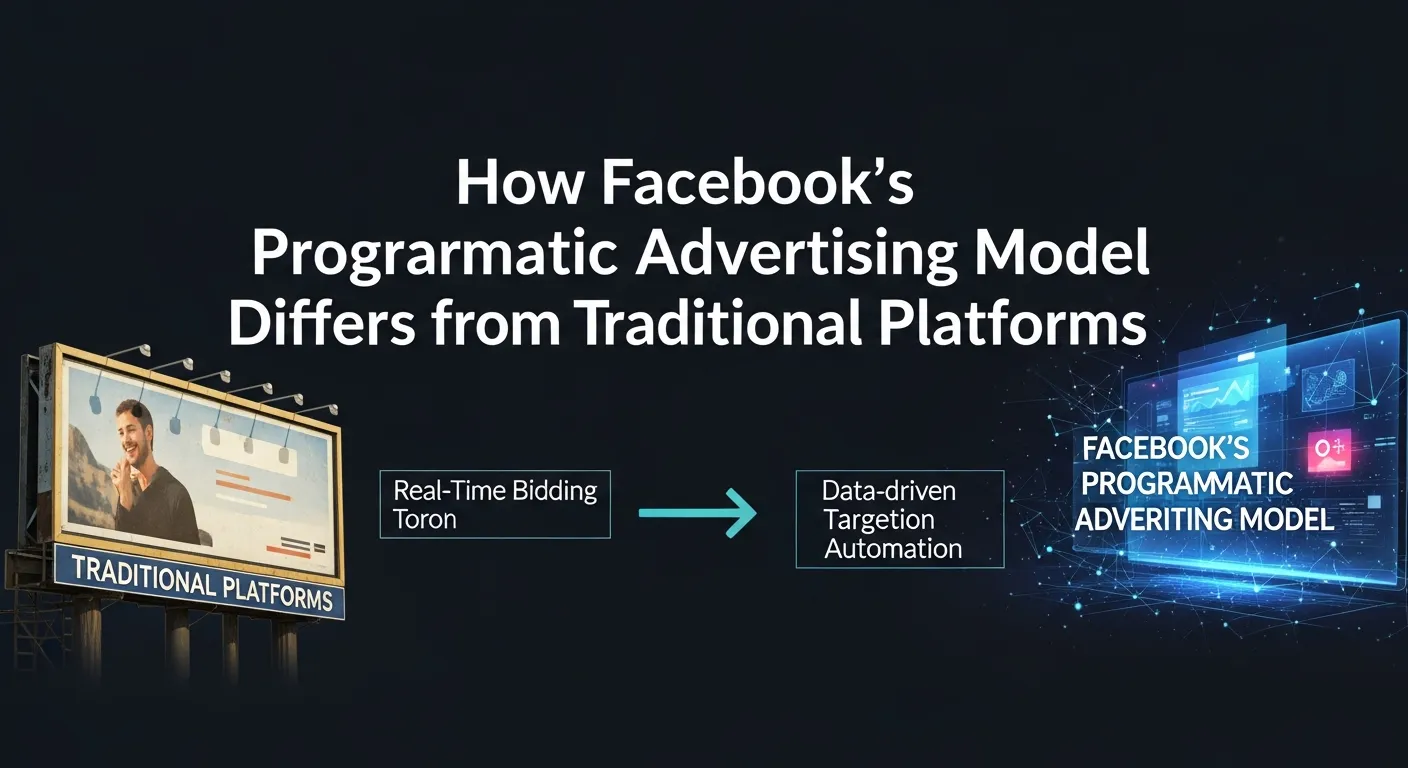
While programmatic advertising is commonly associated with demand-side platforms (DSPs) like Google DV360 or The Trade Desk, Facebook programmatic advertising operates in a fundamentally different way. Instead of buying inventory across open ad exchanges, Facebook operates within a closed, “walled-garden” ecosystem, where advertisers access inventory exclusively within Facebook, Instagram, Messenger, and Audience Network.
This distinction plays a major role in how data is used, how ads are optimized, and how advertisers build an effective programmatic advertising strategy. Understanding these differences helps businesses decide when Facebook is the right choice—and when traditional DSPs may be more suitable.
Facebook’s Walled-Garden Model vs Open Exchange Buying
Traditional programmatic platforms rely on open auctions across thousands of third-party websites and apps. Facebook, however, controls both the inventory and the data.
- Facebook determines where ads appear within its owned properties
- Advertisers do not choose individual websites or placements
- Optimization happens internally through Facebook’s AI systems
This model simplifies campaign management while offering stronger control over brand safety and user experience, making Facebook programmatic advertising explained through automation rather than manual placement selection.
First-Party Data Advantage on Facebook
One of the most powerful features of programmatic advertising on Facebook is its access to rich first-party data. Unlike traditional DSPs that often rely on third-party data providers, Facebook uses:
- User behavior across Facebook and Instagram
- Engagement signals such as likes, shares, and video views
- Advertiser-owned data via Custom Audiences and Conversion APIs
This data depth allows programmatic advertising for engagement and conversion campaigns to perform more accurately, even in a privacy-first environment.
Limited Third-Party Inventory Compared to DSPs
While Facebook offers precision and scale, it does come with limitations:
- Ads only run within Facebook’s ecosystem
- No access to external publisher websites
- Less transparency into individual placement-level data
In contrast, traditional DSPs provide broader reach across the open web, which can be useful for awareness-focused or omnichannel campaigns.
When Facebook Programmatic Advertising Is Better
Facebook programmatic advertising works best when:
- Engagement, conversions, or app installs are the primary goal
- First-party data and audience modeling are key
- Speed, automation, and scalability are priorities
Traditional programmatic platforms may be better when:
- A broad reach across independent publishers is required
- Cross-device or CTV campaigns are a focus
- Advertisers need granular control over placements
Understanding these use cases is essential for long-term success as the future of programmatic advertising continues to evolve.
Facebook vs Traditional Programmatic Platforms: Key Differences
| Feature | Facebook Programmatic Advertising | Traditional DSPs |
|---|---|---|
| Inventory Access | Facebook-owned properties only | Open web & apps |
| Data Source | First-party Facebook data | Third-party + publisher data |
| Buying Model | Automated internal auctions | Real-time bidding (RTB) |
| Placement Control | Limited | High |
| Optimization | AI-driven & automated | Rule + AI-based |
| Best For | Engagement & conversions | Awareness & reach |
Why Should You Care?

Facebook programmatic advertising offers several benefits over traditional ad-buying methods. When executed effectively, it helps businesses gain a competitive edge in their industries. Here’s why it matters:
1. Efficient Use of Budget
Thanks to automated bidding, you ensure every dollar of your budget is being spent effectively. You’re no longer overspending on unlikely leads or wasting money on people who don’t fit your target profile.
2. Higher Conversion Rates
Programmatic advertising uses rich data points and machine learning to show your ad only to users who are most likely to take an action, such as clicking or purchasing. This hyper-targeting results in higher-quality leads and better conversion rates.
3. Time-Saving Automation
Manually fine-tuning ads can take hours. With programmatic advertising, many of these processes are automated, which means you can focus on other aspects of your business.
4. Scalability
Handling small campaigns manually is manageable, but scaling up gets complicated fast. Programmatic advertising enables you to run large-scale, multi-audience campaigns with ease.
5. Real-Time Data Insights
Facebook doesn’t just show you results; it provides actionable insights. You know exactly what’s working and what isn’t, allowing you to optimize almost instantly.
How to Set Up Facebook Programmatic Advertising
If you’re ready to give Facebook programmatic advertising a try, follow these steps to get started:
Step 1. Understand Your Audience
Start by identifying the groups you want to target. Go deep into Facebook’s audience insights to explore who your potential customers are (e.g., their age, gender, and interests). You’ll use this data to optimize your campaign.
Step 2. Choose the Right Objective
Facebook Ads Manager allows you to select an objective (e.g., traffic, conversion, or brand awareness). Programmatic advertising works best when you have a clear goal in mind. For example:
- Driving sales? Focus on conversions.
- Building awareness? Consider engagement or reach goals.
Step 3. Leverage Facebook’s Targeting Features
Facebook provides powerful targeting options to ensure your ads are seen by the right people. Consider using:
- Custom Audiences based on your website traffic or email lists
- Lookalike Audiences to target people similar to your best customers
- Dynamic Retargeting to remind users who’ve interacted with your website about your product
Step 4. Set Up Automated Bidding
Automation is the heart of programmatic advertising. Allow Facebook’s AI-powered system to select bids based on your campaign objective. Use settings like Cost Cap or Bid Cap for even more control.
Step 5. Measure and Adjust Continuously
Even with automation, monitoring performance is key. Track metrics like click-through rates (CTR) and ROI regularly to determine what’s working. Facebook’s Ads Manager provides comprehensive reports to guide you.
Creative Formats That Perform Best in Facebook Programmatic Advertising
Why this works:
You mention creatives being important, but you don’t go deep into which formats actually win in programmatic-driven Facebook campaigns.
What this section could cover:
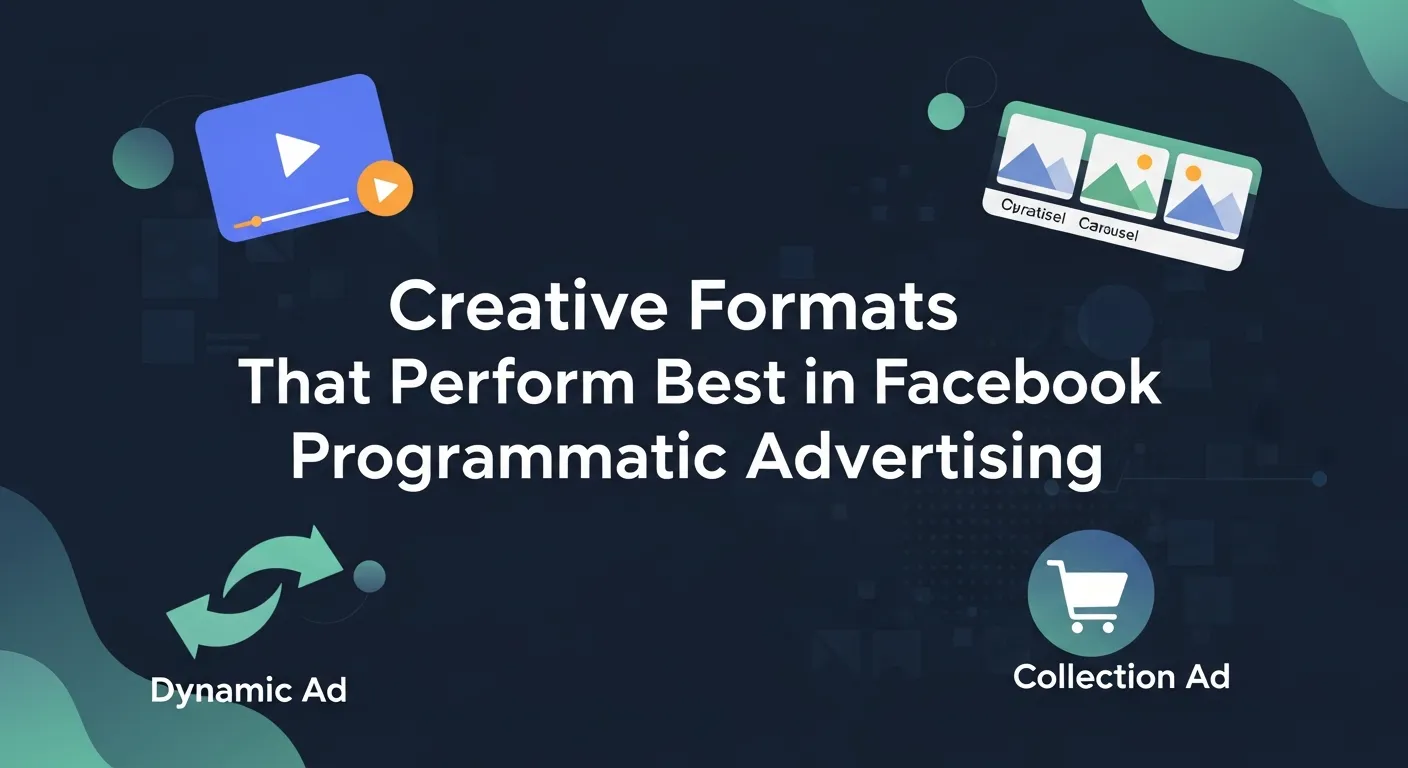
- Best-performing formats (video, carousel, collection, Reels)
- How automation impacts creative rotation
- Using dynamic creative optimization (DCO)
- Matching creative formats to engagement vs conversion goals
This aligns perfectly with programmatic advertising for engagement without repeating earlier content.
Common Mistakes to Avoid
While Facebook programmatic advertising can deliver great results, certain missteps could hinder your performance. Here’s what you should avoid:
1. Neglecting Audience Testing
Your first audience won’t always perform perfectly. Split test different audience segments to see which responds best to your campaigns.
2. Using Weak Creatives
Programmatic advertising works best with high-quality visuals and compelling copy. Ensure your creatives align with your audience’s preferences.
3. Ignoring Post-Click Behavior
Getting clicks is only the first step. Make sure your landing pages are optimized for fast load times and easy navigation.
4. Focusing Too Much on Low Costs
Sometimes, the cheapest clicks don’t convert. Spend where it matters by focusing on quality over quantity.
Real-Life Examples of Facebook Programmatic Advertising
Here are some real-world scenarios where Facebook programmatic advertising has delivered impressive results:
- E-Commerce: A fashion retailer used programmatic retargeting to remind users about abandoned carts, resulting in a 35% increase in sales within a month.
- Local Businesses: A restaurant chain used geolocation targeting to serve ads to people within a specified radius, increasing foot traffic by 20%.
- B2B Services: A software company leveraged Lookalike Audiences to target professionals similar to their top clients, driving a 40% uptick in demo requests.
The Future of Programmatic Advertising on Facebook in a Privacy-First World
A growing emphasis on user privacy, data protection, and advanced automation is shaping the future of programmatic advertising on Facebook. As third-party cookies phase out and privacy regulations tighten, Facebook programmatic advertising is evolving to rely more heavily on first-party data, artificial intelligence, and predictive modeling. Advertisers who adapt early will be better positioned to maintain performance, engagement, and ROI in this changing digital landscape.
Rather than limiting opportunities, these changes are pushing brands to adopt smarter, more sustainable programmatic advertising strategies that prioritize data quality and user trust.
Key Changes Shaping the Future of Programmatic Advertising
1. Decline of Third-Party Cookies
With browser and platform restrictions increasing, traditional cookie-based tracking is becoming less reliable. Facebook’s ecosystem minimizes this impact by leveraging its own first-party data, making Facebook’s advertising explained through privacy-compliant targeting models.
2. Rise of First-Party Data and Conversion APIs
First-party data will become the backbone of effective programmatic campaigns. Tools like Facebook’s Conversion API allow advertisers to track conversions directly from their servers, improving accuracy and campaign optimization while remaining compliant with privacy standards.
3. AI-Driven Optimization and Predictive Targeting
One of the most important features of programmatic advertising is automation. In the future, Facebook’s AI will play an even greater role in predicting user behavior, optimizing bids, and delivering ads based on intent rather than tracked history.
4. Shift Toward Engagement-Focused Campaigns
As tracking becomes more restricted, advertisers will rely more on programmatic advertising for engagement—using signals like video views, interactions, and on-platform behavior to measure success instead of purely conversion-based metrics.
What Advertisers Should Prepare for in the Next 2–3 Years
- Stronger dependence on first-party customer data
- Increased use of machine learning for audience discovery
- Greater emphasis on engagement and brand signals
- More automated campaign management with fewer manual controls
- Privacy-first measurement frameworks replacing traditional attribution
Future Outlook: Facebook Programmatic Advertising at a Glance
| Area | Current State | Future Direction |
|---|---|---|
| Data Usage | Mixed first- & third-party data | First-party data dominance |
| Tracking | Pixel-based tracking | Conversion APIs & modeled data |
| Optimization | Rule-based automation | AI-led predictive optimization |
| Targeting | Interest & behavior-driven | Intent & engagement-driven |
| Measurement | Click & conversion-focused | Holistic engagement + modeled ROI |
Getting Started with Programmatic Advertising on Facebook
The rise of Facebook programmatic advertising signals a new era of efficiency and precision for businesses of all sizes. For those willing to invest in this automated approach, the benefits are undeniable.
If you’re ready to take your Facebook campaigns to the next level, now is the perfect time to get started. Mastering this strategy means enhanced productivity, elevated performance, and unmatched ROI. Whether you’re running small, local campaigns or sprawling multi-audience initiatives, programmatic advertising simplifies the process and delivers results.
Frequently Asked Questions (FAQs)
1. What is programmatic advertising and how does it work on Facebook?
Programmatic uses automated systems and AI to buy and optimize ads in real time. On Facebook, this process happens within its own ecosystem, where data-driven algorithms decide who sees your ads, when they see them, and at what cost—making Facebook programmatic advertising explained through automation rather than manual ad buying.
2. Is Facebook programmatic advertising the same as traditional programmatic advertising?
No. While both fall under programmatic advertising buying, Facebook operates as a closed, walled-garden platform. Traditional programmatic advertising often uses DSPs to buy inventory across the open web, whereas Facebook limits placements to its own properties but compensates with richer first-party data.
3. What are the biggest challenges of programmatic advertising on Facebook?
Some common challenges of programmatic advertising on Facebook include limited transparency into individual placements, reduced control over inventory selection, and dependency on Facebook’s algorithms. Advertisers must trust automation and focus more on strategy than manual adjustments.
4. How does data-driven programmatic advertising improve campaign performance?
Data-driven programmatic advertising leverages user behavior, engagement signals, and conversion data to optimize ads automatically. On Facebook, this results in more accurate targeting, better engagement rates, and improved ROI compared to manual campaign management.
5. What role does strategy play in successful Facebook programmatic advertising?
The role of effective programmatic advertising strategy is critical. While automation handles execution, advertisers must define clear goals, select the right audiences, choose strong creatives, and align campaigns with business objectives to achieve consistent results.
6. What are the main disadvantages of programmatic advertising?
Some programmatic advertising disadvantages include reduced manual control, algorithm dependency, and the learning curve required to understand automated bidding and optimization. Without proper monitoring, campaigns may optimize toward the wrong metrics.
7. Is Facebook programmatic advertising suitable for small businesses?
Yes. Facebook programmatic advertising is highly scalable and budget-flexible, making it suitable for small businesses. Automated bidding and targeting allow smaller teams to compete effectively without requiring advanced technical expertise.
8. How does Facebook handle privacy in programmatic advertising?
Facebook relies heavily on first-party data and privacy-compliant tools like Conversion APIs. As privacy regulations evolve, programmatic advertising on Facebook increasingly focuses on aggregated data, modeled conversions, and engagement signals instead of invasive tracking.
9. Can programmatic advertising support eco-friendly marketing strategies?
Yes. Programmatic advertising eco-friendly strategies reduce waste by minimizing irrelevant ad impressions, optimizing delivery in real time, and lowering unnecessary spend. Automated targeting ensures ads reach only the most relevant audiences, reducing digital ad inefficiencies.
10. What is the future outlook for Facebook programmatic advertising?
The future of programmatic advertising on Facebook will center on AI-driven optimization, first-party data, and engagement-based measurement. Advertisers who adapt to automation, privacy-first data practices, and strategic planning will remain competitive as the ecosystem evolves.
New to the concept of automated ad buying? Don’t miss our full breakdown on What is Programmatic Video Advertising? A Complete Guide.