The Evolution of Programmatic Advertising
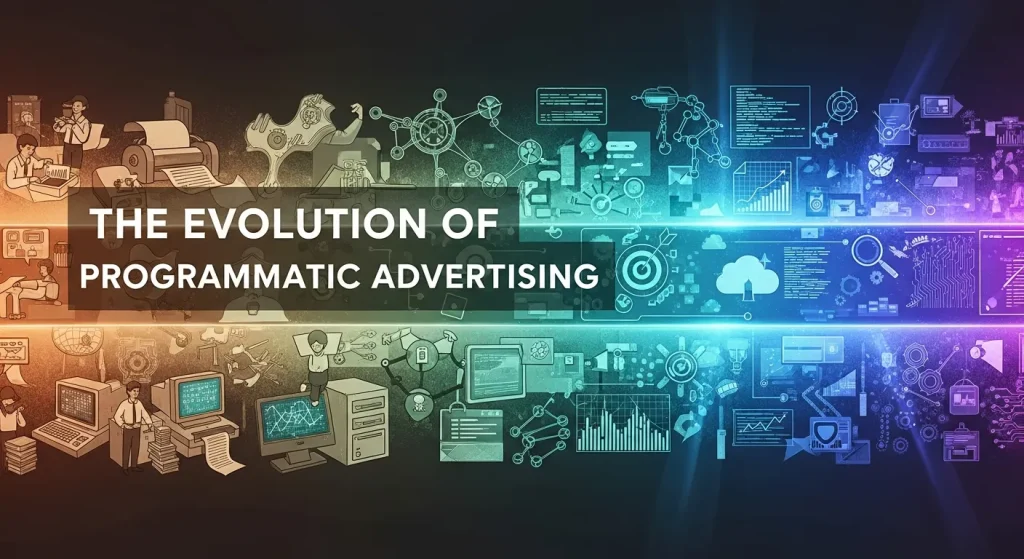
Programmatic advertising automates digital ad buying using data, AI, and real-time bidding, enabling precise targeting, higher efficiency, and scalable, future-ready marketing across devices, formats, and platforms.
Programmatic advertising has fundamentally changed the way companies advertise to their audiences. Manual negotiations and fixed ad positions are things of the past, with automation, data, and trading in real time, creating seismic ripples. But how did it begin, how has it evolved, and where is it heading?
This is the deep dive blog revisiting the evolution of programmatic advertising. We’ll take a deep dive into its roots, revolutionary innovations, and share tips on emerging trends that will mold the landscape of digital marketing.
Understanding the Basics of Programmatic Advertising
Programmatic Advertising has transformed digital marketing by replacing manual ad buying with automated, data-driven systems. Instead of negotiating placements one by one, advertisers now rely on technology, algorithms, and AI to deliver ads more efficiently. Any modern programmatic advertising guide begins with understanding how this automation reshapes reach, relevance, and performance.
Today, Programmatic Advertising is not just a tactic—it’s a core strategy discussed widely in leading programmatic advertising articles and adopted by brands of all sizes.
What Is Programmatic Advertising?
Programmatic Advertising is the automated buying and selling of digital ad inventory using software platforms such as Demand-Side Platforms (DSPs). These systems analyze real-time data to determine where ads should appear, how much to bid, and which audience should see them.
Unlike traditional advertising methods, Programmatic Advertising focuses on audience intent rather than fixed placements. Ads are delivered:
- To the right user
- At the right moment
- On the most relevant platform
This precision makes Programmatic Advertising a foundation for any advanced programmatic advertising SEM strategy, where audience behavior and intent guide media decisions.
Where Do Programmatic Ads Appear?
Programmatic Advertising supports multiple ad formats and channels, including:
- Social media feeds
- Banner and display ads
- Native advertising placements
- Video ads on websites and streaming platforms
This flexibility allows brands to maintain consistent messaging across devices, a key advantage highlighted in many programmatic advertising complete guide resources.
Why Programmatic Advertising Is More Effective
With fewer manual processes and continuous optimization, Programmatic Advertising delivers better outcomes by:
- Launching campaigns faster
- Optimizing bids in real time
- Improving engagement through relevance
Advanced programmatic advertising analytics help marketers track impressions, clicks, conversions, and audience behavior to refine campaigns continuously.
Why Did Programmatic Advertising Become Necessary?
In the early days of digital marketing, advertisers faced inefficiencies that limited scalability and ROI. These challenges made traditional ad buying unsustainable as online audiences grew.
Key Challenges in Early Digital Advertising
1. Manual and Time-Consuming Processes
Buying ad inventory required direct negotiations, paperwork, and fixed pricing, making optimization slow and inflexible.
2. Broad Targeting and Budget Waste
Ads were delivered to large, untargeted audiences, leading to:
- Low engagement rates
- High ad spend with minimal return
- Limited performance insights
How Programmatic Advertising Solved These Challenges
Programmatic Advertising emerged by combining automation, AI, and data to modernize digital advertising. It enables advertisers to:
- Use real-time bidding to adjust spend dynamically
- Target audiences based on behavior, interests, and context
- Reduce wasted impressions and improve ROI
This shift laid the foundation for what many marketers now recognize as a programmatic advertising complete guide to efficient media buying.
Key Advantages of Programmatic Advertising (At a Glance)
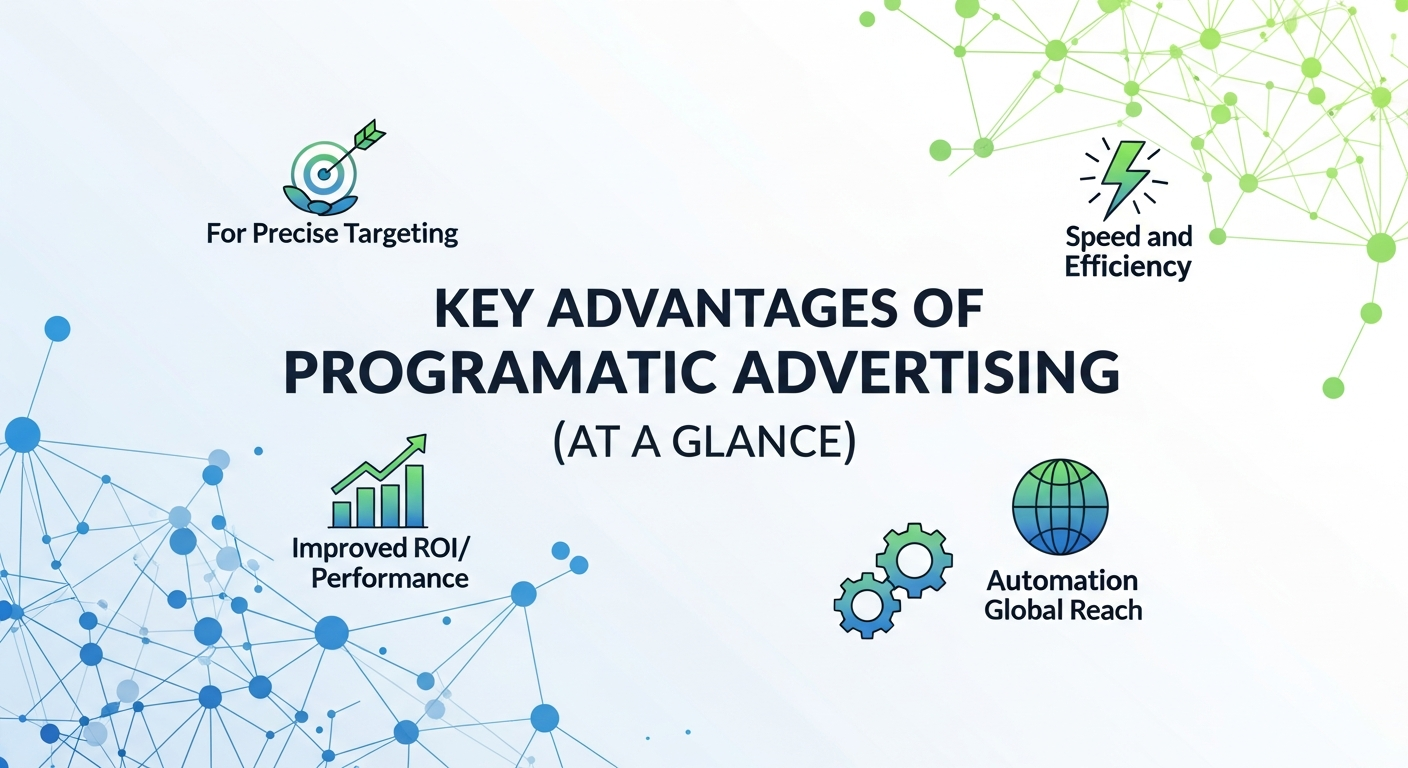
Programmatic Advertising has redefined how brands plan, execute, and optimize digital campaigns. By combining automation, data, and AI, it delivers speed, accuracy, and scalability that traditional digital advertising struggles to match. Most modern programmatic advertising guides highlight these advantages as the reason programmatic has become the preferred buying model.
Core Advantages of Programmatic Advertising
- Automated and Real-Time Buying
Programmatic Advertising replaces manual negotiations with real-time, automated ad buying. Campaigns are launched faster, adjusted instantly, and optimized continuously—making it a powerful foundation for any programmatic advertising SEM strategy. - Data-Driven Audience Targeting
Instead of targeting websites or placements, Programmatic Advertising focuses on users. Marketers leverage behavioral, demographic, contextual, and intent data to reach high-value audiences with precision. - Continuous, AI-Powered Optimization
With AI and machine learning, Programmatic Advertising optimizes bids, creatives, and placements automatically. These systems learn from performance data to improve results over time, a benefit frequently discussed in leading. - Advanced Measurement and Analytics
Unlike traditional digital ads, Programmatic Advertising offers deep visibility into performance. Using programmatic advertising analytics, marketers can track impressions, clicks, conversions, viewability, and audience engagement in real time. - Scalable Omnichannel Reach
Programmatic Advertising scales seamlessly across display, native, video, mobile, social, and Connected TV. This flexibility ensures consistent messaging and broader reach without increasing operational complexity.
Programmatic Advertising vs Traditional Digital Advertising
| Feature | Programmatic Advertising | Traditional Digital Advertising |
|---|---|---|
| Buying Process | Automated, real-time auctions | Manual negotiations |
| Targeting | Data-driven, audience-based | Broad, placement-based |
| Optimization | Continuous, AI-powered | Limited after launch |
| Measurement | Advanced analytics and insights | Basic reporting |
| Scalability | Highly scalable across channels | Limited scalability |
This comparison is often highlighted in any programmatic advertising complete guide to demonstrate why automation and data-driven buying outperform legacy methods.
The Growing Importance of Programmatic Advertising
Programmatic Advertising has evolved into a global industry standard, widely adopted across markets and verticals. Its influence is so significant that it is celebrated during National Programmatic Advertising Day, recognizing its role in transforming digital media buying.
With the emergence of programmatic advertising, campaigns now go beyond basic automation. Advertisers leverage metadata, contextual intelligence, and AI-driven insights to deliver privacy-friendly, highly relevant ads—especially important in a post-cookie world.
Why Programmatic Advertising Matters More Than Ever
- Supports privacy-first targeting through contextual signals
- Improves ROI by reducing wasted impressions
- Enables real-time decision-making at scale
- Aligns marketing performance with measurable business outcomes
As digital ecosystems become more complex, Programmatic Advertising remains essential for brands seeking precision, efficiency, and sustainable growth—an insight consistently emphasized across trusted programmatic articles and industry research.
A Look at the Origins of Programmatic Advertising
The Birth of Automated Digital Advertising
The genesis of programmatic advertising dates back to the early 2000s. Early digital advertising relied on Generalized Time-Based Advertising (GTBA), which lacked flexibility and customization. Advertisers paid for large spots but couldn’t control who saw their ads.
Programmatic advertising as we know it began in 2007, with digital networks shifting toward Real-Time Bidding (RTB) for buying and selling impressions. Platforms like Advertising.com, a pioneer during this time, started paving the way toward further automation.
Real-Time Bidding Changes the Game
The introduction of RTB was a milestone in advertising history. Real-Time Bidding is an auction-based system where advertisers bid for available impressions on an ad exchange.
Each impression is evaluated based on data such as audience demographics, behaviors, and preferences. With RTB, advertisers tap into highly targeted audiences while optimizing ad spend.
By the early 2010s, RTB became synonymous with programmatic advertising and rapidly expanded across platforms like Google Display Network and Facebook Ads.
The Era of Advancement in Programmatic Advertising
Moving Beyond RTB
The reach of programmatic advertising went beyond real-time bidding as the market matured. Here’s a breakdown of key advancements in the field:
- Private Marketplaces (PMPs): Advertisers gained access to premium inventory for private deals. PMPs allowed direct negotiations between advertisers and publishers without forfeiting automation.
- Programmatic Direct: This approach enabled guaranteed ad placements on high-value platforms, bridging manual and automated solutions.
Integration of Data and Machine Learning
One of programmatic advertising’s greatest strengths lies in its use of consumer data to optimize ad targeting.
- 1st-Party Data: Marketers used existing consumer data, like CRM insights, to retarget loyal customers.
- 3rd-Party Data: These external data sets provided additional audience context for laser-focused targeting.
Now coupled with machine learning, programmatic systems continually improve campaigns over time, analyzing massive data sets to refine targeting and maximize ROI.
Video and Mobile Take the Spotlight
As video consumption soared, programmatic advertising seamlessly integrated into video ad platforms. Pre-roll and mid-roll ads became major players, capturing audiences during their favorite content.
Similarly, the rise of mobile devices created opportunities for in-app programmatic ads. By 2020, 80% of US digital display ads were purchased programmatically. This exponential growth cemented programmatic advertising’s role in modern marketing.
Benefits of Programmatic Advertising for Modern Marketers
Programmatic Advertising has become a cornerstone of digital marketing because it blends automation, data intelligence, and real-time decision-making. Unlike traditional ad buying, it empowers marketers to scale campaigns efficiently while maintaining precision and control. A well-planned programmatic advertising guide helps brands achieve better performance across channels.
Key Benefits of Programmatic Advertising
1. Precision Targeting at Scale
Programmatic Advertising enables advertisers to reach highly specific audiences using:
- Demographics (age, gender, income)
- Geolocation and device data
- Behavioral and interest-based insights
This level of accuracy ensures ads reach users who are most likely to engage, making it a vital component of any programmatic advertising SEM strategy.
2. Improved Operational Efficiency
Automation removes time-consuming manual negotiations and insertion orders. With programmatic platforms:
- Campaigns launch faster
- Optimization happens in real time
- Teams can focus on strategy instead of execution
This efficiency is why many leading programmatic advertising platforms highlight automation as a competitive advantage.
3. Cost Effectiveness and Budget Control
Real-time bidding allows advertisers to adjust bids based on performance data. Through programmatic advertising analytics, marketers can:
- Eliminate wasted impressions
- Allocate budget to high-performing placements
- Improve overall ROI
4. Omnichannel Reach and Consistency
Programmatic Advertising seamlessly delivers ads across:
- Display and native ads
- Social media feeds
- Mobile apps
- Video and Connected TV (CTV)
This omnichannel capability ensures consistent brand messaging and user experience.
Emerging Trends in Programmatic Advertising
As highlighted in many programmatic advertising complete guide resources, the industry continues to evolve rapidly. Below are the trends reshaping modern advertising strategies.
Artificial Intelligence Continues Advancing Campaigns
AI has become the backbone of Programmatic Advertising. Machine learning algorithms analyze massive data sets to:
- Predict user intent
- Optimize bids automatically
- Personalize ad creatives in real time
Advanced meta programmatic advertising strategies use AI-driven metadata to improve targeting accuracy and campaign performance.
Contextual Targeting Returns in a Privacy-First Era
With the decline of third-party cookies, contextual targeting is regaining importance. Instead of tracking users, ads are placed based on:
- Page content relevance
- Keywords and semantic signals
- Brand-safe environments
This approach aligns with evolving privacy regulations while maintaining ad effectiveness.
Connected TV (CTV) Expands Programmatic Reach
Connected TV platforms such as Hulu and Roku are transforming video advertising. Programmatic CTV enables:
- Audience-based TV advertising
- Cross-device retargeting
- Measurable and data-driven TV campaigns
This shift is frequently discussed in leading programmatic advertising articles as the future of digital video.
Sustainable Marketing and Ad Waste Reduction
Modern Programmatic Advertising prioritizes sustainability by:
- Reducing invalid traffic and ad fraud
- Improving inventory quality
- Minimizing carbon-heavy ad delivery
Advertisers now leverage programmatic advertising analytics to measure efficiency and environmental impact.
Programmatic Advertising: Benefits vs Traditional Advertising
| Aspect | Programmatic Advertising | Traditional Advertising |
|---|---|---|
| Buying Process | Automated and real-time | Manual negotiations |
| Targeting | Data-driven and precise | Broad audience reach |
| Optimization | Continuous, AI-powered | Limited post-launch changes |
| Measurement | Advanced analytics and reporting | Basic performance tracking |
| Scalability | Highly scalable across channels | Limited scalability |
Take the Next Step in Programmatic Advertising
Programmatic Advertising has evolved from basic RTB to AI-powered, data-rich ecosystems. Celebrated globally—even on occasions like National Programmatic Advertising Day—its impact on digital marketing continues to grow.
Marketing success today is not about reaching everyone, but about delivering the right message to the right audience at the right moment. A strong programmatic advertising guide helps businesses unlock smarter targeting, better efficiency, and measurable growth.
Frequently Asked Questions (FAQs) on Programmatic Advertising
1. What is programmatic advertising?
Programmatic advertising is an automated digital ad buying process that uses data, algorithms, and AI to place ads in real time, ensuring the right message reaches the right audience.
2. How does programmatic advertising work?
Programmatic advertising works through platforms like DSPs and ad exchanges, where advertisers bid on ad impressions using real-time bidding based on audience data, behavior, and relevance.
3. Why is programmatic advertising important for modern marketing?
Programmatic advertising improves efficiency, targeting accuracy, and ROI by eliminating manual negotiations and enabling data-driven decisions across multiple digital channels.
4. What is a programmatic advertising SEM strategy?
A programmatic advertising SEM strategy integrates search intent data with display, video, and native ads to improve audience targeting, campaign alignment, and overall performance across paid channels.
5. Is programmatic advertising suitable for all business sizes?
Yes, programmatic advertising is flexible and scalable, making it suitable for startups, small businesses, and large enterprises with customizable budgets and targeting options.
6. What data is used in programmatic advertising campaigns?
Programmatic advertising uses first-party, second-party, and third-party data to refine audience targeting, improve personalization, and optimize ad performance in real time.
7. What makes this a complete guide to programmatic advertising?
A programmatic advertising complete guide covers fundamentals, platforms, data usage, bidding models, trends, and best practices to help marketers plan and execute effective campaigns.
8. How does AI enhance programmatic advertising?
AI improves programmatic advertising by optimizing bids, predicting user behavior, personalizing creatives, and continuously learning from performance data to maximize results.
9. What is meta-programmatic advertising?
Meta programmatic advertising focuses on leveraging metadata, contextual signals, and advanced analytics to enhance ad relevance, targeting accuracy, and cross-platform campaign optimization.
10. What trends are shaping the future of programmatic advertising?
Key trends include AI-driven automation, privacy-first targeting, Connected TV (CTV), contextual advertising, and sustainability-focused strategies aimed at reducing ad waste and improving efficiency.
Learn More About: What Is Facebook Programmatic Advertising.